Search Results

What? Kiva Is Not Really Person-to-Person Lending

Tuesday, November 17th, 2009

I’ve written about Kiva before - They allows individuals to make loans starting at $25 to low-income entrepreneurs in the developing world, also known as microcredit. By doing so, you can provide affordable working capital for the poor (money to buy a sewing machine, livestock, etc.), hopefully empowering them to earn their way out of poverty.

However, Kiva may not work exactly like it suggests on their website. You’ll notice that they post up pictures and stories of people needing loans, and you get to pick the exact person you want to lend to. Back in 2007, I thought I loaned $25 to Vitolina:

Vitolina owns a set of beach fales that she rents out to back-packers or picnickers passing through the village and works hard to keep the structures in good condition. Fales are simple, small open huts with thatched roofs built in the style of the traditional Samoan house. Vitolina?s fales are situated on a white sandy beach on the Samoan coast. She readily welcomes guests and provides them with a simple roof, unbeatable views, and home-cooked meals. She will use the loan to renovate the beach fales.

However, chances are that the person you clicked on already got the loan months ago. Your money is simply going to the microfinance institution (MFI) who already lent to that person, and will use that money to lend to another future person or general project. The direct “person-to-person” link does not exist like it does, for example, at LendingClub.

There is a lot of recent discussion on the web on this issue. Thanks to the commenter who made me aware of it. Check out this NY Times article and the blog post by David Roodman that started it all.

After reading the posts and several follow-ups, it does make practical sense that Kiva can’t actually match a lender to a specific borrower - it would take too long for the borrower to get the loan. However, it does show that “good stories” do matter. Remember those “Save The Children” commercials where you’d get a letter from the child you helped? Same deal. Your money goes to the general organization, not any specific child.

As a result, Kiva has changed how it explains their loans and their homepage tagline went from “Kiva lets you lend to a specific entrepreneur, empowering them to lift themselves out of poverty.” to the more generalized “Kiva connects people through lending to alleviate poverty.”

The other common variable that is somewhat hidden away to new visitors is that while you loan money at 0%, the actual MFI will likely go on to loan money to the entrepreneur at around 30% APR. The difference pays the operational expenses of the MFI and may partially subsidize defaults in order to maintain the advertised tiny 0-2% default rates.

None of this means Kiva or microcredit is bad. Sure, it’d be nice if I could lend at 0% instantly to a borrower in Cambodia who could pay 0% interest too, but right now that’s not possible. I still plan on lending at both Kiva, but will no longer get the “warm fuzzy connection” feeling from Kiva and may direct more funds towards Microplace or Grameen Foundation.

LendingClub Offers No-Fee IRA

Tuesday, November 17th, 2009

Speaking of LendingClub, I saw that they now offer a IRA with no opening fees and no annual maintenance fees. Previously, there was a $250 annual fee. However, it does now require an increased $15,000 minimum opening balance, which essentially restricts it to a 401k rollover or the transfer of existing IRA funds.

Since P2P loan interest is taxed at ordinary income rates like interest from savings accounts, the ability to place them in a tax-deferred account is attractive. But since person-to-person lending is such a new asset class, I would hesitate to make it larger than say 5% of my portfolio, which would require a total portfolio size of $300,000. So, I’m out.

It is interesting that the custodian EntrustCAMA allows a lot of options in their Self-Directed IRAs like holding physical precious metals, investing in private small businesses, and investing directly in real estate. I’m not sure if you can only hold LC notes in this free IRA.

Prosper P2P: $50 For New Lenders + Up to 2% Rebate Bonus

Wednesday, November 4th, 2009

Prosper.com was the first big name in the person-to-person lending space. Things have been quiet recently, as they took a while getting SEC approval for their investment notes. In addition, the problems with “old” Prosper included the fact that they let just about anyone apply for a loan in the beginning, including people with horrible credit who had been basically turned down everywhere else. Many lenders thought charging a 35% interest rate was enough - it wasn’t. But as this recent Washington Post article outlines, things are picking up in the P2P space.

The way I see it, LendingClub (review, $25 bonus, performance update) basically looked at all the problems that Prosper had and tried their best to fix them. So now, Prosper is back, and in turn looks a lot like LendingClub. For example, LC requires a 660 minimum credit score to qualify for their lowest grade loan (amongst other things), and now Prosper requires a new borrower to have at least a 640 credit score with their new ratings system. With both, you can have them automatically construct a portfolio for you based on your risk/return preference, and you can buy/sell notes before maturity on a open trading market.

Prosper still has their “reverse auction” eBay-style method of determining the interest rate, but lenders are now are restricted to a specific range of interest rates. (LendingClub simply sets the interest rates for you.)

In order to stimulate lending activity, they have a few incentives going on. If you sign up as a lender and bid on two loans (minimum total investment of $50), they will provide you a free $50 bonus. Click here and on the orange “Invest Now” button and you’ll see it. You must reinvest this $50 by the end of 2009. On top of that, Prosper is also offering a 1% or 2% “rebate” back if you invest at least $1,000 or $5,000, which would help juice your returns. Details:

Starting on October 12 if you invest $1,000 - $4,999 you will receive a 1% cash rebate into your Prosper account or, invest $5,000 or more and receive a 2% cash rebate into your Prosper account. Lenders must invest the funds during the promotional period of October 12 through November 15 by being a winning bidder on loan listings that result in funded loans. Notes purchased through the trading platform are excluded from the promotion. Once you have bid and invested on the loan listings your 1% or 2% cash rebate will be deposited into your Prosper account by December 4.

P2P Lending Update: LendingClub Loan Performance (+$25 Bonus)

Saturday, October 10th, 2009

Here’s an update for my person-to-person (P2P) lending activity at LendingClub, which are unsecured loans between U.S. residents. It could be to help people pay off credit card debt, home improvements, business financing, or even buying a house. You can think of it as taking out the bank middleman, which pays tiny interest on checking account balances and then charges much higher rates to borrowers.

LendingClub Portfolio
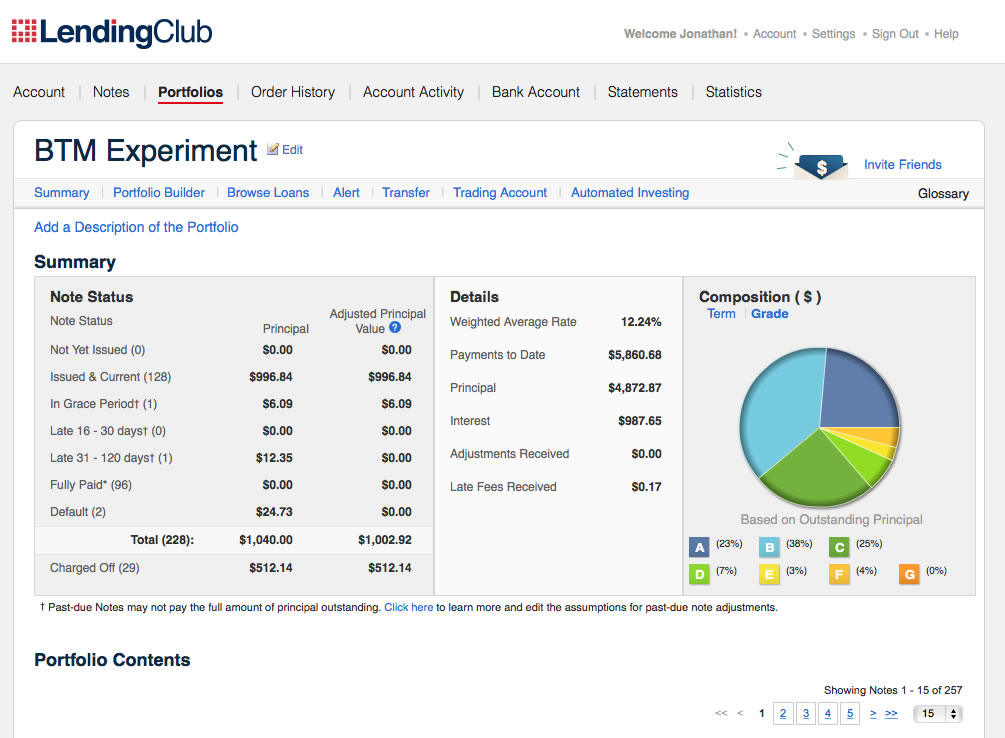
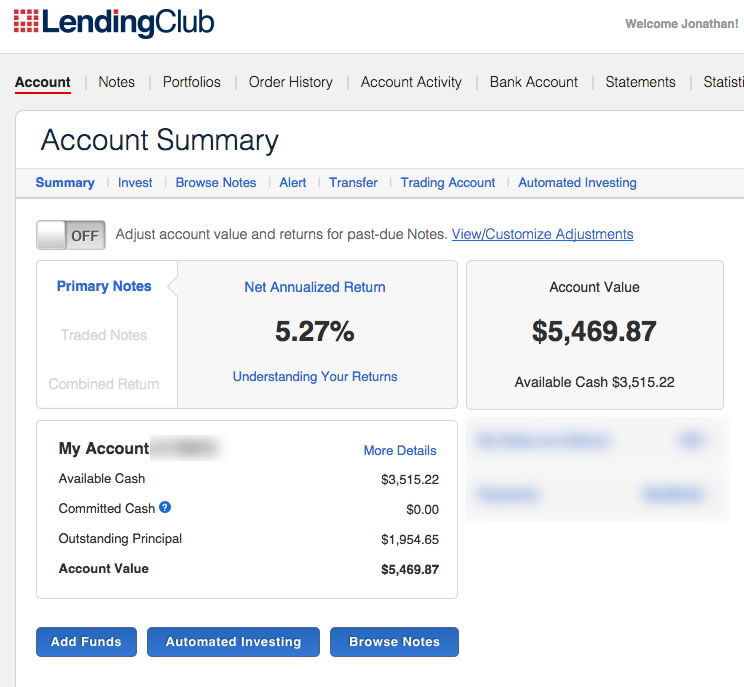
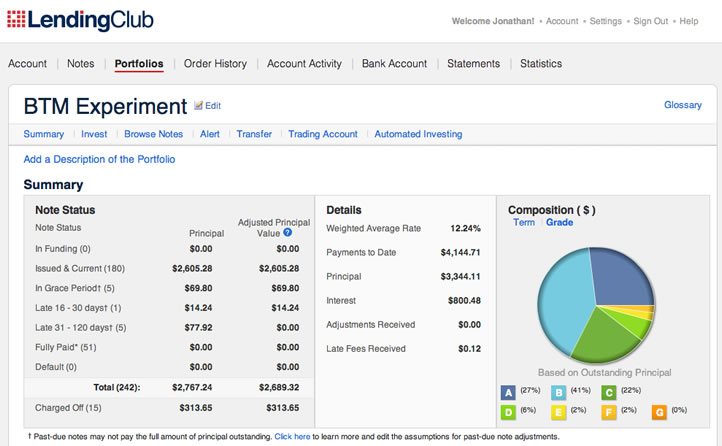
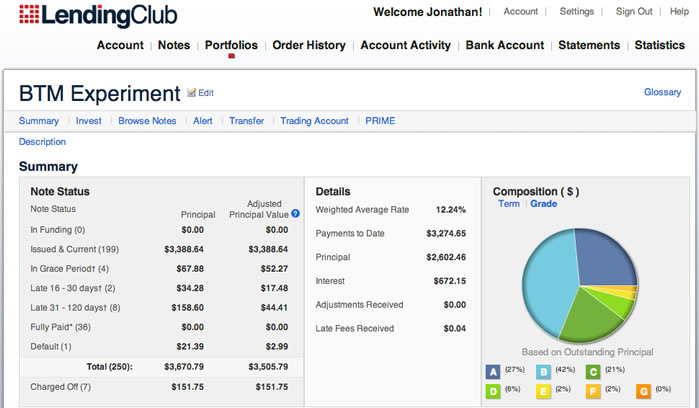
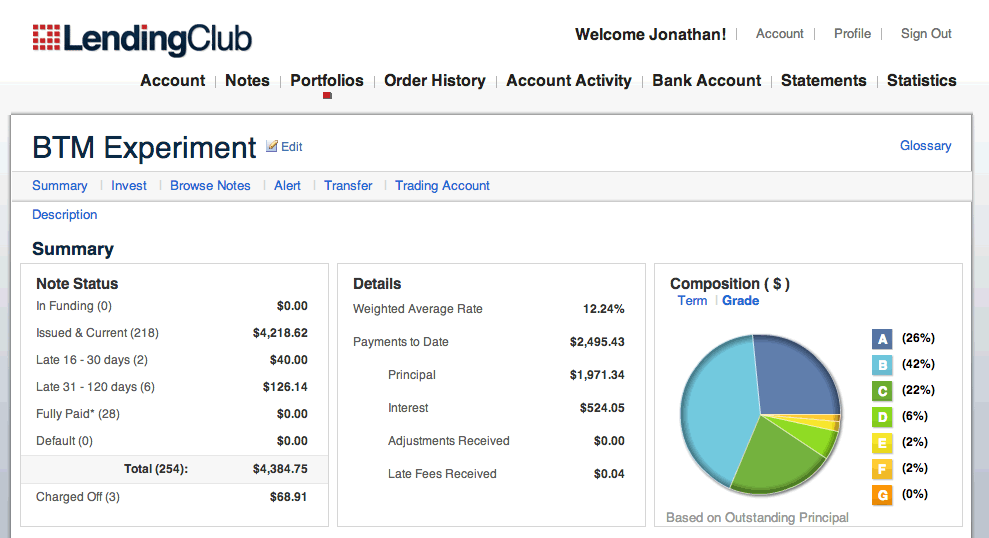
I now have made 62 active loans with $1,680.08 in outstanding principal. Most are A grade, with a decent spattering of Bs. Keep in mind that a borrower has to have a 660 credit score as well as other additional requirements just to make their lowest G grade. (Only about 10% of loan applications are accepted.) Although they do have an automated service to pick for you, I tend to pick my own loans to try and find both a combination of good risk profile and also a person who I want to help out. It’s kind of a hobby of mine. Here is a screenshot from my account page:

Performance & Commentary
The good news is that out of my two previous late loans, one of them is now current again and the other one is on a “payment plan”. I am not sure if that means they lowered the amount due, or that they are just allowing a slower payback temporarily, but it is again showing regular payments (and contact) from the borrower. Much better than reading “left voicemail. left voicemail. we haven’t heard from them in 4 months…”. I have no defaults to date.

According to LC, my “Net Annualized Return on Investment” based on my interest payments received so far is 9.14%. As an investor, I would not expect this rate to be my actual rate to maturity, but so far so good. While my goal is to get a substantially higher yield than from a online savings account, it also comes with a healthy dose of risk. Don’t put your emergency fund here!

$25 New Lender Bonus
If you are interested trying P2P lending with no risk, you can still use this special $25 lender sign-up link to get a free $25 to try it out with no future obligation. There is no credit check and you don’t even have to deposit anything. After you are approved, the $25 will show up in your account balance, and you can lend it out immediately.

If you’re looking to borrow at LendingClub, it’s relatively straightforward. Send in your information, and see what interest rate they offer you. Compare it with your credit card or other financing options. If you like it, fill out your application carefully (verify income if possible) and go for it. If you don’t like the rate or the full amount is not funded, you can either accept partial funding or walk away with no obligation.

Lending Club Investors $25 + $2,500 Giveaway

Monday, September 14th, 2009

Last month, peer-to-peer lending website LendingClub reached $50 million in issued loans. This month, they are expected to get their 25,000th registered investor, and are going to give that lucky lender $2,500 cash. The rules:

* To enter the contest simply open a free investing account by completing all three steps of the investor registration process: create a password, verify your identity and link your bank account
* No purchase is necessary to win
* The winner will be announced after October 31, 2009

$25 New Lender Bonus
In addition, you can still use this special $25 lender sign-up link to get a free $25 to try it out with no future obligation. There is no credit check and you don’t even have to deposit anything. After you are approved, the $25 will show up in your account balance, and you can lend it out immediately. You must reside in a state that allows such investments.

Want to learn more? See my previous posts on LendingClub. I’ve invested in everything from someone’s $38,000 house to a taiko drumming training center.

P2P Lending Update: LendingClub Loan Performance (+$25 Bonus)

Friday, August 21st, 2009

Here’s an update for my person-to-person (P2P) lending activity, which for me are unsecured loans between U.S. residents. It could be for credit card debt consolidation, car financing, business financing, or even buying a house. You can think of it as taking out the bank middleman, which pays tiny interest on checking account balances and then charges high interest to borrowers.

LendingClub Portfolio
I do my P2P Lending at LendingClub, where you can loan as little as $25. You can read more background in my previous update. Although they do have a service to pick for you, I tend to pick my own loans to try and find both a combination of good risk profile and also a person who I want to help out. It’s kind of a hobby of mine.

I now have a total of 49 active loans with $1,548.42 in outstanding principal. Most are A grade, with a decent spattering of Bs. Keep in mind that a borrower has to have a 660 credit score as well as other additional requirements just to make their lowest G grade. (Only about 10% of loan applications are accepted.) Here is a screenshot from my account page:

Performance & Commentary
According to LC, my “Net Annualized Return on Investment” based on my interest payments received so far is 9.06%. The bad news is that I now have two late loans in my portfolio. One has negotiated a temporary reduced payment plan, while the other seems to be dodging phone calls. Also, one loan was paid off early. But I suppose this is par for the course, you get late payments and defaults. If your interest rate is high enough and you have enough diversification in loans, you’ll still end up ahead. We’ll see what happens, even with a default my rate of return so far is still higher than what I’d have gotten with an online savings account. But the risk is still certainly there for more downside.

What really baffles me is that both of my late loans are A-rated. According to the LC stats page, out of all the A loans issued so far, there are only 12 late loans out of 943 still active. That’s a tiny 1.3% late rate with zero defaults for LendingClub in general, and yet I managed to invest in 2 out of the 12 late ones. So either I’m very unlucky or I stink at picking loans, or… both. :P

$25 New Lender Bonus
If you are interested trying P2P lending with no risk, you can still use this special $25 lender sign-up link to get a free $25 to try it out with no future obligation. There is no credit check and you don’t even have to deposit anything. After you are approved, the $25 will show up in your account balance, and you can lend it out immediately.

If you’re looking to borrow at LendingClub, it’s relatively straightforward. Send in your information, and see what interest rate they offer you. Compare it with your credit card or other financing options. If you like it, fill out your application carefully (verify income if possible) and go for it. If you don’t like the rate or the full amount is not funded, you can either accept partial funding or walk away with no obligation.

Personal Finance Education, Delayed Gratification, and Marshmallows

Thursday, August 20th, 2009

Many people agree that there should be more personal finance education in school. This is supposed to be one of the keys to making the average person save more money, have less credit card debt, and invest wisely. You know, teach a high schooler the wonder of compound interest and the related trap of credit card minimum payments.

But I’ve perhaps the problem is even more basic than that. I recently ran across something called the Marshmallow Experiment by Walter Mischel. Check out this video (hat tip to Rob Garcia of LendingClub):

Here’s a quick summary of the original 1960s study. A group of four-year olds were put in a room with just a chair and a table. The kids could pick either a marshmallow, a cookie, or a pretzel stick. The child was then given an option. They could either eat one marshmallow right away, or if they waited until the researcher left and came back, they could have two marshmallows. How long could they wait? The researchers continued tracking them and found that those with the ability to wait were better adjusted, had less behavioral problems, and scored an average of 210 points higher on the Scholastic Aptitude Test.

Teaching Delayed Gratification
Along the same lines, I think a core requirement of good personal finance “education” is teaching people delayed gratification. Imagine how many adults wouldn’t be able to wait a year to get $500 versus getting $250 today. If you can exercise such self-control, then you won’t buy things on credit cards because you “gotta have it now”. You’ll be able to save money towards a retirement that may be decades away. It will be easy to spend less than you earn.

How do you teach delayed gratification? Since it would require years of practice, you’d want to start early and the responsibility would fall heavily on the parents. From an interview with Mischel in a related New Yorker article:

“This is where your parents are important,” Mischel says. “Have they established rituals that force you to delay on a daily basis? Do they encourage you to wait? And do they make waiting worthwhile?” According to Mischel, even the most mundane routines of childhood—such as not snacking before dinner, or saving up your allowance, or holding out until Christmas morning—are really sly exercises in cognitive training: we’re teaching ourselves how to think so that we can outsmart our desires.

But of course, not all parents will do that. So the problem is then how do we systematically teach children this skill in school, which is what researchers are working on now. In my opinion, that would be the ultimate in personal finance education. Because if you don’t have the ability to defer gratification, then learning about index funds isn’t going to help very much.

Martin Lodge-on-Wheels: 10′x20′ House for $37,900

Wednesday, July 15th, 2009

While looking for more LendingClub P2P loans ($25 bonus) to fund today, I ran across a couple that was trying to buy a tiny home called a Lodge-on-Wheels. The current model is 10 ft. by 20 ft. and costs $37,900. I thought it was pretty neat to help fund this loan for people trying to achieve financial independence.

Many more pictures here.

Inspired by her experiences after Hurricane Katrina, owner Julie Martin wanted to design an affordable tiny house that can be easily moved from place to place on a trailer. It is made primarily out of wood, unlike most of the RVs out there, which probably doesn’t make it something you want to be moving around all the time. But I love the look and feel of it, much more “homey” to me.

To get started, just park the LoW, plug in an extension cord, and connect a garden house. Some features:

  • Composting toilet, no sewer line required
  • Tankless water heater
  • Microwave/convection oven, 2-burner stove, fridge/freezer
  • Cedar countertops, and even cedar-walled shower.
  • Fully insulated
  • Hardwood (bamboo) floors
  • Loft for queen-sized bed

Beyond emergency housing, the possible uses for such a place are interesting. The site seems to be catering towards hunters and outdoorsy folks looking for a portable lake cabin. However, as the couple suggests, this could be a permanent home for anyone. You could simply “rent” someone’s backyard space and live in it. Find some cheap land and own your home for less than a BMW. If you have the yard space yourself, you could create your own rental property or in-law suite.

This also reminded me of the 250 sf condos in San Francisco that were selling for $279,000. I wonder how much they are selling for now?

$25 LendingClub Bonus
If you are interested in lending, you can still use this special $25 lender sign-up link to get a free $25 to try it out with no future obligation. There is no credit check and you don’t even have to deposit anything. After you are approved, the $25 will show up in your account balance, and you can lend it out immediately.

Why I Don’t Use LendingMatch To Invest With Lending Club

Thursday, June 4th, 2009

Peer-to-peer lending site LendingClub has a feature called LendingMatch that allows you build a portfolio of multiple notes simply by choosing a desired risk profile. Even though I’ve funded over 30 loans, I never touch the thing. Now, I think in general LC does a decent job rating their loans from A1-A5, B1-B5, all the way to G5. But sometimes I just don’t agree with their assessments, and other times I have a more personal objection to the loan. Today, I found an example that fit both.

This loan passed through all of my usual manual filters. A/B grade only, 714+ credit score, debt-to-income ratio < 10%, and zero delinquencies within last two years. The assigned grade was A5, which is quite good overall.

But then I read the details. (If you’re a member, it’s loan #411092.) His reported gross income is $26,000 per year. He’s only been at his current job for only one year. He has been delinquent on accounts before, but last time was over 4 years ago. He has about $18,000 in credit card debt currently. He has 70% of his annual income as debt? To me, that’s like someone making $100k a year before taxes having $70,000 of consumer debt. Seems like quite a burden.

Already skeptical, I then read the loan description. Here it is, after I stripped out what I felt was not important:

This loan will be used to consolidate the remaining balance on two credit card balances and for home improvement. Looking to payoff some credit card debt and add a sunroom to my home. I am coming to the lending club community to help me build a nice sunroom to enjoy a cold glass of iced tea.

Honestly, I didn’t even know what a sunroom was until I looked it up. According to this site, a small 80 sq. ft. sunroom would cost from $5,000 to $15,000. He already has 70% of his gross annual income as debt, and he wants to add another $5,000 to it? That would result in a debt-to-annual income ratio of 90%.

I like the idea of helping people pay down their credit card debt by lowering their interest and consolidating into one payment. But this guy seems to really like being in debt. Now, that’s his choice, but I don’t like the idea of supporting it. Am I alone in thinking this way? I’m thinking I might not be, as his loan request didn’t fund the first time.

You can read about the other details of my LendingClub portfolio here. My annualized return after fees so far is 8.8%.

LendingClub: My P2P Loan Portfolio Update (+Bonus)

Wednesday, May 13th, 2009

I’ve been meaning to post some smaller updates about my ongoing experiences with person-to-person lending at LendingClub, but I decided to wait and roll them up into one larger post.

Current Portfolio
I now have a total of 32 active loans with $1,122.21 in outstanding principal. Most are A grade, with a few Bs. Here is a screenshot from my account page:

These are the loans that originated after LendingClub completed their SEC registration, which means I can sell these loans on the open market. I also have $91.91 in 4 notes that were pre-SEC registration (these are accounted for separately), all A grade.

Performance
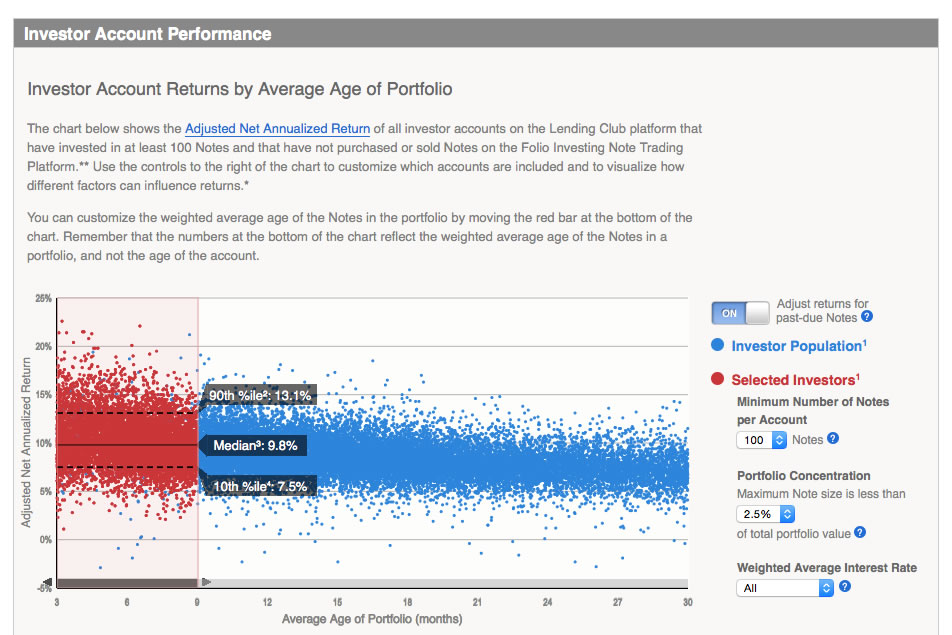
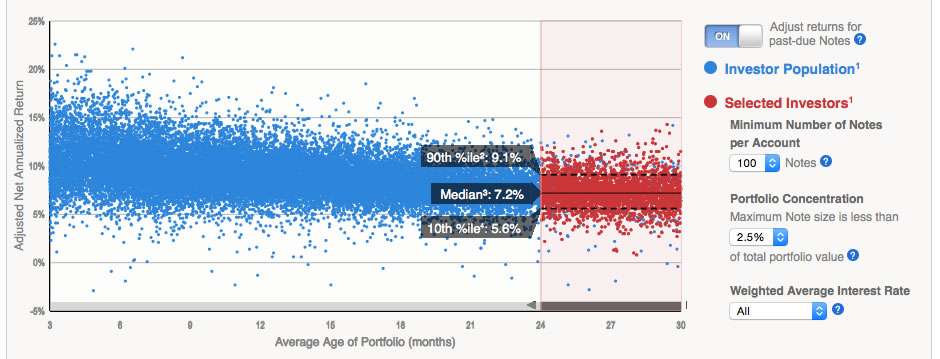
All 32 loans are current, with no late or defaulted loans. I don’t think any have even gone temporarily late. According to LC, my “Net Annualized Return on Investment” based on my interest payments received so far is 8.80%. This is net of all fees. The oldest loans are about 16 months old now, almost halfway through the 3-year term. So far so good.

You can view the statistics for all LC loans here. This study states that as of the end of November 2008, lenders earned an average rate of 9.05%. If you are familiar with Prosper, you’ll note that this is significantly better than their stats. There are several reasons for this, in my opinion. For one, an A grade loan on LendingClub is a lot better quality than an A loan on Prosper. You need to have a 660 credit score as well as other additional requirements just to make their lowest G grade. Also, LC is much more stringent on approving loans. Only about 10% of loan applications are accepted. Their data verification system seems to be more comprehensive and weeds out a lot more questionable and/or fraudulent loans.

Loan Filters / Methodology
For the most part, I only lend to borrowers with a nearly perfect credit profile. I don’t use their PortfolioMatch tool, I handpick each of my loans. It doesn’t take very long; Here’s my basic search filter: A/B grade only, 714+ credit score, debt-to-income ratio < 10%, zero delinquencies, and 50% funding status. The high funding status usually means that the loan has already been approved, with LendingClub verifying enough application information.

I check whenever I remember to, probably once every two weeks or so, and if I see something I like, I throw either $25 or $50 at it. My ideal borrower has a 10+ year clean credit history, a stable government job, and is just looking to consolidate debt into a lower rate. Paying 8% APR from LendingClub is a lot better than 10-20% from even the best prime credit cards, and new credit is harder to get now. I like the idea that they can clear out their consumer debt in 3 years or less.

Open Market
You can now buy and sell loans, so there is no longer a fixed 3-year commitment. I’m happy with my returns so far, and have not yet tried to sell any of my loans on the open market. I do see that loans with a good payment history of 6 months or so are asking a 4-6% premium to outstanding principal, so it might be a feasible strategy to repeatedly find good loans and sell them after 6 months. You might be able to limit your exposure and still maintain a decent return. (Sellers pay a 1% transaction fee.)

Self-Directed IRA Option
In March, LendingClub announced that you can now hold their P2P loans in a Self-Directed IRA and get the tax benefits. The main downside to this is that you are subject to a $250 annual account maintenance fee. Unless you have a very large amount of IRA funds that you wish to commit to this, $250 is a big drag on performance (1% of $25,000, 5% of $5,000). However, you can also hold other things like real estate or physical gold bullion in this Self-Directed IRA, so it does offer additional flexibility.

Safety of Principal
With the new post-SEC setup, you are now technically buying notes from LendingClub. This brings up the question of what would happen if they went bankrupt. This was previously addressed in my Q&A with Rob Garcia, Director of Product Strategy. In addition to that, I saw on TechCrunch a couple months ago that LendingClub secured another $12 million in Series B venture funding.

$25 New Lender Bonus
If you are interested in lending, you can still use this special $25 lender sign-up link to get a free $25 to try it out with no future obligation. There is no credit check and you don’t even have to deposit anything. After you are approved, the $25 will show up in your account balance, and you can lend it out immediately.

If you’re looking to borrow at LendingClub, my advice remains the same. Send in your information, and see what interest rate they offer you. If you like it, try and get a loan. If your full amount is not funded, you can either accept partial funding or walk away with no obligation.

Reader Questions: Lending Club Peer-to-Peer Lending Q&A

Thursday, February 12th, 2009

Back in December, I wrote a detailed review of the “new” LendingClub, a site which lets individuals lend money directly to other individuals and earn 7-20% interest (depending on credit scores). Many of you sent additional questions about LendingClub, and Rob Garcia, Director of Product Strategy, was gracious enough to answer them. I want to thank Rob for his time and candidness, as some of the questions were quite blunt. :)

Some of my readers are concerned about your company being in its early stages. What would happen if Lending Club goes bankrupt? What would happen to our notes in that scenario? Would we be unsecured creditors of LC?
Yes the notes are unsecured obligations of Lending Club. That being said, we’ve structured the program in a way that makes it as “bankruptcy remote” as possible: all lender funds are kept in a trust account that is not part of Lending Club assets, and therefore would be off-limit to other Lending Club’s creditors. We also have a back-up servicing agreement in place with Portfolio Financial Servicing Corporation (www.pfsc.com), one of the largest loan servicer in the country, who will service the loans should Lending Club be unable to do so.

Any insight to why the income and net worth requirements are somewhat restrictive for lenders?
This comes from state regulations; most states impose financial eligibility requirements for clearing new types of securities offerings. We are hoping that some of these requirements will be lifted as the program continues to build its track record. As pointed out in a recent Javelin study, the average annual return for Lending Club lenders has been 9.05% over the last 18 months, with little volatility. If we continue showing that sort of track record over a long period of time, we hoping the financial eligibility requirements will become unnecessary.

Do you expect to add more eligible states soon?
Yes. We are actively pursuing registration in states where the offering has not yet been cleared. Note that residents of most states who haven’t been cleared for the main offering can already buy notes on the Note Trading Platform from FOLIOfn.

Can I just take the current $25 bonus and run? [See below]
You certainly can, although we’d love you to try Lending Club.

Is there plans to fund via PayPal or some other more instant form of funding? I saw a loan I wanted last week, but had to wait 4 days for my bank deposit to clear and missed it.
We do offer this capability, but only to lenders who do not have a linked bank account. Once a bank account has been linked, it is a lot more cost-efficiently (although admittedly longer) to move funds by ACH.

Any plans to pay interest on idle cash?
Not immediately. Believe it or not, there are lots of regulatory challenges for a non-“deposit taking institution” like Lending Club (basically not a bank) to pay interests on idle funds. It is in our interest to do so to attract more lenders, so we are looking for a way around (along the same vein as what PayPal is doing) and are confident it will come through.

I have several old loans from Lending Club still in repayment. However, after the new regulations, I am no longer eligible to lend due to both my state of residency and income. Any idea what might happen to my loans? I don’t want to ask Lending Club in case they close my account…
No worries; we’re not closing anybody’s account! All “old” loans continue to be serviced and all lenders get their monthly payments credited to their account irrespective of their state of residence. The new restrictions only restrict the ability to buy new notes.

– End of Interview –

Follow-up Updates and Comments
Here is a excerpt from the Executive Summary of the noted Javelin study, which notes both pros and cons:

If an individual had invested $10,000 on June 1st, 2007 in a representative group of loans on the site, the value of that individual’s account at Lending Club would have grown to $11,594 by November 2008 (assuming reinvestment of payments received). That return would have outpaced other common investments or indexes such as the Standard & Poor’s 500 Index ($6,289), the Nasdaq Composite Index ($6,605), 1-year CDs ($10,678) and 6-month Treasury bills ($10,501). This comparison factors in Lending Club’s 1% service charge but does not include fees and other transaction costs for the other investments. This comparison does not factor in differences in liquidity between Lending Club notes and the other investments or indexes. Notably, Lending Club notes can only be sold through the Note Trading Platform that was made available recently (on October 14, 2008) and there is no assurance that liquidity will develop on that platform.

Over the last few months, we have seen credit card companies canceling inactive cards, reducing credit limits, and raising rates on lots of borrowers. As a result, I have definitely seen a rise in loan volume at LendingClub.

As a lender, I’ve tried to take advantage by slowly investing in lots of small $25 loans to folks with squeaky-clean credit histories and good job histories, and now have about $1,000 lent out. I understand there is risk involved, and will report my results. I do wish the PayPal funding option was always available, as the convenience would be great. Also, another reader pointed out that if they accepted PayPal, one could fund with a credit card for the rewards.

If you are interested in lending, you can still use this special $25 lender sign-up link to get a free $25 to try it out with no future obligation. There is no credit check and you don’t have to deposit anything. After you are approved, the $25 should show up in your account balance, and you can lend it out immediately.

Lending Club P2P: Review of New Post-SEC Changes, Free $25 Lender Bonus

Sunday, December 14th, 2008

Now that LendingClub has finished their SEC filing and is one of the only P2P lenders currently operating (everyone else either shut down or is in an SEC quiet period), let’s take a look at some of the changes. You are now officially “investing” in notes offered by LendingClub, as opposed to directly “lending” to private individuals. The bad news is that this also means some new restrictions that have been added. The good news that now these notes can be traded on a secondary market, offering liquidity for loans that used to be a 3-year commitment.

Borrowers

I have always found borrowing from LendingClub to be very straightforward to borrowers. You get a 3-year, unsecured loan at a fixed rate. If you qualify (see below), you simply submit an free application and they tell you what rate you get. Then you can simply compare this rate with your other options - credit cards, home equity loans, whatever - before deciding if you want to attempt a listing. However, which the current credit conditions, remember that credit cards can only guarantee 6-12 months of a low rate, and home equity loans have gotten a lot more strict (and also put your house at risk).

Eligibility. However, be aware LC is only seeking “prime” borrowers. Borrowers must be a US citizen or permanent resident, and at least 18 years old with a valid bank account and a valid Social Security number. You can’t be from the following 8 States: Idaho, Indiana, Iowa, Maine, Nebraska, North Carolina, North Dakota, and Tennessee. You have to have good-to-excellent credit in addition to satisfying additional requirements. From their FAQ:

In order to qualify for listing a loan request, you will need a FICO score of at least 660 with a debt-to-income ratio (excluding mortgage) below 25%. In addition, your credit history must show that you are a responsible borrower:

* at least 1 year of credit history, showing no current delinquencies, recent bankruptcies (7 years), open tax liens, charge-offs or collections account in the past 12 months,
* no more than 10 inquiries on your credit report in the last 6 months,
* a revolving credit utilization of less than 100%, and
* more than 3 accounts in your credit report, of which more than 2 are currently open.

Put together, these minimums are actually relatively strict. However, as a lender I would say that crafting a convincing loan listing showing your income, expenses, and exactly how you plan to pay off the loan is still very critical to get your loan funded.

Fees. Borrowers pay an upfront fee that is a percentage of the loan amount. The fee ranges from 0.75% to 3.50% based on the credit grade given.

Lenders

The interest rates charged by LendingClub currently vary from 7.37% to 20.11% (6.69 to 19.37% after fees) based on the credit grade assigned by LC after reviewing the borrower’s overall profile. There is no eBay-like bidding here. You see the rate, you read the listing and credit grade, and you decide either to fund it or not. Remember the minimum requirements above. The rates are higher than before, probably to counter potentially higher future defaults and to match increasing rates in the overall market.

Default Rates. You can see all the stats on existing LendingClub loans here. Up to this point, I have only investing in top-grade “A” loans. Out of 332 A loans, only 2 have been late since they started in June 2007. That’s a 0.6% late rate, with no defaults yet. Across all their loans, they have had a default rate of less than 3%. This includes a few loans that were of slightly lower quality than their current minimum requirements.

Looking at the overall late and default rates as compared to credit grades, it would appear the “sweet spot” is currently B and C grade loans. However, I personally still like minimal risk and plan on sticking mainly to A grade loans.

Finally, it is interesting to note that out of the $23 million of issued loans, there was also $199 million of “declined” loans. I’m not sure if this is due to rejection by LendingClub, or simply prospective lenders deciding that the loans were unsatisfactory. It also could be due to a lack of funds by lenders, so only the “best” loans were funded.

Eligibility. After the SEC filing, you must now meet certain minimum income and net worth requirements. You must also be a resident of on these 25 states (new states are added as they are approved):

California, Colorado, Connecticut, Delaware, Florida, Georgia, Hawaii, Idaho, Illinois, Louisiana, Minnesota, Mississippi, Montana, New Hampshire, Nevada, New York, Rhode Island, South Carolina, South Dakota, Utah, Virginia, Washington, Wisconsin, West Virginia, and Wyoming.

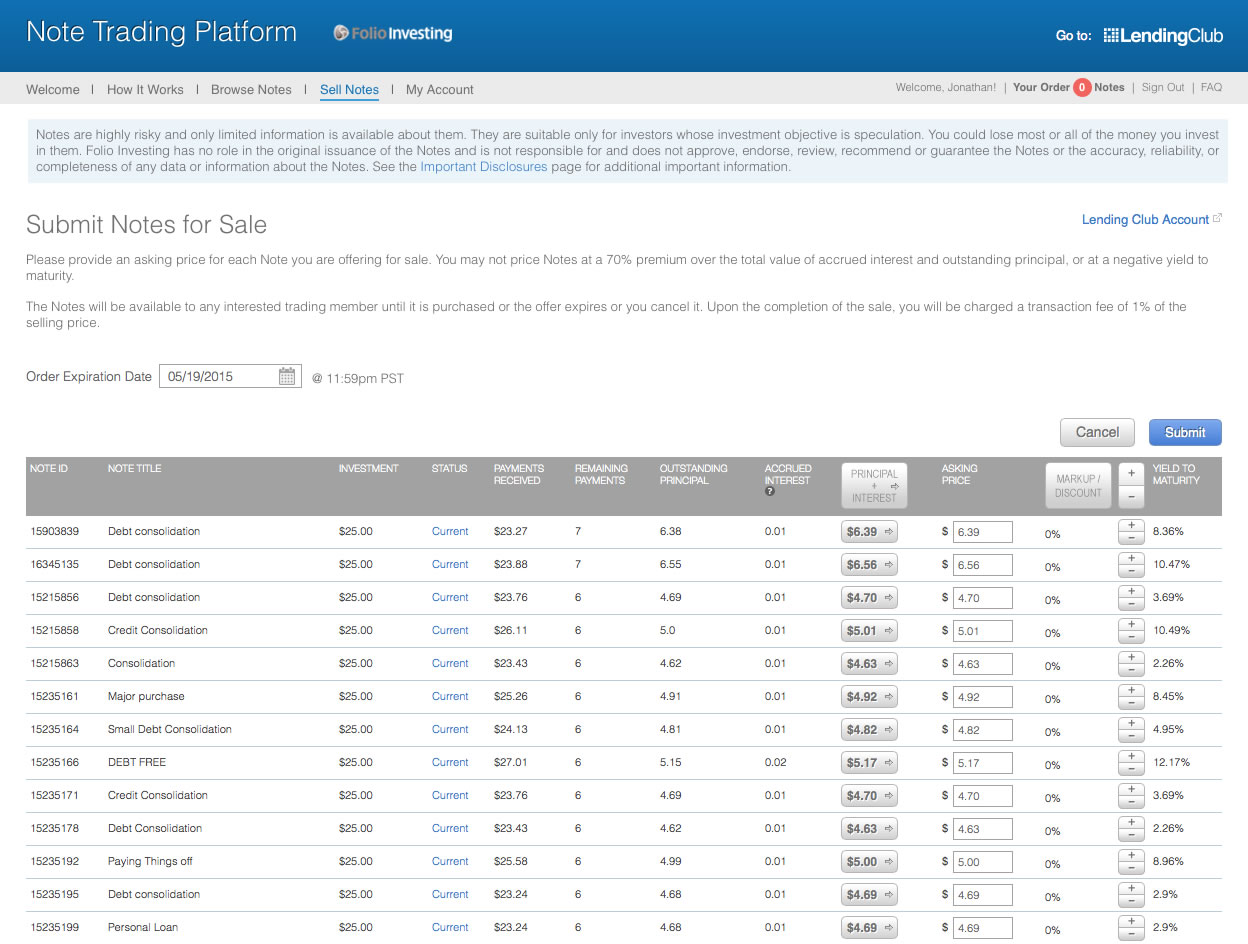
Liquidity. All loans you take on can now be sold on a secondary market at FOLIOfn, so if you need your money back it is possible. As an existing lender, I had to fill out some additional information, but my application was approved in a day and I can now view a listing of loans that people want to sell. FOLIOfn charges the seller a 1% trading fee.

Fees. Lenders pay a 1% service charge on all interest payments. Due to reasons that I haven’t worked out, this reduces the APR by less than 1%.

My Experience

In general, my use of LendingClub has been limited to some experimental investing. I like the idea and I like trying out new financial services, but as I mentioned, I’m also very risk-averse. My loans have to have an A-grade (I choose them myself and don’t use LendingMatch). Also, they have to outline a clear plan for repayment. My main problem so far is a lack of such high quality loans. I’ve only funded about 8 loans so far, but the volume seems to be picking up. I’ve been earning about 7% (8% minus fees) with no lates or defaults. The movement of money back and forth between my bank is smooth, just like with an online bank. I only wish there was an “instant funding” feature, as I don’t like to keep idle cash sitting there, but I like the ability to fund attractive loans quickly before they fill up.

In fact, although I usually don’t care about this sort of thing, yesterday I used their loan map mashup and actually found a loan by a local store that I have shopped at before. After reading it over, I am now moving some funds in to help fund that loan. Should be interesting.

Free $25 Lender Bonus

As a new promotion with LendingClub, if you click through this specific link and sign up as a new lender, you can get a $25 bonus. There is no credit check and you don’t have to deposit anything. After you are approved, the $25 should show up in your account balance, and you can lend it out immediately however you like.

How are your experiences with Lending Club?

P2P Lending Update: Prosper, Lending Club, Zopa, Loanio

Thursday, October 23rd, 2008

There have been a lot of comings and goings in the person-to-person social lending arena, so here are some updates and opinions as a casual observer sprinkled in.

Prosper Steps Away
The first and biggest (by total outstanding loans) P2P lender, Prosper, recently shut down to lenders while pursuing registration with the SEC to allow folks to buy and sell existing loans:

Until we complete the registration process, we will not accept new lender registrations or allow new commitments from existing lenders. If you’re an existing lender, your current lender agreements will be unaffected; your existing loans will continue to be serviced; you’ll be able to track and monitor your loans; and you’ll be able to withdraw funds from your Prosper account.

If you’re a borrower with an existing loan, you will continue with your current borrower agreement and be unaffected by the registration process. If you’re a borrower seeking a loan, you will still be able to create a new loan listing, which we will endeavor to fulfill through alternative sources.

Personally, I think having a liquid secondary market for these loans is a great idea in the long run. I always disliked the idea of making a 3-year loan that could be repaid by the borrower early, but not sold early. As a point of reference, Lending Club took around 6 months to complete the SEC registration.

More posts: Review Part 1, Review Part 2, Default rates, Scary graph

Lending Club Returns
After going through their own quiet period, Lending Club is now accepting new lender registrations again, as well as allowing existing lenders to bid on loans. But now, you can also buy and sell existing loans now on partner site FOLIOfn. It costs you a 1% fee to sell your loan, in addition to any possible gain/loss in the open market.

Right now, it would seem that Lending Club is the best game in town. For lenders, the loan performance stats seem to be better on average than Prosper, with much lower default rates so far, although there is still definitely risk these days. For potential borrowers like credit card consolidators, you can try them first to see what rate you can get. When you apply, you get an overall credit rating which determines your interest rate.

More posts: Lending Club Review

Zopa US Quits Pretending
Even at first glance, I thought Zopa US was a credit union in disguise. Well, right before Halloween, Zopa takes off the mask and reveals that… hey! We are a credit union. Now “lenders” are directed to buy a certificate of deposit at a credit union, and borrowers are offered a credit union loan from USA Federal CU.

It was (and still is) a shame that Zopa could not bring their UK model here due to legal issues. Hire some better lobbyists!

Loanio Arrives
A new competitor arrives to stir things up as well. Loanio is now open for business. Their model is pretty similar to Prosper, in that you bid on specific loans and the interest rates adjust downwards like a reverse auction. They have a referral program as well, and new lenders can earn a $25 bonus:

Every time you refer a new borrower who gets a loan, you’ll earn $50.00 and for every new lender referred, you and the new lender will receive $25.00!

Here is my referral link. I opened a new account last week. You must deposit $100 to start, but can withdraw it later. However, you must fund a loan ($50 minimum bid) to get the $25 bonus.

First impressions? Reminds me of Prosper, but the site design could be better, and it loads slowly. I’m also having trouble finding a loan to fund. If you see a good one that’s nearly funded, let me know!

Prosper P2P Lending Update #2: Scary Graph and Stats

Saturday, March 29th, 2008

I was trying to run some more recent numbers to update my most recent concerns regarding person-to-person loans at Prosper.com. Essentially I was wondering if the loan performance would continually get worse over time. I was curious because it’s one thing to advertise 8-12% returns when the loans are new, but what really matters is the performance at the end of the 3-year term.

While trying unsuccessfully to churn those numbers, I ran across this related chart from the very analytical Prosper lender Fred93’s blog. The graph is essentially % of loans defaulted vs. loan age. Fred93 explains further:

These charts show statistics for the performance of all prosper.com loans. Each curve represents the set of loans that were created in one calendar month. The vertical axis is the fraction of those loans that have “gone bad”, in other words are 1 month late or worse (up to and including default). The horizontal axis is now days since month of loan origination. All data comes from Prosper.com’s performance web page.

altext

If you look out one year from origination (ie 360 days) you will see that about 20% of Prosper’s loans have gone bad. You can also see that this is remarkably consistent from month to month (ie the different curves). One can only conclude that the default rate of Prosper loans is in the neighborhood of 20% per year. Loans originating after Feb’07 are going bad at a slightly lower rate, probably because Prosper increased the minimum credit score required for a Prosper loan at that time.

I learned also that he makes these conclusions because (1) historically over 85% of Prosper loans that reach 1 month late eventually go into default, and (2) the recovery rate after being sent to collections is terribly low. Together, you have his statement that ~20% of loans go into default each year. For a three-year loan, that ain’t good!

The slope (default rate) does seem to be slightly lower for the newest loans, but what concerns me the most is the constant linear deterioration of loans. This confirms my fear that loan performance consistently gets worse as the loan ages.

Now, I know this chart doesn’t tell the whole story, but I do think P2P lending is still very new and has a lot of growing pains to overcome. For borrowers, it can be a great deal. But as much as I want to be grabbing some solid returns this way, I’m still wary of committing significant money given this information.

(I haven’t found similar numbers for competitor LendingClub yet. They are still young, but they seem to be doing better in defaults so far. I’m waiting for more loan data to accumulate.)

Related P2P Lending Posts

Easy Money: Get Paid $115 To Try These Financial Services

Saturday, March 15th, 2008

I can’t stop the stock market from tumbling any further, but here’s a quick roundup of promotions by companies willing to pay you to try out their services. None of these listed require even a credit check. Additional information can be found through the links provided.

I have gotten all of the bonuses above successfully except for the Prosper one, as I had signed up before the promotion started. I have also gotten several $100 bonuses from these credit cards, although applying will require a credit check.

net worth progress bar