Archive for the 'Banking' Category
Wednesday, May 11th, 2011
Like many of you, I am a big fan of having a sizable cash reserves. Having at least six months of expenses provides financial stability, helps you avoid debt with high interest payments, and lowers stress levels. In addition, cash is an asset class where you can increase your return without having to take on additional risk (stay FDIC-insured or equivalent). Even though interest rates are low, consistently earning 1% more over time can be significant. I last shared my emergency fund breakdown in January, so here is a 2nd quarter update. The size of the circles are proportional to the balance I hold in each account.
Rewards Checking Accounts
Usually through smaller credit unions with limited membership areas, these checking accounts pay a higher interest rate if you jump through some hoops each month. However, if you make a mistake you’ll forfeit virtually all your interest for that month, so it can be tricky. More details here.
Many now seem to be struggling and lowering rates, but one nationally-open example is the Free Rewards Checking at DanversBank, which amazingly is still paying 3.01% APY on balances up to $25,000, provided you satisfy the following each month.
* perform at least 12 debit card transactions (excluding ATMs);
* receive their monthly statement electronically and log into Online Banking
* sign up for direct deposit or receive a recurring ACH transfer
Find a local rewards checking account by using the filters at the DepositAccounts database. I recently moved my money out of my local account, as they dropped their interest rate to 1%.
Long-Term CDs – Ally Bank
If you have a large cushion, it’s quite likely to just sit there for years or more. Therefore, I think it’s okay to put some of it in longer-term investments. With the Ally Bank certificates of deposit, you can still access your money as long as you pay a early withdrawal penalty of 60 days interest. That’s significantly less than at other banks. I have 5-year CDs paying 3% APY, but the current rate for new deposits is APY for a 5-year CD. I’ll show you below why this is both a competitive and flexible rate.
Let’s analyze a CD paying 2.40% APY with an early withdrawal penalty of the last 60 days of interest. (2.40% APY ~= 2.37% rate compounded daily.) Here’s how your actual annualized interest rate would fluctuate given your holding period.
After just 6 months, you’ll already be earning 1.59% even after the penalty. If you hold it a year and withdraw, you are already at 2% APY. Try to find any similar term CD that beats those rates. Basically after just 6 months I have nothing to lose and a lot to gain, so I keep a sizable chunk here.
U.S. Savings Bonds
For inflation-linked Series I Savings Bonds, the total rate earned consists of a fixed rate and a variable rate that adjusts with inflation every 6 months. The new inflation rate officially announced in May is 4.60%. If you bought a bond now, you’d get a 0% fixed rate and 4.60% inflation rate, you would have an opportunity to earn at least 2% over the next 11-14 months. Details here.
My patience with my older I-Bonds is paying off, as some of them have a higher fixed rate of about 1%. Currently, I am only earning 0.94% to 1.94% for six months, but soon I’ll be earning 4.6-5.6% for the next six months. There is an annual purchase limit of $5,000 in paper bonds and $5,000 in online bonds per Social Security Number. For a couple, that’s $20,000 per year.
Online Checking and Savings Accounts
Each day there are more online banks competing with online checking and savings accounts. Last time, I was putting the remainder of my funds at SmartyPig, an online piggy bank that with some tricks could be used an a savings account. They still offer a competitive 1.35% APY, but I discovered that they don’t let you withdraw money when there are “pending” transfers for a few business days, and if you have a regular transfer something always seems to be pending. They are still good for savings goals, but not as much if you want to make regular withdrawals.
Since I already have my CDs there, I’m trying out Ally Bank for my daily banking convenience and emergency fund needs. Their Interest Checkingcurrently pays 0.50-0.90% and their Online Savings is atAPY. Most other online banks are clustered around 1% APY as well, and I am only going with Ally due to their checking features like no fees, fee rebates for an ATM, and free overdraft transfers from savings. This allows me to keep a minimal balance in checking and more in savings/CDs. Check out my Ally Bank Checking account review for an in-depth rundown.
Alternatively, SalemFiveDirect is was guaranteeing 1.25% APY until April 2012. Everbank has their Yield Pledge Money Market paying 1.26% APY for the first 3 months for new accounts. Alliant CU also offers a good checking account solution at 1.10% APY, though their ATM rebates are more limited.
Posted in Banking, Insurance | 11 Comments »
Tuesday, May 3rd, 2011
The Ally Bank blog recently announced that they are gradually rolling out their eCheck Deposit service, where you can use a scanner and submit your deposits over the internet without having to visit a branch or mailing anything in. This is another step towards being able to step away from the big Brick & Mortar banks and take advantage of the higher interest rates and lower fees of internet banks.
The service is currently only available by invited account holders of an Ally Interest Checking account, but you can call them at 1-877-247-2559 and ask to be added to their next rollout list. They expect to continue expanding this service throughout 2011. (Update: Ally contacted me and said that invited account holders of their online savings account and money market account are also eligible.)
This adds another feature to my Ally Bank Checking account review, which I found comparing the features to be one of the best online checking account alternatives out there. No minimums, no direct deposit required, all ATM fees refunded, 24/7 phone reps, and a decent interest rate.
Posted in Banking | 16 Comments »
Tuesday, May 3rd, 2011
My very first big boy bank account was with Bank of America, opened when I first landed at college nearly 15 years ago. I realized today that even though I have probably opened and closed nearly a hundred (yes, 100) bank accounts since then and pocketed several thousand dollars in signup bonuses (yes, a least that much) in the process since then, I have always kept that same Bank of America account open.
BofA has a bunch of different accounts across the nation, but from what I recall, the MyAccess Checking account I opened was one of the most basic and the easiest to avoid a monthly fee on. Today, I received notice that they will be raising some fees, effective for statement cycles starting on or after May 24, 2011. The monthly fee is now $12, up from $8.95. To avoid it, I’ll have to keep at least $1,500 in my account or have a direct deposit of at least $250. Previously, a direct deposit of any amount was acceptable.
Neither of changes will really affect my current banking patterns, but it does signal that fees are going up and reminds me that there are other deals out there. Am I somehow emotionally attached to a bank account after all these years? Or maybe I’m just a creature of habit.
Posted in Banking | 19 Comments »
Tuesday, April 12th, 2011
If you’ve been thinking about switching to an online checking account, ING Direct is now offering a $50 bonus for opening an Electric Orange checking account and making three debit card purchases. No special reference code needed. If you already have an ING Direct Orange savings account, you can enter your login info and speed through the application without having to enter your personal details again.
Electric Orange has no minimum balance requirements, no direct deposit required, and no monthly fees. You can use any ATM in the Allpoint network without fees. The interest rates are currently 0.25% APY for balances under $50,000, 1.10% APY for $50k-$100k, and 1.15% APY for $100k+. If you have under $50k, then try to keep most of your money in ING savings. Another random feature? Their new debit card is totally flat and un-embossed, with the card number printed on the back. I don’t really get it.
I still think the Ally Interest Checking account has better features, but if you are a loyal ING Direct fan this is a nice incentive to try it out.
Posted in Banking, Deals & Offers | 5 Comments »
Tuesday, April 5th, 2011
In case you haven’t been notified, the e-mail marketing provider Epsilon Data Management got hacked and tons of email addresses and names were stolen. Clients include major companies like Chase, Capital One, Best Buy, Target, and more. While the data breach is not enough for identity theft, the fear is that they will use these emails to target phishing scams since they know what merchants you are comfortable dealing with.
While logging into my Bank of America account this weekend, I saw that they recommended me to download and install a free software program called Trusteer Rapport, which supposedly provided “online fraud protection”. Of course, as I click over, they also point out that:
Trusteer may offer a different privacy policy and level of security than Bank of America. Bank of America is not responsible for and does not endorse, guarantee or monitor content, availability, viewpoints, products or services that are offered or expressed on other websites.
So, basically, “hey, you should install this unknown software program to protect against other unknown software programs, but we don’t officially endorse it, and it’s not our fault if it doesn’t work or actually causes even more damage than doing nothing.” Huh?
First, I looked up Trusteer, a privately held computer security firm. There are numerous articles about Trusteer in various IT security magazines that I’m loosely familiar with, so that gave them some legitimacy. However, they are a new company (first mention is 2009) and unaffiliated with any other well-known security firms. Several other major banks besides Bank of America have “suggested” that people install Rapport, including ING Direct, HSBC, and Suntrust.
How does Trusteer Rapport work? According to their FAQ:
- Rapport verifies that you are really connected to the bank’s genuine website as opposed to a fake website created by criminals. Although this sounds trivial, it’s not obvious that you reach a genuine website when you type your bank’s address into your web browser
- Once verification is complete, Rapport locks down communication between your computer and the bank’s website. This prevents criminals from hijacking your online connection with the bank
- Rapport protects your computer and internet connection by creating a tunnel for safe communication with your bank, preventing criminals from using malware to steal your log-in data and tamper with transactions
So, they try to stop things like fake websites and keyloggers. Also of interest is the fact that they work closely with the banks themselves to customize the software to each site:
Rapport’s access control policies are set by your bank. Banks that work with Trusteer build and maintain policies that define which information is sensitive and which operations on this information should be restricted.
So what’s with the non-endorsement? BofA says it’s because they already reimburse you for fraudulent losses. From the NYT Bucks Blog:
Using the Rapport software isn’t mandatory for Bank of America customers, Mr. Gordon said, in part because the bank already protects account holders from losses if their account is compromised. But it is advisable, he said, because malicious software programs can also steal sensitive nonfinancial information, which can be used in identity theft. “One of the goals of malware is to go gather information,” he said.
Some users of the of the software have noted that it slows down your system. Trusteer counters that it’s most likely due to your other security software conflicting with what Rapport is trying to do. Well, that sounds like a couple hours of fun troubleshooting. I dislike installing additional software unless necessary, so I think I’ll hold off for now. Prediction: Trusteer will be acquired by a large branded security firm in the near future.
Posted in Banking | 31 Comments »
Monday, April 4th, 2011
If you have been a customer of Fifth Third Bank and incurred any overdraft fees related to a debit card transaction, the following may interest you. According to a class action lawsuit, Fifth Third Bank posted debit card transactions and/or ATM withdrawals in non-chronological order so that the bank could maximize the number of overdraft fees it charged to customers. Without admitting wrongdoing, Fifth Third ended up settling for $9.5 million. The official website is OverdraftSettlement.com. Taken from the claim form:
Eligibility: If you hold or held a Fifth Third Account any time between October 21, 2004 and July 1, 2010 and incurred at least one Overdraft Fee associated with at least one Fifth Third Debit Card Transaction, you are eligible to submit a Claim Form.
Settlement Benefits: Settlement Class Members who submit a valid Claim Form may receive a payment of up to three times the amount claimed on this Claim Form, depending on the total amount of valid claims submitted. The Court in charge of this case still has to decide whether to approve the settlement. Payments will not be made until the Court grants final approval and after any appeals are resolved. Please be patient.
The applicable period is pretty long, nearly six years. You could get up to triple your overdraft fees back. Supposedly final approval was supposed to be given on March 16, 2011, but I can’t find any updates. Claim deadline is coming up soon on May 2, 2011.
Posted in Banking | 22 Comments »
Thursday, March 17th, 2011
With the megabanks like Bank of America and Chase gradually increasing requirements ratcheting up the fees, what is a good alternative checking account? I just closed down my Chase account of several years last month, but have kept my Bank of America for now. I usually tell people to go with a local credit union for no fees, and an online savings account linked up for higher interest on savings. Online checking accounts started getting popular with ING Direct’s Electric Orange Checking, but currently I find the best all-in value proposition at the Ally Bank interest checking account.
If you imagine all the requirements of your “dream” checking account, Ally Bank’s offering does a really good job covering them. Here’s a rundown:
No minimum balance, no fees, no direct deposit requirement
There is no minimum balance to open, no balance maintenance requirements, and no direct deposit requirement. There is no hassle at all to avoid monthly fees. You can fund the initial deposit online via ACH, by mail, or by wire.
No ATM Fees Across the US
Ally Bank has the best ATM fee rebate program I’ve seen. When it comes to ATM fees, you have to worry about (1) your bank charging a fee, and then (2) a fee from the bank owning the ATM you’re using. Ally Bank never charges a fee on their side. They also rebate any external bank’s ATM fees, so you can use any ATM you like in the world. You are not limited to any specific network. There are no usage caps or monthly limits to the fees.
Fees are automatically refunded at the end of each monthly statement cycle. International ATMs are even included, although they do ask to you keep your receipts just in case the fee is not automatically refunded. As of August 2011, I found out they no longer give fee rebates on international ATMs.
Higher Interest Rates + Free Overdraft Transfers
Currently, Interest Checking has a tiered interest rate of 0.50% APY for balances less than $15,000, and 0.90% APY for balances of at least $15,000.
In addition, with their free Overdraft Transfer Service, they will automatically transfer available funds from your Ally online savings or Money Market account to cover any overdrafts for free. Alternatively, you can schedule balance alerts to transfer X amount over if you checking amount reaches a certain threshold. This means you can keep a relatively low balance in checking if you wish and put more into savings since it pays APY currently. Remember, you can only do 6 withdrawals from savings each money due to banking regulations.
Old-Fashioned Paper Checks
Ally Bank still supports paper checks. You get free checkbooks (50 to start, order more online) and unlimited checkwriting. They’ll send you postage prepaid envelopes to mail in deposits. They only thing you could ask for is the ability to scan in smaller checks via computer or smartphone. Hopefully this is coming. Update: It’s here!
Other Free Stuff + 24/7 Customer Service
Let’s see, you get free online BillPay, free debit card. They are FDIC-Insured to the same limits as other banks. You can easily set up online links other other banks and ACH transfer money in and out, with the usually 2-3 business day hold. They have 24/7 customer service, either by phone or live chat. (Even the megabanks don’t have that.)
It’s not perfect, but if you go through these features one by one, you’ll see why I opened an Ally interest checking to compliment my existing Ally savings account and the 5-year CDs that I’ve talked about before. If you have further questions, I can try to help in the comments, or you can simply ask them directly using their convenient 24/7 online chat.
Posted in Banking | 56 Comments »
Wednesday, March 2nd, 2011
Oh alright, here’s another net worth update. My last snapshot was about 9 months ago. I know people like the voyeurism, but hopefully my commentary will also provide some helpful insights as to achieving our goals.
Credit Card Debt
I used to take money from credit cards at 0% APR and place it into online savings accounts, bank CDs, or savings bonds that earned 4-5% interest (yes I know, much less recently), keeping the difference as profit while taking minimal risk. (Minimal in regards that the risk was only dependent on my behavior and not outside factors.) However, given the current lack of great no fee 0% APR balance transfer offers, I am currently not playing this “game”.
Most credit cards don’t require you to pay the charges built up during a monthly cycle until after a grace period of about 14 days. This theoretically provides enough time for you to receive your statement in the mail and send back a check. As this is simply a snapshot of my finances, my credit card debt consists of just these charges. I don’t carry any balances or pay any interest charges.
Retirement and Brokerage accounts
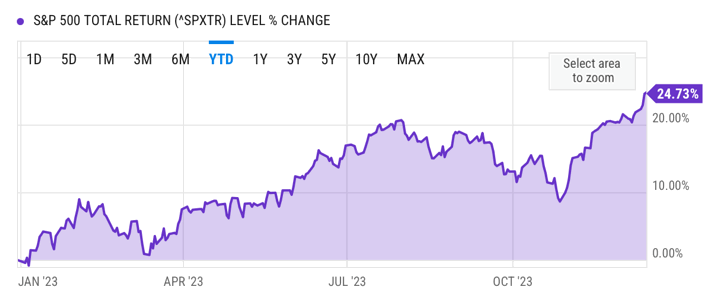
Since my last update, the broad stock indexes have risen significantly, about 25% including dividends according to Vanguard Total World Stock Index ETF (VT) that I use as a general benchmark. Although these high valuations make me nervous, I am still a believer in stocks for the (very) long run and rebalancing your asset allocation regularly. Don’t buy high and sell low.
Here is our target asset allocation. Being heavy in stocks, our portfolio bounced back significantly as well.
Our total retirement portfolio is about $360k or on an estimated after-tax basis, $318,000. At a theoretical 4% withdrawal rate, this would provide $1,060 per month in retirement income, which brings me to 42% of my long-term goal of generating $2,500 per month. These are all really rough numbers, but helpful to measure progress and visualize living off your portfolio.
Cash Savings and Emergency Funds
We are happy to hold a year’s worth of expenses (conservatively estimated at $60,000) in our emergency fund. According to my emergency fund poll, many of you readers also have substantial savings set aside, with most having at least 4 months of expenses. Very nice.
Recently I wrote about how I maximize interest in my emergency fund, including the specific banks and institutions I use.
Home Equity
I would like my house paid off in 15-20 years at most, so I’ve been putting some extra money towards the mortgage. Note that this is only after maxing out both our 401k plans, fully funding IRAs every year, and creating a one-year emergency fund. I’d like our mortgage pay-down progress to parallel our portfolio growth so that both are ready for at least partial retirement in about 10 years.
So there you have it. Mrs. MMB and I both earned a six-figure salary again last year, which combined is in the top 5% of households. We try to save a lot of it while it stays this way.
The future is hard to see, but we’re getting there a lot faster than we thought we could.
Posted in Banking, Credit Cards, Goals, Investing, Retirement | 23 Comments »
Thursday, February 17th, 2011
Reader Jonathan wrote in the tell me that the Bank of China (BoC) is offering FDIC-insured bank accounts that are denominated in renminbi, the official currency of China. Also referred to by the primary unit yuan, you may have heard about how China tightly controls this currency in the news. Since many sources view the yuan as being undervalued relative to the dollar due to artificial exchange rates, some people view holding yuan as a good investment. Here’s how the Bank of China news has played out in financial websites.
- 1/12 – The Financial Times blog BeyondBRICs brings up the ability to open accounts in yuan, but says “No need to rush out and open a renminbi account just yet.” They note that this ability has actually been around since February 2010, but nobody in the media really noticed.
- 1/12 – The Reuters blog by Felix Salmon picks it up and brings it a step further, pointing out that US officials have said the yuan is overvalued, so that “Chinese revaluation is going to happen at some point, and when it does, you’ll make money”, and “the downside is limited”. More excitement.
- 1/14 – The Wall Street Journal blog ROI joins the fray, stating (1) It’s very unlikely to go down. (2) It’s very likely to go up. (3) You won’t miss out on a lot of interest elsewhere, as nowhere else is paying a lot of interest. (4) It will diversify your portfolio. (5) It may offer you and your family something of a hedge against the decline of the U.S. economy. Can you feel the buzz?
- 2/7 – Time Magazine blog Curious Capitalist has another post on the topic a few weeks later. It provides more detail on what this account does not offer: interest, the ability to withdraw yuan, deposit yuan, write checks, or use debit cards. Basically you can speculate on the conversion rate of USD-CNY and that’s it. More below.
So, should you go out and open an account? Well, first you must go in person to a Bank of China branch in New York City, either at Madison & 48th St or in Chinatown. Some of the articles erroneously reported that you can open up an RMB account at the Los Angeles branch. According to the Bank of China website, this is not true. The branch does not offer FDIC-insured accounts, and doesn’t offer personal account of any kind.
The limit a U.S.-based individual customer can exchange is $4,000 a day. From what I have gathered, you open an account and “buy” RMB from Bank of China using your U.S. dollars. Your deposits are FDIC-insured against bank failure, but not losses from currency fluctuations. If you wish to withdraw, you must again exchange your RMB back to USD, leaving you again with dollars. You can’t withdraw any RMB, here or in China. The savings account earns no interest. So any difference will be due to the exchange rate.
According to the Wikipedia entry for Remminbi, academic studies have shown then yuan to be undervalued relative to the dollar using “purchasing power parity analysis”. The Treasury Secretary called it “substantially undervalued” a month ago. Per this article, the rate of 6.5855 CNY to 1 USD set just yesterday (2/16) is a record high, leaving the yuan up 3.6% since last June.
I honestly don’t pay enough attention to currency markets and all the politically-related news to really weight the pros and cons properly. Even if it does seem like the yuan is undervalued right now, but who knows when or how it will be corrected? China sets the exchange rate for the most part, so it could be years or more. During that time, its economy could experience high inflation as well which could make RMB even weaker relative to USD.
I see no sure bet here, just a speculative investment. But if you have a “play money” account capped at 5% of your portfolio like I do at times, this might be one idea that you could drop some bucks on. What do you think?
Update: You can get basically the same thing online at Everbank WorldCurrency Access deposit account. It doesn’t currently earn any interest, and unfortunately there are no interest-bearing CD options available right now either. But it does let you get it renminbi-denominated.
Posted in Banking, Investing | 12 Comments »
Tuesday, January 18th, 2011
The results of my Emergency Fund survey are in, and appears that there are a lot of big savers out there! 28% of respondents had cash reserves of over 12 months of expenses, and 24% of you had the more-often recommended 4-6 months of expenses.
With such sizable cash reserves, where you do guys put it all? I figured I’d share my stash-the-cash choices, which may not be perfectly optimal but I’m open to talking about it. The size of the circles are proportional to how much of my money I keep in each respective account.
With interest rates so low across the board and still dropping it seams, it’s been hard to get really excited about many new options. But remember, it can be better to be earning 2% with low inflation than 5% interest in a high inflation environment. Every basis point helps.
Rewards Checking Accounts
You’ve likely heard of these by now. Usually through local credit unions, these checking accounts pay a higher interest rate if you jump through some hoops each month. However, if you make a mistake you’ll forfeit virtually all your interest for that month, so it can be tricky. More coverage here.
One nationally-open example is DanversBank, which offers their Free Rewards Checking currently paying 3.01% APY on balances up to $25,000, provided you satisfy the following each month:
* perform at least 12 debit card transactions (excluding ATMs);
* receive their monthly statement electronically;
* access Online Banking, and
* sign up for direct deposit or receive a recurring ACH transfer
To find a local rewards checking account limited to your area, check out DepositAccounts and use the filters. Sadly, my local account recently dropped their rate significantly.
Long-Term CDs – Ally Bank
If you have a large cushion, it’s quite possible (if you’re lucky) to not have to touch it for years or more. Therefore, I think it’s okay to put some of it in safe investments but slightly less liquid.
With the Ally Bank certificates of deposit, you can still access your money as long as you pay a early withdrawal penalty of 60 days interest. That’s significantly less than at other banks. I have a 5-year CD paying 3% APY, but the current rate for new deposits is APY for a 5-year CD.
Rates change constantly, but let’s assume you have a certificate of deposit from any bank paying 2.39% APY with an early withdrawal penalty of the last 60 days of interest. (2.39% APY ~= 2.26% rate compounded daily.) Here’s how your actual annualized interest rate would fluctuate given your holding period.
After just 6 months, you’ll already be earning 1.58%, more than a comparable 12-month CD. If you somehow had to withdraw after 1 year, you’d still have earned 1.99% APY. Basically, after just 6 months I have nothing to lose and a lot to gain, so I keep a sizable chunk here.
Savings Bonds
I have some older Series I Savings Bonds, but they aren’t a very good buy right now. The total rate consists of a fixed rate and a variable rate that adjusts with inflation every 6 months. If you bought a bond now, you’d get a 0% fixed rate and only 0.74% from inflation. However, my older bonds have higher fixed rates, and according to my TreasuryDirect statement they are earning 1.74%, 2.25%, and 2.75% right now. The annual purchase limit is now $5,000 in paper I-bonds and $5,000 in online I-bonds per Social Security Number. I’ll keep them for a while, as I like the tax deferral benefits and inflation may come back to bite us.
Online Savings Accounts
Rewards checking account and savings bonds have deposit limits, and you only want to lock up a certain amount in longer-term CDs, so the rest goes into the now-popular online savings account. There are a lot of players out there now, but many of them are packed together with very similar features and interest rates.
Right now the rest of my cash is over at SmartyPig.com, an FDIC-Insured bank account that lets you save for specific goals like an online piggy bank. However, they’ve added so much flexibility that you can pretty much use them like any other savings account. Their rate has dropped recently from 1.75% APY to 1.35% APY for balances up to $50,000. This is still amongst the top rates, but I’ll be watching them closely.
Alternatively, Everbank has their Yield Pledge Money Market paying 2.01% APY for the first 3 months for new accounts. This rate is higher than any 3-month certificates of deposit currently available, while still being available for withdrawals at any time. The rate is guaranteed stay in the top 5% of competitive accounts. Evantage Bank has their Mega Money Market account paying 1.75% APY for balances up to $35k. Most other banks are clustered around the 1% to 1.2% mark.
So… where’s your cash?
Posted in Banking, Investing | 30 Comments »
Wednesday, December 1st, 2010
While catching up on snail mail after getting back from Thanksgiving, I found a letter from Chase Bank telling me that my Chase Fee Extra Checking account (formerly Washington Mutual Free Checking) will now be called Chase Total Checking as of February 8, 2011. Along with the new name comes – you guessed it! – a new $10 to $12 monthly service fee* unless I meet at least one of the following criteria each statement period:
- At least one single direct deposit of $500 or more,
- A minimum daily balance of $1,500 or more,
- An average balance of $5,000 across all Chase deposit accounts (checking, savings, CDs) and/or investment accounts with Chase Investment Services Corp,
- Pay $25 or more in qualifying account fees (not including this monthly service fee)
Back in April 2009, I reported that Chase was converting over WaMu Free Checking accounts and was keeping the important no monthly fees and no minimum balance feature. Well, that lasted about a year and a half.
I haven’t been using my Chase checking account very much recently, especially since their savings account basically pays no interest at all. As it stands, I’ll be subject to the $10 monthly fee. I don’t think I want the hassle of making online ACH transfers back and forth to simulate a direct deposit each month, so I’ll probably end up closing the account. WaMu was my primary bank for a few years, but I’ve learned not to get too attached to any single financial institution.
* According to the Terms & Conditions booklet, the monthly service fee is $10 for accounts opened in California, Oregon, or Washington. Otherwise, $12.
Posted in Banking | 106 Comments »
Friday, November 5th, 2010
Chase Bank has a promotion that can get you up to 25,000 Continental Airlines miles for the following actions:
- 10,000 bonus miles when you open a new Chase Checking account with at least $100 and either make 5 debit card purchases or set up direct deposit.
- 15,000 bonus miles if you open a Chase Continental Airlines Preferred Debit Card ($65 annual fee) and make a purchase on it. However, in the fine print it says you can opt for the regular Chase Continental Airlines Debit Card with $25 annual fee and still get the 15k bonus. Both cards offer the first checked bag for free for you and companions on your same itinerary.
Unfortunately, this is only for new Chase checking account holders, so I am not eligible. You must print out the coupon and bring it into a Chase branch to redeem. Continental is merging with United, but that probably won’t be completed until later next year. Offer ends December 31st, 2010.
If you are a new customer, live near a Chase branch, and fly on Continental or United, this is a relatively cheap way to earn a some frequent flier miles. Finally, I note on this other Chase page that you can also get 2,500 bonus miles for getting an additional debit card for a joint account holder (up to 3).
Selected fine print:
Read the rest of this entry…
Posted in Banking, Deals & Offers | No Comments »