Most homeowners know that they have the option to pay more than their required monthly mortgage note, which will directly reduce the principal. Assuming there is no prepayment penalty, due to the power of compound interest (backwards?) this can significantly shorten your loan period. Whether or not this is a mathematically and/or behaviorally optimal idea is a subject of debate, which I won’t go into here.
Anyhow, one of the more popular ways to do this is the “biweekly payment plan”. Imagine you had a 30-year mortgage with a payment of $1,200 per month. If you paid $600 every 2 weeks instead, you would be done with the mortgage about five years early! (Use this calculator for more exact numbers.) Because there are 52 weeks in a year and not 48 (12×4), you are essentially making one extra mortgage payment per year.
The attraction of the biweekly plan is that it often coincides with your biweekly paycheck and thus you don’t “feel” that you’re paying extra.
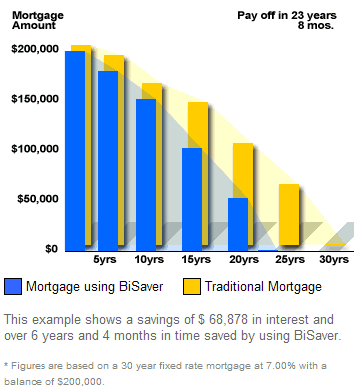
BiSaver®
Today I got an letter from my bank lender about a program called BiSaver, which is basically an automated bi-weekly payment system. Every two weeks the increased biweekly amount is taken from my bank account, and it is eventually paid towards my loan.
However, it costs $399 upfront, plus $1.50 each transfer ($39 annually)*. Another sneaky way they make money is off of the float. Say your loan is due on the 31st of the month. Earlier in the month, on say the 1st and 15th those two biweekly payments (ex. $750 x 2) will be taken out of your bank account. But according to the fine print, only on the 31st will the amount be paid toward your mortgage. In the meantime, BiSaver is earning interest off of those payments.
I really hated this part of their sales pitch:
Can I pay biweekly without BiSaver®?
No. We are not aware of any mortgage company that will accept biweekly or semimonthly payments for a monthly mortgage. What you may do is submit more than your regular monthly payment each month to reduce your principal balance faster and save interest.
No? If you don’t credit the actual payment until the end of the month, then you’re not saving me anything anyways! In fact, I’m losing the opportunity to earn interest in my own savings account.
Yes, You CAN Do It Yourself For Free
After some research, I found out that “BiSaver” is simply a third-party company that goes around pitching this system to mortgage holders like it is some sort of secret sauce. But really they just accept the payments, and then forward them on to the lender. While it purports to “pay for itself in interest savings” almost instantly, it also neglects to mention that anyone can do this for free. If anything, I’d be paying for the convenience factor. But first ask your bank about one of these options.
Lender-Initiated Automatic Transfers. Right now, my mortgage payment is due on the 15th and the amount is automatically sucked out of my checking account every 10th. This is a system offered by my lender. So I called them up and asked if I could add an additional principal payment to each monthly transfer. The said I could, and it would be free! This confirms my theory that BiSaver pays lenders to market to their customers this fake package, and gives them some sort of kickback. Why not just tell us about the free option??
To replicate the results of the BiSaver program, simply take your monthly mortgage payment and divide it by 12. Now add that to your monthly payment amount. So if you originally paid $1,200 you would add $100 for a total of $1,300 per month.
Use Online Billpay. Now, if your lender doesn’t allow this, then you should still be able to make extra principal payments by check. Now simply use your bank’s online billpay system and have them send a monthly recurring payment for $100 (using this example) to your lender. To force a paper check, you should simply set up the payee as a “custom payee” and supply the mailing address. You should also be able to designate what to write on the memo line of the check. Again, ask your lender for specifics, but something like “principal reduction” or “apply towards principal only” and also your loan account number should ensure that it does not get confused with your regular payment or escrow account.
Use Savings Accounts. The most simple way to think about this is that you need to make an extra payment per year. Every Jan 1st, just write an extra check for $1,200. If you like automation, just setup recurring withdrawals with an online savings account – they all offer this feature. If you use Capital One Consumer Bank, open up a new subaccount.
* Note: $399 + $39 per year, growing at a rate of 5% annually (not 8% to account for inflation) comes to $3,306 at the end of 25 years. Don’t pay for a biweekly payment system when you can do it for free!
 The Best Credit Card Bonus Offers – March 2024
 Big List of Free Stocks from Brokerage Apps
 Best Interest Rates on Cash - March 2024
 Free Credit Scores x 3 + Free Credit Monitoring
 Best No Fee 0% APR Balance Transfer Offers
 Little-Known Cellular Data Plans That Can Save Big Money
 How To Haggle Your Cable or Direct TV Bill
 Big List of Free Consumer Data Reports (Credit, Rent, Work)
“We are not aware of any mortgage company that will accept biweekly or semimonthly payments for a monthly mortgage.”
Countrywide will, albeit for a $4 per payment fee. Aren’t they the nation’s biggest mortgage lender? Sounds like these people have their heads deliberately in the sand, or else they are actively defrauding people.
I have gone through the blogs. Can some one clarify this – On biweekly program looks like we need to pay one monthly payment extra per year becos 52X4= 364days.
Let say current monthly payment is $2000 then per year, need to pay extra $2000 and then for 24 years( loan will be closed with bi weekly program) 24X2000=$48,000 paying extra and this is amount saving on switching from monthly to biweekly program. So where is the benefit? can some one explain, if I am missing anything?
Thanks
Ana
Ana, you nailed it
the benefit is from paying extra principal
– which when you switch into a program like this, becomes mandatory
you get no benefit from paying more often (every 2 weeks)
so if you want to simulate this benefit, without being penalized if you want to stop,
just add 1/12 of your mortgage payment to each payment, you will be basically in the same place
for example
if your mortgage payment is 2400
add an extra 240 each month
you will shave about 5 years off your loan
oops, 1/12th of 2400 is 200 not 240
Equity plus wants to manage your money, in case you are too stupid to just add money to a monthly payment. They hold your extra money and do not pay the extra payment until later so they wind up holding your money that you could have already been paying each month. They deliberately do not tell you that they will not be paying the extra money they collect until much later. They hit you with a lot of numbers and money savings so your head is spinning and you think it is a great deal. You are much better off paying more on your loan yourself. They also missed my first payment by sending it to the wrong address. Aren’t they the mortgage expert’s? I fired them after the first missed payment and had to suck up the start up fee. Run from them as fast as you can.
Sorry had Countrywide did their 26 pay program and in the fine print it said they would hold payments till the first the month and then apply them. There are no simple interest mortgages out there that I am aware of. If there is I will jump on the band wagon for sure.
Bank of America offers a biweekly pay option and for its normal retail customers it too charges a setup fee + small transaction fee for each payment. However, if you are a BoA premiere customer they will set this up for you for free, no setup charge, no transaction fees. Based on my mortgage size, and rate, the biweekly option will knock 7 years off my 30yr mortgage. I will have the home paid off in 22 years 7 months.
I almost jumped into this when I first purchased my home. Like you I did the math, realized I wasn’t really saving anything. Did some research and discovered they weren’t really doing much either except taking my money. At that point I concluded I could be disciplined enough to make my own extra payments. Just adding $100 in additional principle each month on my mortgage reduces the time by 6 years and actually saves 30k more than the bi weekly mortgage company proposed they could save me.
Bank of America offers a biweekly pay option and for its normal retail customers it too charges a setup fee + small transaction fee for each payment. However, if you are a BoA premiere customer they will set this up for you for free, no setup charge, no transaction fees. Based on my mortgage size, and rate, the biweekly option will knock 7 years off my 30yr mortgage. I will have the home paid off in 22 years 7 months.
They accumulate the payments into an escrow account and every 60 months there is a principal reduction equivalent to 50% of a full monthly payment.
My only complaint with this is that Quicken 2008 does not handle bi-weekly mortgage payments very well. Also BoA had to provide a new printed amortization schedule. Trying to track it properly in Quicken is a royal pain and requires some creative transaction juggling. I set up a “placeholder” transaction for the biweekly payments, and allow quicken to post the normal monthly payment. I need to remove the placeholders after the monthly payment is applied in order to have an accurate account balance in my checking account. Then once every 6 months I manually add a principal reduction transaction to reflect the correct mortgage balance. Its a bit kludgey, but I love that I am shaving 7+ yrs off my loan.
Wells Fargo offers a bi-weekly payment at no charge, they will automate it and you can increase the amount taken at any time. It is called their Accelerated ownership plan. I set it up so that they would take the money the day after my payday. (This is saving me 6yrs 3months and ~$95K in interest)
My second mortgage is with Principal bank. I was originally told that I could do this as well on my own then later another customer service person told me that they are not set up to take bi-weekly payments. I went to my billpay and just set up a an automatic payment for every 4 weeks. Which will also coinside with the day after a paycheck comes in.
Almost all of this personal finance stuff is new to me, but I am learning and have found that there are ways to work around almost any issue a company presents to their customer.
the math says that if you make half your payment on the 1st of the month, and half on the 15th of the month, you should be ahead of someone who only pays on the 1st because of the compounding aspect.
I ended up having long talks with my bank (wells fargo) about this. It doesnt seem like its possible there. Does anyone know if any bank offers a semi-monthly payments schedule where they apply payments as they get them — not just hold them until they get both payments
Nuri – That’s the problem. Most mortgages will only apply payments once per month. If you pay anything earlier, they just make money off the float themselves until the date comes due.
If one of these programs actually does *credit* biweekly, then it might be worth a small fee for the benefit. I haven’t done the math there.
You don’t have to do it automatically, anyway. In those months when you get an extra check, you can just mail in some extra money. You can probably find a form online to do this, or you may have received one in the mail. Be sure to check the box or otherwise explain that this extra money is to go toward the principal or your plan won’t work.
I only get paid once a month, so adding extra each month works best for me.
Do make sure to talk to your lender about the effects of early payment. If they don’t apply your payment until the end of the month, then don’t make your payment until (just before) the end of the month. If, like the lender for my first car, they use the “rule of 72s” (which means basically, your total interest charged is based on the date of your last payment, as if you had been making equal payments each month), then wait until the very end of your loan to pay the extra money.
Even if it turns out there is a penalty for early payment, it can feel good to build up enough savings to be able to pay off the rest of your loan, even if you don’t actually do it.
My biggest motivation when I started was to look at the amortization schedule. It shows you how much is going toward principal and interest each month. At first, very little is going toward principal, but this number increases each month. When I first started, only $30 of my $600 payment was going toward principal. Depressing! But the good news was that by paying an extra $30, I was cutting a month off the end of my schedule. By paying an extra $100, I was able to cut the length of my loan quite drastically. (Nowadays, it’s not so exciting because $371 is going toward principal. Now my debt plummets faster, but extra payments don’t have such a dramatic impact on my date of last payment.)
Navy Federal CU offers loans including mortgages that are specifically setup to be due on the 1st and 15th, a time that corresponds to many people’s paychecks. There’s no charge.
I switched my auto loan to be that way, I’ll end up saving about $600 over the 5 year loan.
Thanks for the great post. I’m closing on my condo October 3rd (less than one month!!!) and any info I can gather on a mortgage is much appreciated.
I suppose another option would be to open up a separate savings account and transfer money into that savings account and make a separate payment towards the principal. There’s absolutely no reason anybody else should make money off of you with this float garbage.
I have a family member who signed up for a similar “biweekly” payment plan for a “small administrative fee,” despite my best efforts to convince them they could do it themselves for free. Perhaps I’ll drop this article in their inbox as further proof!
bisaver? is this some sort of program for saving bisexuals from hellfire?
sarah — this is a personal finance blog.
bisave refers to bi-weekly mortgage payemnts instead of monthly
sarah… nothing can save them. the rest of us have to suffer through having half as many potential mates to pick from… they get hellfire in return. its only fair.
my bank will allow me to transfer from my checking to my mortgage principle at any time. i made a full extra payment in February and it went through on the 15th of the month… my usual payment goes through on the 5th.
haha this is funny…..when you have the money to pay off a house, people tell me I am being stupid for doing so…….but then they find ways to pay off the house faster.
Well, most of the mortgage company will allow one to submit a lump sum payment to be applied to the principal. Why not just do that at the beginning of the year (since it saves a little interest)? I used to do this with my previous house, but one must be very disciplined in doing that because he/she will really need to set aside funds each year to do that and it’s easily ignored at the last second because of that “special vacation”
Did you get a lender that allows for paying mortgage with credit card, so you can redeem a ton of rewards over a lifetime? They do exist.
My local bank offers a biweekly plan AND if you automatically deduct it from your checking account (no float here) they cut another .125 of the interest rate. The only drawback is you have to have the auto pay come from their checking account which pays next to no interest. But as long as I transfer the money (automatically every month) from my ING account, I’m set.
It sounds like your lender is unscrupulous, to put it kindly.
My mortgage payment is one of the few I still prefer to make by snail mail. I am wary of what foul ups might occur if I were using automatic deductions and my lender were to sell my mortgage (I’ve had problems of this sort in the past). I know, online payments should be a no brainer, but my lender — Wells Fargo — actually has the gall to charge an additional fee for the privelege of giving them my money faster. So I just mail in a statement, old fashion like. There is a space on the payment coupon to specify as much extra principal as you wish to add. I use to do so quite often in the early days — $25 to $50 per month. But after refinancing several years back to a much lower rate (8.5% to 5.7%) and having fewer than 15 years left on the mortgage, it doesn’t now seem to have that much impact.
It appears that “bisavers” is trying to get paid for something that anyone could do on their own. I am sure that they have many unsuspecting customers who think they did the right thing by using them and feel good about saving money (NOT)!
I need to end my enrollment with the Bi-Saver people. You just motivated me to add it to my TODO list! I know it was costing me but kept overlooking that piece of the puzzle. Thanks.
Chris in Boston…
Be careful with Bank of America. I signed up for what I thought was bi-monthly payments with them, but it turned out they were just taking the money and putting it in an escrow account until the second payment was taken out, then they paid the mortgage and took the money I would have recieved from interest.
Maybe they have another plan, but the one I did (only for a month) cost me not only interest but saved me nothing in the long run.
I do not think the bi-weekly idea is wise but certainly if you are going to do it don’t pay someone for the privilege of paying bi-weekly. That is just crazy. Just pay without the middleman or costly service fees a bank charges to have there computer make a couple debits a month.
Brett,
Yes you are correct. BoA’s program holds your half payment in an escrow account. They take 1/2 the mortgage payment every other friday. They credit your mortgage account on the due date of the mortgage. However, if you follow the schedule, the escrow account ends up with exactly half a mortgage payment in extra deposits by the 26th 1/2 payment (6 months). At this time the 1/2 payment is credited to your mortgage account as a principal reduction. The net effect is actually better than paying an extra 13th payment at the end of a year as you get principal reduction twice annually with their program.
I am aware that while the money is in escrow they are earning some interest off it for 30 or so days. However, i still reduce my mortgage time by 7 yrs and 3 months, plus save a ton of money on the interest over the 22 yr period.
Normally for retail customers they charge a setup fee of $395 and a transaction fee for each 1/2 payment. As a premiere banking customer they waive all fees, so aside from the lost interest while the money is in escrow (which is tiny $ relatively speaking) the option is actually a decent plan for the long term.
Normally I would not recommend paying down a mortgage early. I prefer to invest my spare cash and build liquid assets rather than non-liquid equity. I do both however by participating in a bi-weekly plan, AND investing my spare cash.
Or you could do this yourself another way. Since bi-weekly is the same as making 13 payments in 1 year, you could just make 1 1/13 payment every month on the due date . You don’ thave to pay anyone a fee, you don’t have to mess with quicken. I wonder how this compares financially to making bi-weekly, does one way save more interest than the other?
In Canada we have a payment option called accelerated weekly, which is monthly payment divided by four and then use this number to pay weekly. Net effect is you make 4 weekly payments (one month) extra per year. In Canada no extra charges to have an accelerated weekly or bi-weekly payment option.
I am currently on a mortgage paid off countdown of 2 years 8 months left having used an accelerated weekly option.
Excellent post on the fine print of such payment plans. It’s sad that such a simple concept has to have a cost.
No offence, but the American banking system seems really, really primitive.
I just log into my internet banking account, set up a fortnightly transfer between my accounts (my mortgage is in the list of accounts) and go back to drinking margaritas 😉 I could make a daily payment if I wanted (although that would be strange :)).
I think maybe you guys should lobby for something a little more advanced. If I write 2 cheques a year its amazing and all my bills come with online payment options. Just type in the code numbers and set the payment date (I could skip typing the numbers by using the banks online-bill system, but I choose not to).
Or am I missing something about how this all works?
Gotta hand it to that BiSaver marketing… they even resorted to misleading graphs and staggered the traditional mortgage balance behind the BiSaver mortgage balance in order to make it look even bigger.
auntie_green… small discrepancy in your math.
1 1/13 x 12 payments = 12 12/13…. which means you are still short of the full 13th payment. You want to make 1 1/12 payment each month, so that over 12 months you make the 13th payment.
i think this is what the post suggested when it said to add the $100 to a $1200 a month payment.
I prefer the idea of paying an extra payment in january of every year – saves you interest all year long.
Another angle – I track my income and expenses in excel, and split my money into pots as it comes in… including setting back 1/2 of my mortgage payment each paycheck… so twice a year I have an extra half payment on my hands when I get the 3 pay month… this is easy money to throw at the mortgage.
Any ideas on how one could actually create a way on off weeks of the biweekly cycle an amount can go directly towards principal thus lowering down the stairway of amortization curve. So when that 2nd biweekly hits and merges with the first it eats up a bigger % of interest than if u didn’t do a small principal payment n ur off cycle
I have my mortgage with Chase, and I, too, almost signed up for the bi-weekly program. After thinking about it, I decided to just pay extra every month. I just log onto my Chase account online and click on “”extra principle payment”. Since I am transferring from my checking account it takes about 2-3 days for the transfer. I purchased the house 4 years ago and I am on schedule to have it paid off in Dec 2010. I work a second job and all of it goes towards the house. Then, debt free!!!!!!!! I am a Dave Ramsey fan 🙂
Retirement was near. I used 0% credit card offers to pay off our Mortgage. I always paid off the card before the 0% EXPIRED. Turned 14 years into 2 years. Now we are retired without a mortgage to worry about. Saved a bucket full of interest.
Chris in Boston: Thanks for the explination…I realize that is how it worked. I’ll have to look into it
ChrisMR: If you make an extra payment each January, you would be able to collect interest throughout the year, but wouldn’t you also be accuring interest on the loan principal, which, if its like mine, is at a higher rate than you can get in a MMA??
I paid off my Wells Fargo mortgage in January, 8 years early. I wish I had been informed earlier, but I only started researching it about 3 years ago. I agreed to paperless statements and signed up for the online payment option, linking my BoA checking account as my payment source. I paid whatever I could afford in principal, but never less than $100, and I always paid it in the middle of the month.
What most people don’t seem to realize is that if you make a principal only payment in the middle of the month (or any time before your next payment is due), it lowers the interest you pay on your next payment, so you are not only knocking down your principal, you are paying less interest from the moment you start. Your interest is calculated on your payment date, so if you have lowered your principal ahead of time, your next payments interest will be lower also. Paying extra principal when you make your monthly payment helps, but you can save thousands by paying the extra principal before your regular payment is due.
I didn’t automate my payments, because I was on a mission to pay off my house and how much I paid depended on my circumstances for each particular month. I kept a spread sheet of my payments and interest saved each month, and I still love looking at it. I used an online mortgage calculator that I played with all the time. As long as you are signed up for the online payments, Wells Fargo doesn’t seem to have a limit on the amount of principal only payments you can make. That last month I made about 7 online payments. They required that the last payment be wired on the exact date the last payment was due.
My mortgage interest was 8%, so each time I made an extra principal payment, I felt that I had earned 8% on that money.
Thoughts on doing this rather than just getting a 15 year mortgage? Aside from the obvious that if you get a 30-year and pay extra, you have flexibility to not pay extra ….I remember a recent discussion here about 15 year mortgages and some seemed adamant that 15 year mortgages were the best thing since sliced bread and others felt equally as strongly that you are nuts if you take a 15 year mortgage. But here in this discussion, it seems most think its a good idea to pay extra…(I have a 15 year mortgage, and am happy with it)
Also, kudos to Toni, buying a house in 2004 and paying it off by 2010. Wow
I went for a 20 year mortgage. It’s easier to pay the extra principal if you’re not obligated to pay an extremely high mortgage payment every month.
I’m surprised at the comments that mortgage companies won’t let you pay, or at least apply the additional principal when you send the online payment earlier than your payment date. I had no problem at all getting it applied by the next day, thus lowering my interest for the next month’s payment.
I’m glad my comment was well received : )
Nuri – yeah, I’ve been reading daily for almost two years now.
Great blog!
I remember getting these letters and then making extra principal payments every month instead of biweekly. One thing to consider: How do the mortgage companies calculate monthly payments? Is it based on the total mortgage remaining every month? If yes then this really makes sense.
My friend was recently buying a car and the dealer told him that even though he prepays the principal the interest calculated for that year will need to be paid regardless. Seemed odd to me though
I think it depends on the company and plan you have, which you should know before you sign the mortgage or other finance papers.
My plan with Wells Fargo allowed me to make principal only payments before my monthly payment was due, which lowered my interest on my next payment. They calculated my interest with my principal balance on my payment date.
Read the fine print in whatever finance program you get in to. I think they pretty much can make their own rules.
How abr making the payment at the begning of the month..instead of 2 biweekly..
i.e. if ur monthly payment is due on 31st of a month..instead of 2 biweekly payment in that month…pay the whole payment at the begning of the month..
how will that work..
Coincidentally I wrote about this topic myself just the day before you. I also concluded it wasn’t a good idea based on the fees and since you can simply pay extra principal and reach the same net result for free. I have a mortgage with Citibank and they offer a similar biweekly plan and they charge a $375 setup fee and $1.50 per draft charge.
DO NOT PAY FOR A BI-WEEKLY MORTGAGE PAYMENT FEATURE.
As the blog notes, you can do the same for free by just writing a check or making an extra payment along with your regular payment every month. As the blog says, put a memo saying “EXTRA PRINCIPAL PAYMENT”. If you want to duplicate the bi-weekly mortgage results, just pay 1/12 of your monthly payment. It’s that simple. Put it on automatic using your checking account bill pay or the automatic payment feature of your mortgage.
BTW, don’t be scammed by programs that claim to pay your mortgage off in 1/3 to 1/2 the time using magic rocket science algorithms. It’s your extra money that doing the work, not these algorithms.
Wouldn’t you make more money if you auto-invest the extra money you would apply to your cheap 5% mortgage in the stock market assuming it will make 8-10%?
For bimonthly payments, you’re not spending any more money.
INGDIRECT Easy Orange offers biweekly payments for free, though this is not your typical mortgage.i.e after the fixed 5 yrs you have to renew.
Barb, 9-5-08, How do you manage to pay off a mortgage using 0% credit cards? With my current mortgage and income, there is no way that I can qualify for credit in the amount of my payoff.
I did the bisaver with my last 20 year mortgage. It would have knocked it down to around 16 years.
I currently have a 30 year mortgage. My plan is to put 1/2 my payment into a savings account every payday(2 weeks) and earn a little interest. I will make my “extra” payment at the end of the year. Or would it be better to pay the extra $100 a month towards principal?
Lots of great info here, thanks!
SunshineGuy:
Instead of earning a little interest, save yourself a lot of interest. Take your monthly mortgage payment and divide that number by 12. Pay that extra amount, along with your regular mortgage payment each month. Don’t forget to make a separate payment for that extra principal and mark it as EXTRA PRINCIPAL. The sooner you pay down the principal, the more interest you save.
Thanks JimmyDaGeek, that definitely sounds like a better plan. Thank you, everyone else for your input.
To sunshine Guy: If I got a 0% balance transfer offer I would apply the max amount to my mortgage. It is important to pay them off before you lose the intro rate. Thus down with my principal and less interest to pay. It made more sense to send the extra money to a 0% account than double up on my mortgage payments. We have great credit and are always getting these pre approved card offers. I pay for everything on credit and pay off each month. I love those reward points. I have 5 cards with $30,000 limits. I even bought our last car on a credit card. GOOD LUCK!
Barb, you are a GENIUS!!! Your plan saves oogobs of interest $$ AND gives a ton of credit card rewards! I will do this. Thank you for sharing!
Many people who have these bi-weekly mortgage payments are under the false assumption that they are intact making bi-weekly payments. What actually happens is the bank will collect your 1/4 payment weekly or a 1/2 payment bi-weekly and hold it in your account until a full payment has accumulated and then post it to your mortgage account. This does reduce the term of the loan and the interest payable as you are making 1 extra payment per year. The problem is the bank does not post the funds to your mortgage account until the partial payments equal a full payment. If the bank did post the funds to the loan on a weekly or bi-weekly basis it would further reduce the amount payable saving the consumer more money. The other problem is that the bank does not pay interest on the money they collect from you nor does it offset the interest accumulating on the loan until it is posted. These programs are still better than just making monthly payments however it is a big scam the bank gets your money free of charge for 2 to 4 weeks each month. In Canada and other countries banks offer bi-weekly programs that actually post the funds when they are collected saving the consumer a lot of money. This is not done in the USA. Why should the bank get to keep my money each month without paying me interest? What a scam
Updated
Make principal only payments, and they will be posted when you make them. Don’t sign up for the bi-weekly thing…just make the extra payments that will lower your principal, thus lowering your interest.
Seems like most people aren’t reading most of the postings. There’s a lot of info there.
Exactly right, those fees are completely useless. Basically banks just try and rip off their customers now. It is very sad. I wish they would offer services and charge reasonable rates and try to help customers but they show over and over they will try and take your money if they can trick you out of it. You have to act as those they are trying to con you at every step. Which might mean they actually try to help you and you don’t believe them but that doesn’t seem very likely.
Well, the thing I keep missing here is are we really saving anything by paying extra principal now? The problem is that the extra principal you pay today goes toward the last payment due at the end of the mortgage, i.e. in 15 or 30 years. And an extra monthly payment today will be worth a lot less than that same amount in 15 or 30 years. For example, if you have one dollar today, and inflation decreases the value of your dollar by 2% per year, the value of that dollar would be about 74 cents in 15 years and about 55 cents in 30 years. And your salary is likely to increase during that time period as well. If you save the amount of the extra payment, you can earn interest on the money that otherwise you would not make. Of course the value of your house appreciates, so you earn income in the form of appreciation for each dollar you spent on the house. But your house appreciates whether the dollar is borrowed or your own. I’d rather have appreciation value, plus interest on the saved money, plus decreased real value in mortgage payments, plus the ability to use that saved money for investments (like buying another property) without having to apply for a loan to borrow equity out of the house. Seems like this is just a way for the bank to entice me to pay down the principal and reduce their risk …
YZ Says:
January 6th, 2009 at 9:37 am
Well, the thing I keep missing here is are we really saving anything by paying extra principal now? The problem is that the extra principal you pay today goes toward the last payment due at the end of the mortgage
this is absolutely incorrect. i had a mortgage broker try and persuade me that it was correct, but please dont believe it.
if you pay extra principle now, you will owe less interest on EVERY payment from now until the mortgage is paid off. you cannot simply say that you wont owe the last payment.
Not only will you pay less in interest for every payment from now until the mortgage is paid off, more of your monthly payment will go towards principal and not interest. This has a snowball effect. Of course, banks will try to tell you otherwise as they get more money if you’re paying more interest and less principal.
@YZ,
If you want to understand loan prepayment better, print an amortization chart for a loan, any loan. Choose any 2 adjacent months. The payment for the first month you choose consists of the interest you owe for the outstanding balance plus enough principal to even out the payment. If you prepay the *next* month’s principal , you save all the interest you would have paid that next month and you move yourself forward by one month in the amortization chart. You can create a spreadsheet that will prove this.
The other question you need to answer for yourself is whether prepayment makes sense. As you wrote, your house value changes regardless how much money you pay for it. Supposedly, you can do better to invest your money for the long-term and make mortgage payments. Also, you would have easier access to your invested money, instead of taking out a home equity loan. OTOH, many people like the idea of getting rid of a large debt sooner, rather than later.
Don’t get caught in the mess I’ve just found myself in! We’ve been on the bi-weekly plan with Beneficial since we got a loan with them (boy were we stupid in refinancing with them) — We’ve done the automatic payment route and just figured everything to go smoothly. We are about to refinance again, with rates so low, and with a different company through our broker… and what should happen to me this weekend? I get a letter in the mail telling me our account is PAST DUE — yes, our account is past due — HOW can this be, since they make the automatic payments and pull the money straight out of our account twice a month? And no payments have gone unpaid or underfunded! SO, I decided to do a little checking w/ my online statements… They applied our FIRST check in March (3/04) as Additional Principle! We made two payments (as usual) in March, 3/04 and 3/18 — which all should have been applied to our APRIL payment (due April 1). We canceled our automatic payment, as we are doing the refi and don’t need to continue with paying them automatically, because we’ll be paying them off. So now, I have to go get on the phone and argue with this company to change how the 3/4 payment was applied, so that it shows my account as current. APRIL would have been the month for the additional principal payment as I have three checks this month… so I do not understand WHY they applied it to the first payment in March and I’m livid as this could screw up our refi! Beneficial was bought out by another company a few years ago, and now they’ve completely gone under, or at least closed all of their offices and are no longer accepting loan applications. I can see how, with the way they screw their customers!
What an eye-opener! I’m thankful for everyone who takes time to explain! We just bought our first house a year ago, and have added $200 extra principle almost every month. On our $173,000 loan, I learned using a mortgage calculator that if I add $225 extra principle every month, we could pay our house off 10 years sooner!!!!!!! 🙂 WOW!!! Wishing everyone all the best!
The bi-weekly plans don’t really save you money because:
A) They charge you an initial setup fee.
B) They charge you a bi-weekly transaction fee around $2 – $3.
C) They don’t send every payment directly to the mortgage company (they merely hold 2 payments, then send the monthly payment to the mortgage company).
D) You could do this yourself (just get the discipline not to touch that money until you send the mortgage payment) and the money could be in your bank earning interest (even at 0.25% it is still a savings) instead of theirs.
I was about to fax my contract to the Bisaver Program,
after reading all your info, that contract is in the trash can.
thanks a million for your info
Thank God I found this site.
Just canceled my contract within first 3 days. I can do this myself!!
Thanks to all!!
If you pay every two weeks, you end up making two additional payments per year. I discussed this with the mortgage expert at Wells Fargo, who said that if I had automatic pay every two weeks, I’d save two years off of my 15 year loan. I calculated two more payments per year would be an additional 216 per month. She told me if I just automatically had my payment plus 216 per month taken from my account, I SAVE 4 YEARS off my 15 year loan and over twice as much interest overall than if I pay every two weeks. This is because paying once a month designates that the 216 extra gets APPLIED 100% TO THE PRINCIPAL, where as paying every two weeks just delays the payment until the full amount is received, then it is posted. The overall principal savings is far less the latter way.
It’s wierd, but by paying once a month, you SAVE TWICE as much as you would paying every two weeks.
The guys that charge you to “accellerate” your loan for a fee are ripping you off, and Wells Fargo will gladly accept your bi-weekly payment, but only tell you your real savings if you specifically ask!
I got contacted by an outfit called Nationwide BiWeekly Administration in association with Interest Minimizer. I got four emails after I got my JP Morgan/Chase mortgage. They get your mailing address and bank info (I guess from public record). Glad I searched the name first and found this bolg.
BEWARE OF BI-WEEKLY.I STARTED WITH CITI-BANK WHICH IS UNDER THE FNC BRANCH AND HAD NOTHING BUT PROBLEMS.FNC TOOK A PAYMENT OUT OF MY CHECKING ACCOUNT 2 WEEKS EARLY,LUCKILY I HAD ENOUGH FUNDS TO COVER THE DRAFT.I WANTED OUT.I WAS TOLD AFTER 2 HOURS ON THE PHONE WITH CITI BANK AND FNC I ONLY HAD 30 DAYS TO CANCEL.I TOLD THEM WITH THE PROBLEMS IT TOOK A MONTH TO START THE PROGRAM.THEY SAID REPEATEDLY 30 DAYS YOU LOOSE THE $375 FEE NO EXCEPTIONS.GREAT CUSTOMER RELATIONS.STAY AWAY FROM CITIBANK.
I pay my mortgage weekly with my bank. There are no extra fees associated with this, it`s just the schedule that I set up in the beginning with them. To make it even better, I chose Monday as the day my payments come out, as there are several months in the year that have five Mondays. This forces me to make an extra payment every three or four months, even if I`m focused on other financial goals. I sweeten the deal by continually upping my weekly payment. This is allowed at any time under the terms of my mortgage, but once I`ve increased my payments, I can`t decrease them, so I`ve done it gradually. I`ve bumped my payment up as little as $10 a week, and as much as $50 over the past couple of years. What started out as a $286 payment is now at $470 per week – it`s the whole frog in water theory – I don`t miss that money because it`s been such a gradual incline. By doing these things, I have shortened the term of my mortgage from 25 years to a current projected length of 9 years. That`s right, 9 years instead of 25.
Extra payments are WORTH IT. Tack on an extra $100 to your montly payments, look at some mortgage calculators and be shocked at the amount of money that you save.
I still put aside money, and use windfalls to make a couple of “real“ extra payments every year, which just puts me that much closer to being mortgage free within a decade (who knows, maybe I`ll even get it to a five year term if I keep this up.)
BEWARE: Bank of America Bi Weekly payment plan floats your payment. The fine print on BofA bi weekly plan says they hold the first payment until the second one arrives. Basically, they are making more money off of your money instead of reducing your interest expense. DO NOT DO IT. You can accomplish the same thing my taking 1/12 of your monthly payment and adding that to your payment. Set up a monthly payment and make sure they know any excess goes towards principal. Then at the end of a year you have really made an extra payment, which is the goal with bi weekly payments, but you can float your own money instead of letting your bank use your money.
Just like “thom Says” said, NEVER trust any accelerated payment plan; it ALWAYS costs you more than doing it yourself.
Just set up a monthly auto BillPay schedule from your own bank (most banks now have such feature online), throwing in a few more dollars than you actually owe. Over time, it saves you money. It’s painless and cost-free.
most of the insurance policies comes with a hefty price tag. If we are interested to pay our mortgage every two weeks instead monthly payments, we have to know the all details of our policy terms and conditions. but all mortgage banks not accepting biweekly payments.
Hi All,
Thanks for the great information. Everyone’s experience has added a ton of knowledge about the Bi-Weekly product. I am aware that some companies do charge fee’s to do a Bi-Weekly payment program. Yes, that does seem like a scam! However there is definite upside to all of this. The amount of time you spend paying your mortgage is significantly less. Plus the OVER-all interest paid will be reduced. Assuming that the mortgage is re-calculated, twice, each month, the savings in the accumulated interest is greatly reduced. The total interest saving is a big factor! For me that real money in the bank.
Do your research and find out the facts. I have looked at many banks and found that some do charge crazy fees. Others keep it within range, $30 to $45. Any thing over $45 is stupid, you can find better banks.
Make sure that the bank WILL re-calculate the mortgage, twice, each month. They have to have it in writing. This calculation most show up on the monthly statement. With each payment, the mortgage is lowered and the banks calculate the interest on the new balance every two weeks.
Just sharing my experience. Good Luck to all.
@ JaimeD
I know of no banks that will recalcualte the interest mid month if you may a partial payment. If this were the case, it would change the math significantly.
If you know of any banks that do recalculate the interest after any partial payments, please list them here for all of our benefit.
Hi Nuri,
I signed up with Primerica. They are a subsidiary of Citi. I have heard some negative things about Citi. I can say that the service with Primerica was good. Their sales pitch was kind of stupid, but mortgage product was REALLY good.
The Bi-weekly program I am on is the set up of the mortgage. The bank makes automatic deductions from my bank account twice a month. They recalculate the mortgage balance and the interest twice a month. I signed up with this bank when I refinanced my home.
There is no prepayment penalty. I pay an extra $300 a month, right to the principle. They split that $300.00 payment to $150.00 twice a month. Again, they recalculate the mortgage balance and the interest. Please understand that this is the design of the mortgage.
I will be honest; I did not get the lowest interest rate. I was offered lower rates from other companies. The bank does charge $35.00/month for the service. The real benefit was the bottom line. With this mortgage, the overall interest paid out would be less. The bank gave me the amortization breakdown. I compared that with other breakdowns.
Please understand there is allot of frustration when looking for banks and brokers. It took months of looking. I looked for about six months before I found and realized all the right options. I was looking at several different banks. It was a huge process of just looking. My own opinion is that I had to become an expert and learn it all. I looked for several months. I applied with many banks and broker companies. I finally settled with my bank.
JaimeD:
I did some thinking about what you just wrote, and then i did some excel math, because i didn’t exactly know how the numbers would work out.
First off, the idea of a mortgage that would calculate interest on a semi-monthly or bi weekly basis, instead of on a monthly basis is something that could save homeowners a few dollars. the problem is that the savings is only small dollars over the course of a 30 year loan
So i looked at some actual numbers, i dont know if these are the same numbers as your loan, but i just picked round numbers
i compared:
30 year conventional loan, of $300K, 5% with 300 dollars extra pre payment paid every month
vs
30 year loan of $300K at 5% which is amortized semi-monthly, and has 150 dollars extra each payment, but is also charged $17.50 as a fee each payment (i got the fee from your $35 fee and i divided it in half each payment). the only other thing i did was modify the payment from the semi-monthly amortization up half of the amount that the conventional paid (that way the same amount was paid to each loan each month- apples to apples)
i found that over the course of the conventional loan you pay $188,026.59 in interest
vs over the course of the semi annual w/fee you pay $194,789.93
a difference of 6700.
comparing the total amount paid out of pocket i saw an extra 6k paid to the semi annual loan.
as you admit, the interest rate was also higher. I don’t understand how the bottom line was better. if you are comparing a bi monthly payment to a conventional 12 monthly payments, that’s not apples to apples, since more of your money is coming out each month.
i did one more calculation, i changed the fee that you pay the bank for this service, until the value you got was break even for the conventional. I came up with about $2.50 being a fair value.
one last thing. Since interest is tax deductible, and bank fees might not be, is the 35 dollar fee you are paying each month (420 a year) a tax deductible expense? if its not, then that might change things even more.
please look over my calculations, and if i have made any errors please point them out, i want only to point out the truth.
i felt these paragraphs were unclear, and it appears that comments on 2 year old threads cannot be edited
30 year loan of $300K at 5% which is amortized semi-monthly, and has 150 dollars extra each payment, but is also charged $17.50 as a fee each payment (i got the fee from your $35 fee and i divided it in half each payment). the only other thing i did was modify the payment for the semi-monthly amortization. instead of the exact semi-monthly payment, i changed it to be half of the amount that the conventional paid (that way the same amount was paid to each loan each month- apples to apples)
i found that over the course of the conventional loan you pay $188,026.59 in interest
vs over the course of the semi monthly w/fee you pay $194,789.93
a difference of 6700.
Hi Nuri,
I have done several calculations on my own about this on my own excel program. But I also found several web sites that provide the breakdowns. You can use the two links below to do your own breakdowns. These type of web sites will provide breakdowns of several different options. I have done the breakdowns for illustration.
Link 1
bankrate.com Mortgage Payment Calculator
Option # 1:
30 yr straight mortgage, no prepayment, 5% rate, $300,000 loan.
Total Interest paid after 30 yrs: $279,767.35
Option # 2:
30 yr straight mortgage, $100 monthly pre-payment(to principle), 5% rate, $300,000 loan.
Total Interest paid after less than 27 years. Oct 1, 2010 to Jan 21, 2037(last payment): $239,830.10
Option # 3:
30 yr straight mortgage, $1,200 once a year, each year pre-payment(to principle) in December 2010, 5% rate, $300,000 loan.
Total Interest paid after less than 27 years. Oct 1, 2010 to Feb 21, 2037(last payment): $241,311.41
Option # 4:
30 yr straight mortgage, $1,200 once a year, each year pre-payment(to principle) in December 2010, 5% rate, $300,000 loan.
Total Interest paid after less than 30 years. Oct 1, 2010 to Jun 21, 2040(last payment): $275,698.18
Link 2
bankrate.com Biweekly mortgage calculator
Option # 1:
30 yr Bi-weekly mortgage, no prepayment, 5% rate, $300,000 loan.
Total Interest paid after 25.3 yrs(last payment): $229,715.
Option # 2:
30 yr Bi-weekly mortgage, $100 monthly pre-payment(to principle), 5% rate, $300,000 loan.
Total Interest paid after less than 22.6 yrs(last payment): $201,040.
As you can see there is a difference in the interest paid. Normal once a month payment option would result in a over all interest paid of $279,767.35. When you apply an additional $100 toward the principle, monthly, interest paid would be $239,830.10.
Please ignore Option # 4. That is a typo. I was not carefull when I was copying and pasting.
As you will see, when using the Biweekly mortgage payments with no prepayment, the total interest paid would be $229,715. And the loan would be paid off sooner. When using the Biweekly mortgage payments and using a $100 monthly pre-payment(to principle). The total interest paid would be $201,040.
JaimeD
I tried to reproduce the numbers you found through bankrate. What i believe you are comparing is making monthly payments of
1,610.46 each month vs making bi-weekly payments of 805.23
this not a fair comparison, because in one case you will pay
12 * 1610.46 = 19325.52 per year and in the other case you will pay
26 * 805.23 = 20935.98 per year
a difference of 1610.46 over the course of a year
if you divide that number by 12, $135 and pay that much extra each month
you will then almost have an apples to apples comparison
the bi-weekly amortized loan you will pay (like you said)
229,715 in interest
and the conventional loan you will pay
228,625.55 in interest
i dont know why the bi-weekly isnt less (i would expect it to be better)
but as you can see its very close
the only thing left to deal with is, the fact that you have to pay 35 extra a month for your deal
hello everyone, as a first time homebuyer, i’m trying to gather as much as informations that would help me more to save money in the long run.
id like to pay biweekly, can i pay it online 2x a month and/or send them a cheque 2x a month from my own time and not on a automatic scheduled payment? because from other’s experience based from this blog, that they get charge by automated 2 scheduled payments , hold the 1st payment in escrow account for the banks benefits and wont pay it to their loan mortgage not until they took the second payment. but if other says i can do it myself , does this mean i paid it myself 2x a month on my on time ofcourse i’m making sure payments would be sent off before the monthly due date. by this, im paying before due date and bi weekly. is this possible?
We have been paying Wells Fargo two payments a month for over a year and they didn’t like that we set it up ourselves so they now refuse to apply one of the bi-monthy payments and are holding our $675.00 hostage. (I guess when I started this I overpaid by one 1/2 payment-by setting it up after I had paid a full month already)
They have sent two letters now saying their terms do not allow partial or bi-monthly payments unless they agree to it (although they have been taking them for over a year) and we must give them access to our bank account in order to pay bi-monthly and sign an agreement with them. I do not like giving any company access to my account; I prefer to set up automatic payments through my bank.
Now I either have to pay them an additional $675.00 to post the payment (to make another “one full payment” on top of the full payment they already have) or they are just going to keep holding our money. At what point are they legally required to post it or give it back?
If the bank has it in writting that they only allw one method of repayment, that is the way they will process it. Wells Fargo is know for being stingy like that. All I can say is that you look for other Banks.
I just realized that Wells Fargo accelerated program is really not working to my benefit. Here is the situation.
When I refinanced my property and my loan was transferred to WF, I contacted the representative regarding this accelerated program advertised. The explanation given was that when the 13th payment was collected, that full payment amount would be applied to the “PRINCIPAL” of the loan. That would include the property tax impound account. What I just found out based on my own amortization chart and the current loan balance, is that it appears that an additional payment was done which includes principal and interest. This is not what I was told was going to happen! Why would I want to make an additional interest payment? Why would I not want to instead do my own extra principal each month that totals to a loan payment amount (principal and interest) and avoid paying the interest?
I feel like I have been taken by Wells Fargo and I can’t believe I fell for this program.
– FR
Isn’t it against the law to falsely advertise a plan as “bi-weekly ” when in fact they float the first half of the loan payment until it is applied at the end of the month. I understood that bi-weekly meant that I would benefit from having that amount applied to my loan as soon it was taken from my account. Has any one checked into the legality of calling it a bi-weekly payment when it isn’t being applied that way? I am with Wells Fargo.
i found this on Wells fargo site about their terms and conditions:
https://www.wellsfargo.com/mortgage/account/compare/preferred_terms
— I understand that withdrawn funds will not be applied to my mortgage until sufficient funds have accumulated for a full monthly payment to be made.
@Bernadette Wells Fargo is not calling is a bi-weeking payment… it is called a preferred payment plan
to me it sounds like that i just pay monthly payment with extra amount is the same as their plan…
OMG! Just stop with the plans that the banks have offered you! They are only in it for themselves. I paid off my house with Wells Fargo 7 years early by just applying my extra money to the PRINCIPAL ONLY. It lowered the interest I paid each month on my payment, which was beneficial all the way around. Don’t go for THEIR plans…get your own!!! Your financial instituation is NOT there to help you. Just pay extra on your principal from the get-go, and make it happen.
I screwed up last fall and paid my September payment 2x, once on the 3rd and then again on the 7th.
When I realized my error and called, Chase informed me they had applied the payment made on the 3rd to September’s mortgage payment and then had taken the payment made on the 7th to what would have been due in October! Both payments included escrow for taxes and insurance.
I had not designated anything in the memos as they had been generated through my online banking. Was taken back nothing had been applied to the overall principal. They told me people sometimes make 2-3 payments around the same time, when they expect to be traveling.
Was really surprised they treated my extra payment this way!
I have yet to find a TRUE Bi-weekly payment plan. This is where the banks will take half of the payment and apply the money AS they receive it, instead of waiting for the sum of the payment to be applied at the beginning of the month.
Mostly for people to calculate their employees’ gross wages on a biweekly payment schedule, they will divide the total salary by 26 pay periods. Many people easy getting miscalculate and confuse on the pay period and they need to figure this out clearly.