 While visiting the parents, I was also asked to provide some input on their retirement savings. I don’t want to invade their privacy, but I’m sure they share common concerns with others out there. My father, who is in the non-profit/education sector, has much of his retirement money with TIAA-CREF (Teachers Insurance and Annuity Association – College Retirement Equities Fund). They are one of the biggest financial services companies in the U.S., and are operated on a non-profit basis.
As you might guess from their name, a very popular option for members is the TIAA Traditional Annuity, holding over $163 billion. I was not at all familiar with this beast, so I decided to learn more about it. Here’s a quick rundown from the website:
A guaranteed annuity backed by TIAA’s claims-paying ability, TIAA Traditional guarantees your principal and a minimum interest rate, plus it offers the opportunity for additional amounts in excess of the guaranteed rate. TIAA has credited additional amounts of interest every year since 1948.
The annuity primarily invests in publicly traded bonds, commercial mortgages, direct loans to business, and real estate. It has no loads, no surrender charges, no maintenance fees, and very low annual operation expense ratios of about 0.25%. (Sources: SURS, Dixie State Univ. )
Accumulation Stage
So you invest in this annuity, your account value will never decrease as long as TIAA is around. In fact, it will go up in value by at least 3% every single year, and most likely more depending on market conditions. Think of the savings on antacids during the next stock bubble! There are two tiers of performance – From what I understand, the higher paying tier is for money that is contributed directly by the employing company or group, whereas the lower paying tier is for voluntary contributions from the individual. Here are the historical returns:
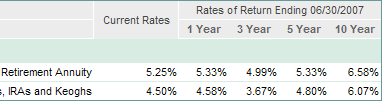
For comparison, the venerable Vanguard S&P 500 Index Fund (VFINX) has a 10-year trailing return of 7.05%, and the Vanguard Total Stock Market Index Fund (VTSMX) has a 10-year return of 7.60%. The Vanguard Total Bond Market Index Fund (VBMFX) has a 10-year return of 5.74%.
Withdrawal Stage
When you reach retirement and are ready to start take money out of your annuity, you have a variety of options. There are one-lifetime income options, two-lifetime income options, fixed-period (ex. 10-year) income options, interest-only payments, and also a few others involving taking a lump-sum or just the required minimum distributions.
Of course, all annuities are simply a promise, not a 100.00% guarantee. In this regard, TIAA does have the highest possible credit ratings from all the major agencies: A++ by A.M. Best, AAA by Fitch, Aaa by Moody’s, and AAA by S&P.
Summary
Overall, it was very interesting learning about this additional investment option. Here were my tentative opinions:
- There is an expected trade-off of lower long-term performance in exchange for a guaranteed minimum return if you purchase this annuity. For those with longer time horizons and the discipline to ride out the market’s ups and downs, it may be better to invest in low-cost stock/bond mutual funds or ETFs instead. Those that are very risk-averse will love this investment.
- The lifetime income options are nice and reliable, but you could also do the same with a portion or all of any retirement portfolio. Just cash out your stocks and bonds, and go buy an immediate annuity with a lifetime payout option.
- Still, if you’re going to buy such an annuity, TIAA-CREF offers some of the best and safest returns along with the lowest fees available in the annuity marketplace.
- As my father is nearing retirement and I think the safety of this investment is very comforting to him, I think this option will work adequately for him. The majority of his annuity holdings are also in the higher-paying tier. I am, however, providing him some guidance in the rest of his portfolio to provide some diversification, as well as telling him what questions to ask his group’s financial advisor.
 The Best Credit Card Bonus Offers – March 2024
 Big List of Free Stocks from Brokerage Apps
 Best Interest Rates on Cash - March 2024
 Free Credit Scores x 3 + Free Credit Monitoring
 Best No Fee 0% APR Balance Transfer Offers
 Little-Known Cellular Data Plans That Can Save Big Money
 How To Haggle Your Cable or Direct TV Bill
 Big List of Free Consumer Data Reports (Credit, Rent, Work)
Just curious, since I’m also a TIAA-CREF investor… I’ve found their fees favorable, and I’ve been happy with my investment options. But have you found their service good?
I wonder, because I’ve found their customer web site lacking. It frequently shows incorrect information about my contributions, not showing transactions that I have made or sometimes showing “phantom contributions” that I have not made. In their defense, the totals always seem to be correct.
I’ve made simple inquiries about my account and had to wait months for a reply. (Like, “If I take a distribution from my Roth IRA through the web site, will it be a principle-first withdrawal?”)
And they’ve botched up a recharacterization of contributions I made last year. At the end of the year I discovered that I couldn’t make Roth contributions and they had to be recharacterized as Traditional contributions. It took them months to do it, and naturally none of it appears correctly on the web site. Finally, they reported it incorrectly to the IRS and it I’ve been waiting for over a month now for a corrected 5498 statement. At least they told me up front that my new 5498 would probably have to be handled manually, and it would take a long time.
I have the bulk of my retirement assets with TIAA-CREF, but I find it less than comforting to endure mess-ups with my account. Really, the one thing you want to know is that your investments are safe (up to the inherent risk of your portfolio selection of course).
Personally, this year I’m making my retirement contributions with another company. I suppose that’s just another kind of diversification.
I had the opportunity to use TIAA-CREF or Fidelity. I chose Fidelity because my RothIRA is there. Also, since I only plan on staying in the education sector for a little while, should I just stay with Fidelity? Or would it be worthwhile to invest a little with TIAA-CREF?
Good timing, Jonathan. I am starting a job at state university next week, and TIAA-CREF is the company they use for their “Voluntary” retirement program (participation in the pension program is compulsory.) Fortunately, my future employer allows me to make my contributions to mutual funds (the CREF side) instead of annuities. I will want to stick with the mutual funds instead of the annuities, won’t I? I’ve checked out their mutual fund offerings and they seem to have performed pretty well and have very low costs. Any help from any poster is appreciated.
I’ve found the annuities to be fine investments, comparable to their mutual funds. I’d not favor one type of investment over the other because of that distinction, but rather on the usual things like acceptable risk and low fees. The only thing special about the annuities is that when you retire you have the option to “annuitize” them (accept an ongoing series of payments that adjusts according to the value of the fund). If you don’t choose to do that, you can just sell your shares and it doesn’t really differ particularly from how you would handle a mutual fund.
I would say about 75% of my investment portfolio is held within their annuity choices and about 25% within their mutual funds. Many people don’t even really realize that they’re buying annuities with TIAA-CREF because the variable annuities behave so similarly to mutual funds.
TIAA-CREF has consultants (i.e. sales people) that can explain it to you. They don’t call them sales people, but they are adamant that they can’t give you investment guidance so they aren’t really counselors. In my experience they can explain (to my satisfaction) how the investment choices work. I asked specifically the annuity/mutual fund question the last time I met with one.
TIAA-CREF is known for having some of the lowest costs/fees. So they are good place to keep your money long term. The investment choices are pretty limited, but offer something for everybody. I feel pretty secure with them, knowing that practically all teachers and universities, along with with health-care workers have TIAA-CREF for their retirement too. If only Social Security funds were handled the way TIAA-CREF handles these assets, it would be in such a good place today.
Maybe they should take over Social Security?
My father’s other investment choices are CREF mutual funds, and I’ve found them overall to be okay, covering the major asset classes without adding too many random vague funds, and the funds have limited turnover and expense ratios around 0.50%.
I just converted my TIAA account of $194k into a variable annuity with TIAA-CREF. I had a high opinion of their low fees, etc. However…
Their documentation and especially their regional sales people (yes “sales” is the correct word) misrepresented the probability that the variable portion of the quoted monthly payment would not change. What was quoted to me in October as $1522/mo. went down to $1483 when the first payment started in January, 2015. No one at TIAA/CREF would return my calls for an explanation until I went thru the office of the Massachusetts Attorney General to get their attention. It turns out they do not record phone conversations with the regional “sales” offices, so their oral misrepresentation was my word against theirs and in the end they refused to change anything.
My advice would be to deal with their office for annuities that is based in NYC and when they say the variable portion “may” change, you should understand that to mean “will” change. As I found out in later phone calls, it always has changed. And in my case the change at the end of December was done so that it impacted my contributions from years ago disproportionately vs. those of recent contributors.
C Schuerhoff
From what I’ve read elsewhere, TIAA-CREF’s fees have actually been going up slightly, which people have theorized is the influence of their newish CEO Herb Allison, formerly of Merrill Lynch.
I also use TIAA-CREF for my 403(b), and I’ve found them satisfactory (I don’t invest in the Traditionally Annuity, however). I have also noticed that their online system leaves much to be desired. I read it is partly because they attempted to make massive changes in their systems a few years ago. Some of their data is still on the old system, which can cause some items in your online account to not match up exactly, although it usually gets fixed eventually.
Jonathan, I am very happy to see you talking about TIAA-CREF as well as others talking about their own experience with TIAA-CREF. Just wonder why no one pays attention on TIAA real estate fund. I have TIAA-CREF 403b acc over 13 years and only recently looked at this fund. It started on Oct. 1995 and the avg return is 9.4% since inception. The beauty is that from day one, no single month losses money. The way that achieves such performance is not like stock market going up and down but rather consistently gain more or less 1% per month year after year. I started watch this fund daily this year and found it has very weak or no correlation with the stock market. So far YTD return is 7.87% and is on track to gain 12-14% at end of the year. However, this fund is not open to everyone but only to qualified people. Hope more people are interested in this fund and bring more detailed analysis. Jonathan, hope you do more though analysis to see if it is suitable to your dad. By the way, I think TIAA-CREF lost it non-profit status some years ago but not sure. The reason I like TIAA-CREF is that the business is not a greedy business and people who has acc are not greedy people either. Just hope the new CEO does not bring Merrill Lynch?s bad business model here.
I actually came back to comment again because I had forgotten to mention their real estate fund (which is actually one of the annuity choices I believe). It really is unique as far as I have seen and I have been glad to have it in my asset allocation.
TIAA CREF has been the investment vehicle for teacher and educator pensions for many years. It is organized as non-profit driven enterprise. Notice their website is tiaacref.ORG For many years they had most of the market for educator pensions, but in recent years they have been losing business to other firms like fidelity. It used to be you could only invest in their products if you were an educator investing through work, but several years ago the offered their products to the public. I was attracted to them because of their history and their low fees. But that has changed with their new CEO. Recent they have withdrawn from the public mutual fund market. They have taken their public mutual funds and combined theim with their institutional fund and they have added a 12b-1 fee to the mutual fund that I own. TIAA CREF claims they were losing money. I’m not very happy with this change.
The product is great – CS sucks big time.
In many areas CS is open till 5pm.
One department does not talk to another.
Takes 4 weeks to cash a contribution check/etc/etc…
Don’t use them if you are easily irriated – otherwise you will drive yourself mad
My husbands retirement was/is with tiaa. He passed away in Dec and I am in the process of getting it switched over to me. We are going on 7 months getting this taken care of. He had a very good return on his money but like Don said lots of problems especially in their tax dept. I am waiting for my 3rd 1099 to be sent because the first 2 were incorrect. No one seems to be able to give me correct information on the taxes I’m resposible for (out standing loans) and what I’m not resposible for. It is so fustrating. I have found many small mistakes in paper work etc. I have not been able to view his acct since February because it needs to be frozen in order to move the money over to a savings and investment. I am considering moving my money away from them and into an acct with someone else because of how inept they are.
As a University employee, I also had TIAA-CREF for my 403b for a few years. Performance was acceptable, and as already noted, the Real Estate fund seemed to be a unique winner. Unfortunately, online service was horrible — interfacing TIAA-CREF with Quicken was nightmarish. I also stumbled upon a university study (can’t seem to find the link now) citing relatively poor long-term performance of TIAA-CREF’s offerings compared to the broader offerings of vendors such as Fidelity and Vanguard. Having other accounts at Fidelity, my switch seemed to be a no-brainer. I’ve been happy overall (except with my Fidelity Real Estate Investment fund, which has tanked since my sinking money into it!), online access is great (but Quicken still has trouble dealing with the fact that both my wife and I have 403b accounts with Fidelity), particularly with Fidelity’s recent introduction of the MySmartCash checking account that further simplifies my life.
Nice thread on TIAA. Thanks for all of the viewpoints.
One thing to keep in mind though is that when you are in your withdrawal portion of the annuity, the gains are taxed at your MARGINAL rate (like regular income) vs the more advantageous capital gains rate. Also, if all of your contributions were in pre-tax dollars, ALL of the annuity will be taxed. Keep in mind that this then locks you in at a minimum tax level then for the rest of your life since your income is now fixed (not saying this is bad, but just realize that).
If you have the discipline, it is better to put the accummulation phase money in regular mutual funds or ETFs then buy an immediate annuity when you want to start the income stream. That way, your gain gets taxed at the lower rates for as long as possible. Yes, that would mean some near term capital distributions, but you are paying this while you still have a job vs when you are trying to live off the most you can with what you have.
Of course, if you get matching dollars by the company, that would have advantages, but I don’t think you’d necessarily want to maximize beyond the match if you really want to optimize your dollar’s performance…
It is nice to see that you are investigating your Dad’s retirement
choices. I have been trying to understand the TIAA Traditional
Annuity and have two specific questions which TIAA have refused to answer. One is what the expense ratio actually is. They argue
this cannot be defined because it is an “insurance product”. One can find on the web from the state universities of illinois that the ratio is 0.45% and from the state universities of connecticut that it is 0.25%. Quite a difference. TIAA will not admit to any number. My second question would be what is the long term (say since 1950) performance of this product. This ought to be public knowledge but TIAA refuses to say. Has your father kept good records? If so he may have the answer. I suspect that this actually is a good product but it is quite bizarre that one cannot find out basic information about it.
It is tempting to think of the TIAA Traditional account as a kind of bond fund, and, even though it holds bonds, it is quite unlike a bond mutual fund. It is an “insurance product” and any money you put there is trapped for 10 years; you cannot simply move money out of TIAA Traditional. So, how do they determine your “yield” — well, they have a committee that “decides.” This is not like the yield on a bond fund, where you get the interest payments on the bonds it holds. At TIAA they may decide to give you a little less this year, just so in case next year’s returns are bad they will have a little “cushion.” In other words, their grandfathered exemptions to all sorts of consumer protections makes them one OPAQUE asset. You can trust, but you can’t verify.
Most of my retirement is in TIAA traditional. In these tumultuous financial times, I wonder about the safety of TIAA in meeting its obligations. I’m a year away from retirement. Granted that they have a great record and the highest ratings. But what does that really mean when they have invested in bonds of all sorts, commercial mortgages, and real estate. It is impossible to get any answer from TIAA except for their usual guarantee of a minimum 3% annual growth. I’d be interested in any insights any one might have and so would a lot of other people I know.
Tom
I am 44 and don’t have the temperament to watch my money drop 70% in value in the stock market. I am now in a money market acct at Tiaa and am really attracted to the guaranteed principal from the TIAA Traditional. Because they have that ten year payout requirement I’m leary about investing b/c it is basically a one way street. I would like to hear your thoughts about whether it is too conservative to take the Traditional Approach for my entire Tiaa account. I like the stability but am I too risk averse for my own good? (Also given the very grim economic indicators, I’m expecting a very very long bear market).
Hi,All,
I am at the place where I need to begin payout from my TIAA-CREF accounts. A retirement specialist mentioned the lifetime monthly payments from my annuity, maximized if I surrender the policy to TIAA-CREF with no beneficiary payouts.
While this is attractive given that I have no beneficiary concerns, I wonder the degree to which the monthly payout for life will vary from the amount given by the TIAA-CREF online calculator. The retirement specialist said that the monthly amount would vary slightly (up as well as down) but did not give a range of fluctuation.
Has anyone taken this option and if so, are you pleased with the outcome? The option has engendered for me a slight feeling of Marlowe’s Faustus and Mephastophilis.
Thanks so much for your replies.
Hi All,
I have heard that Bowdoin College in Brunswick Maine recently decided to stop using TIAA-CREF for their retirement plans for their employees and was switching to Fidelity. The reason seemed to be recordkeeping issues and other unspecified issues. Does anyone know anything about this?
Has anyone gotten any more concrete information about the security of the guarantee of the Traditional annuity I am still puzzled.
thanks,
Jenny
I’m confused to see my TIAA Traditional Account drop over $4,000 in value from last quarter (even as I’m still adding to the account). Is that all interest earned that they are stripping away?
It is interesting to read all the comments back to 2007 particularly the ones that stock mutual funds offered higher rates of return over TIAA traditional. i wonder what these folks would think now after the 2008 -38% decline of the S&P500 and 2009 -20% returns. Proves that you should have a diversified portfolio and don’t believe the buy and hold Kool aide.
As for for Tom’s question of Oct 12,2008 about safety, nothing in live is without risk. We have seen that money market funds can even decrease recently and what’s to prevent the government not honoring FDIC insurance if the federal government keeps going into debt and goes bankrupt like Iceland, Latvia. TIAA says it doesn’t have subprime debt in the Traditional annuity which is one good thing and hopefully no credit default swaps.
Interested in any other comments.
Google around a bit and you will find web pages galore about the disaster that TIAA-Cref has become. Every transaction when you want to get your money out is a nightmare. ANd the returns are not any better than elsewhere. Low expenses seem to mean low ability as well. The annuity payout is simply not as good as others. They are a fraud.
I think Bob makes a good point. TIAA-CREF advertises in multiple venues, Vanguard does not. The CREF stock portfolio has a 60 bp expense ration, almost ten times the expense ratio of Vanguard SP500 fund. The TIAA traditional fund is NOT a bond fund or a fixed income investment. It is an INSURANCE CONTRACT. It does offer a “guaranteed” return of 3%, but you can not withdraw (or move) more than 10% of your money in one year. Still, the worst thing is that they make such information very hard to get — DO YOU KNOW WHAT THE EXPENSE RATIO OF TIAA TRADITIONAL IS? If you do, you are a grandmaster. I am eager to learn the number.
The correct comparison for the Vangard SP500 fnd is not the CREF stock portfolio, which has a significant foreign component and attempts to beat the SP500, but the CREF Equity Index portfolio which would be the equivalent of the Vanguard total stock market index fund. Their expenses are fairly similar.
Keep in mind when you take distributions once that distribution period is over (your life, spouses life or period certain) any money left in the account is not paid out. This means if you have a 100K in your annuity and take a single life payment when you retire. Then get hit by a bus the next day 100K that you could have left to a beneficiary, non-profit, alumni group etc is gone.
I recommend taking the lump sum and rolling it over to an IRA. Use a Financial Advisor or manage it yourself, but the investment and payment options will be much better.
Another thing to remember is that TIAA will make you wait 10 years to get your money out, so start early…..
I have had a TIAA-CREF contract since the late 1950’s (CREF was added the second year). I also had a gap of some 15 years because of a job change and the new institution did not include TIAA-CREF. There are good things and bad things about TIAA-CREF, heavier on the bad side in the last ten years. As noted by several others it is difficult to get information from them and even more difficult to get them to correct errors. If you call the “consultants” they can answer routine questions but know very little about problems or how to handle them. They will not give you phone number to call to get someone who actually knows anything. If you write you will get a response from various people and if you write back the response will be from someone new ad infinitum. It took me more than a year to get them to admit there were some errors on quarterly statements and then they found a convenient way to “fix” them without changing the totals. They have a variety of internal rules that are not published in any of their public materials or in the contracts, you only find out when you run afoul of one of them. It is only in the last year or so that they have admitted that they use “vintages” in the TIAA- Traditional account. You can get a snapshot of how much money you have in each vintage but there is not way to monitor them. There has a lot of publicity about the computer problems they had (and are still having) but they do not want to admit to them. They have also had a lot of turn over in employees, note they are going to outsource a lot of what the Denver office was doing to India. The really big problem is that it is almost impossible to cross check their records since they only report the “unit values” There was a link with a study on CREF stock fund historical expenses but it seems to be gone, it showed that the expenses went up a the wrong time. I used Interest Only income after I retired and up until I was 70 then switched to RMD. The IRS says you must compute the RMD separately for each tax deferred account but then you can decide which account you actually want to take the distribution from. TIAA-CREF doesn’t like that and insists on doing it proportionally (because of changing employers and changes in the laws and other things I have three TIAA accounts, three CREF as well as an SRA. I finally got them to take the RMD only out of the TIAA plans (since I had about 50% in those). It took a lot of arguing however. If you are a participant you will note that they changed the format on the quarterly reviews they now have two items called “additions”, “reductions” but these include internal transfers and hence do not add to the totals nor subtract from them. This is a recent change and replaces something they used to call “other Activity” but which they could not keep straight.
TIAA-CREF is very “paternalistic” (definitely not “maternalistic), they want you to know they are in charge and will tell you what is best for you. They make a lot of noise about fighting for good corporate governance but ignore their own weaknesses. Management is grossly overpaid and participants are not allowed much say
I’ve been with TIAA-CREF for over 20 years and plan on retiring in the next 10 years or so. My wife and I both have Roth IRA accounts with TIAA. Both of these Roth’s have been in place 5+ years, started with the same amounts and have had no additional contributions for the past two years. My account has about 5% more than my wife’s because I invested for a time in equities with positive results.
Here is my issue: We both received separate statements for the first quarter of 2010, both reflected no changes, additions and both were invested in TIAA Traditional. My wife earned about 12% more interest for the quarter than I did, even though we were invested in the same fund and my account held more funds.
This is not the first time I’ve seen abberations in my TIAA accounts and it makes me really wonder what is going on here. If the systems at TIAA are not reliable enough to provide accurate returns for the quarter, how will my actual retirement calculations be affected. I’m thinking maybe we should withdraw all our funds and move to another retirement system, like Fidelity.
tiaa-cref has low fees because they do not offer any advice. so you get what you pay for. thier annuity barely keeps pace with inflation and you also have to look at the taxable consequences in regards to different investment. However, most people do not take that into account. They just look at investment performance when there is so much more to take into account. Which is why financial advisors get paid well for so they can be a resource and provide advice on many different areas including estate planning (along with the attorney), tax consequences (along with the accountant), trusts, time horizons, volatility, guidance to help take the emotion out of investing. It is about a PLAN not the just investments.
The TIAA CREF Traditional Annuity is a fixed annuity, and compared to other fixed annuities is not competitive because it is not liquid and will never be liquid while you are alive. You will always be 10 years away from YOUR money, even if you find something better or you need some or all of your savings.
The interest rate is middle of the road; there are many fixed annuity options with similar credit ratings and have the same additional protection that varies from state to state. TIAA-CREF is not a “safer” option than other highly rated fixed annuities.
I encourage public servants to shop around and do not rely on the “trust me, we love teachers” TIAA-CREF marketing. If you find something that provides equal or better safety, equal or better interest rates and does not deprive you of control of your life savings, then you should take your business elsewhere. There are many, many clearly better alternatives to this investment that, in my view, preys on the trust of public servants.
Ron is exactly right about the ten year period to extract your funds. This is brutal penalty. Even so the idea that the return is “fixed” needs some interpretation. The return is fixed for a year going forward, but that “fixed rate” is changed each year by a TIAA committee. This is pretty much like being told what you will get next year, but … we’re going to keep you money for ten more years … and we will not tell you the return for nice of those. If four guys from New Jersey ran a fund with rules like that, well, they’d be looking at hard time.
Does anyone else have multiple “plans” with TIAA-CREF? I do because of changes made by my employer and also by TIAA-CREF. In the last year or two they have made significant changes in the Quarterly Reports (including the end of the year report). They no longer give an account balance separately for each plan, i.e., the way they do on the website when you select the “Plan Balances” view. They aggregate sub balances in various ways and it is not possible to match the numbers given in the Quarterly Reports with the numbers given on the website (the numbers on the website are transient so you have to try it the evening of the last day of the quarter). I have tried calling the consultants, had written correspondence with them, talked to a local representative and all to no avail. This may not affect anyone who has only one plan and who does not use any of the TIAA-CREF mutual funds or any external mutual funds.
They also insist on calling internal transfers “Additions” or “Reductions” on the cover sheet of the reports (Summary section)
Don, I have experience similar troubles with TIAA and their multiple accounts. I still have the tail ends of six or so. What I did was move as much as I could move to a Vanguard IRA. This was not easy but it was worthwhile. I was then left with some funds in a TIAA Traditional accounts and I set up the 10 year process to transfer this money out. I put this off for about five years, but finally decided it was the only rational thing to do. Finally, with the funds that are left, I just put everything in to the real estate asset — this is only about 5% of my assets and this is the only thing that is unique at TIAA. When the transfer payout annuity has finally emptied out, I’ll move the whole wad to Vanguard. TIAA makes northing easy! Good luck. M.
I have nothing but nightmares in trying to deal with TIAA-CREF. One advisor, in Oct 2008, told me to transfer a portion of my assets to TIAA Traditional until the market stablized and then move them out. She did not tell me it would take 10 years to transfer them out and I specifically asked that question. Another problem I have had is every year they give me a different figure for my grandfathered amount. It’s just one problem after another and the advisors are not well trained and helpful. They just answer phones!!!!
I’m caught in the 10 year payout after I specifically told him I was going to invest the funds myself. I did agree to transfer 20% of my money from CREF into TIAA and he transferred 100% of it.
As soon as the transfer appeared on the computer I called to tell him he did not do what I had requested. His answer was too bad it can’t be changed now.
So Im now retired and can not do what I have been planning to do for the past 43 years.
This is illegal and is is a crime, the only recourse we have is to ban together and fight back. I’m looking for people who have experienced this injustice and are willing to stand and be heard so we can be justly treated. We need the power of numbers.
Jim Woodhull woodhujr@yahoo.com
Pouring through the options available at TIAA-CREF is tiring. My co-worker swears by the TIAA-Traditional fund because its “guaranteed” 4% rates of return and his complete lack of faith in the markets and USD (he actually has an MBA in Finance). I on the other hand do not appreciate the illiquid aspect of the fund (10%/yr) and the insurance contract/annuity terms that I assume can be changed at any point. I spread my contributions across the TIAA-CREF International Equity Fund and TIAA-CREF Large-Cap Value Fund. From what i understand these are not annuity’s, so they carry higher expense ratios of 0.74%. I am not satisfied with any of my choices as these fees are way too high.
Bryan,
The smallest expense ratios on TIAA are on their INDEX funds, many of which are < 0.10%. They have comparable, and in some cases, better returns than the more expensive options such as the International Equity and Large-Cap Value. I recently transferred a bunch of my assets into the lower expense ratio options.
TIAA-Cref does not have to publish an expense ration on their traditional fixed annuity because it is a group annuity contract which is an insurance product. It is not a mutual fund regulated under a set of rules dating back to the 1940’s requiring a prospectus and specific financial disclosures.
Does your bank publish an expense ration on your checking, savings or money market funds? The question as to their expense ratio is not really valid and the answer not very important. What is important is (1) is the yield fair in todays marketplace (I’d say yes) and (2) is the minimum 120 month pay out fair when you decide you want your money? I think this is a major drawback, but it is for you to decide based upon your unique circumstances.
I find that many folks in the non-profit and educational community are not very interested in financial matters so TIAA-Cref has found a nice quiet home where few questions are asked and the competition thin. If this is all your employer offers, thats the way it goes. If you have other choices, spend more time reviewing your goals and retirement plans. If you can’t figure this stuff out or don’t care to, get qualified professional help, not the guy down the hall or your brother-in-law. Finally, expenses are NOT everything, results are.
TIAA-CREF are the biggest scam ever. Why invest in ONLY CREF mutual funds when there are 30,000+ mutual funds to choose from?
Also, why invest in their TIAA Annuity when you can do the same thing yourself? When you need to access your money they only allow 10% to be distributed every year so you have to wait 10 YEARS to get your money out!!!
IT’S A HUGE SCAMM!!!!!!!!!!!!!!!!!!!!!!!!
I am shopping for annuities and since I have worked for universities and nonprofits, I am eligible for TIAA-CREF even in their non-brokerage products, but I’m not a customer. So I called them. After a very long time on the phone and being transferred around to different reps, the last rep I talked to finally admitted he just didn’t know enough about their annuity products to answer my questions. He was able to give me one quote, on a level-payment, lifetime fixed annuity, but when I asked about options like gradually increasing payments and guaranteed minimum time period of payout, he just didn’t know. The quote he gave me on the level payment option was not competitive with quotes I have gotten from Vanguard and Fidelity. He said he would have someone call me who knew more. I’m still waiting, days later. The contrast to Fidelity couldn’t be more stark. I have dealt with Fidelity since the 1980s and have been amazed at how helpful and well trained all their people are. Usually any question I have is answered quickly in one brief call. In the few instances where a callback was required, it came promptly. TIAA-Cref should get its act together.
You mention that you are “eligible” for TIAA-CREF products. Do you mean that you are employed by an organization that contracts with TIAA-CREF for its retirement program? TIAA-CREF is now open to the public but I don’t think things are exactly the same for public customers. If you are in a retirement program with TIAA-CREF through your employer you would get a 403(b) or a 401(a) plan but as just a public member you would have to do it through an IRA. Even then the arrangements are slightly different than for retirement plans. TIAA-CREF refers to various products as “annuities” but that may be mis-leading. The actual annuitization only takes place later, at least if you are in a retirement plan. Note that the employer may also have put some restrictions or choices into the plan (they are not the same for every employer). At least through a retirement plan TIAA Traditional has severe restrictions on how you get money out, annuitization in one way but you would have some choices even then but they all start from what is called a “single life annuity”, that means you get an income for life and there is no residual or beneficiary when you die. If you want things like a guarantee for certain number of years of payments that will reduce the income, if you want a beneficiary to receive a fraction of your income after you die that will reduce the income to you, etc. You income will depend on your age at retirement, balance in your account, interest rate set in your contract and supplements determined annually by TIAA-CREF. The interest rate during accumulation is not the same as the rate after retirement. If you get TIAA Traditional through an IRA the accumulation interest rate is less than if you get it through a retirement plan. I don’t know about just “buying” an annuity through TIAA-CREF, that is not what you do if you are in a retirement plan.
I think you ought to be able to find a lot more information on TIAA-CREF’s webpages but the key question is whether you are in a retirement plan or just a member of the public. I think you will find that the consultants are mostly prepared to answer questions (not give advice) for participants, i.e., those enrolled in a retirement plan.
I am a bit confused by the guaranteed return rate on my TIAA-CREF Traditional Annuity. It was my understanding that the trade-off for investing in this annuity with such low returns instead of putting your money in more aggressive investments was that your principal was guarateed and you were guaranteed a minimum 3% return on your investment. When I look at my quarterly statements, however, the return on my investment has been less than 3% (2.6% and 1.9% for the last few quarters). How is this possible??
You need to check your contract, older contracts used 3% but more recent contracts are for 2%, these are the so-called “guaranteed” amounts. In addition they declare a dividend essentially each year (usually valid for a year), i.e. an additional amount of interest.
In addition they will divide up your holdings in TIAA Traditional into “vintages”, these depend on when the contributions were made and the credited interest rates differ for different vintages. If you ask they will tell you how much you have in each but that will be just a snapshot since they change constantly, i.e. credited interest will go into a later vintage than the principal on which the interest was earned.
Ask them to explain, there should be a counselor come to your institution at least once a year and you can get an appointment to talk to them.
Personally I think that TIAA-CREF is no longer a good reliable institution and I am moving all my monies out, am just starting the Transfer Payout Annuities to do the last part now. Unfortunately it takes 10 years to do it.
Too many mistakes in the records, too slow to process things and poor investment choices (my former employer made big changes last summer (2011) that greatly restrict my choices
Susan: These are quarterly returns, not annual “guaranteed” returns.
Donald, thanks for the info- very interesting, it was my understanding that I was investing at the 3% guaranteed rate. I will definitely contact TIAA-CREF to into this.
Bryan- Unfortunately those were not the quarterly rates- my quarterly rates were in the 0.6% range.
I agree with Don. Long ago TIAA-CREF was one of the best available but now their fees (direct and indirect) are not competitive with Vanguard. They may look “modest” but they are twice as high as the competition, so why pay — and get poor service, etc.
The real problem about TIAA traditional is that you are not told what payouts will be in future years. The return is determined annually by a committee. It turns out that TIAA Traditional is actually a very complicated instrument — more complex than a fixed annuity and more complex than a bond fund where you know that you are getting your fair share of the actual financial results. I started withdrawing my funds 7 years ago and I am pleased that I will be out in 3 more years.
Good funds don’t put that kind of handcuffs on your money.
NEED PARTNERS FOR A CLASS ACTION SUITE
WE NEED TO GET WHAT WE WERE PROMISED
I just retired from 43 years of faculty service with SUNY and spent several hours talking to my retirement rep. I told him how I was planning to use my retirement money to make investments myself. He was adamant that I should move some of it into a bond fund offering a low stable rate of return which would be paid out over 10 yearly payments. I have had a small portion of my retirement in such a fund during my career, so I agreed to have 20% moved into that investment. I checked my account for a few days and was horrified at eventually find he had moved 100% of the state contribution into that fund locking most of my retirement money up which would not allow me to use it for self-managed investing as I had told him I was planning to do. I was furious and called him and everyone else in the company I could find. They all told me it was too bad and it could not be changed.
I have contacted an attorney who specializes in class action suits and He believes there is a good winnable case here. We are looking for any people that this has happened to who would be willing to participate in in this suit. This is worth many thousands of dollars to those of us who have been caught in this situation. Why should we give decades of faithful service only to allow these greedy people to steal our hard earned retirement money for their own benefit??
Jim Woodhull, woodhujr@yahoo.com or 516-658-8381
Jim Woodhull: Are you talking about a “tiaa-cref-traditional-annuity”, the subject of this thread, or some other plan? Please clarify.
There is no “tiaa-cref-traditional-annuity”, tiaa is an insurance company It with two investment choices, one of which is “tiaa traditional”. it does not become an annuity until you “annuitize”, usually at or after retirement. cref is a separate investment company and has its own list of investment choices. In general you can move money from one cref investment choice to another or even to tiaa traditional. BUT once it is in tiaa traditional you have limited options (see prior comments about “ten years”). When tiaa was first established, “tiaa traditional” was only an annuity, there was no other way to get your money out then the “transfer payout annuity” (see “ten years” comments) and Required Minimum Distribution (like an IRA) were added as well as “Interest only” (only useable to age 70). Your employer (present or past) may have restricted these, in particular you must have terminated employment
Dan – suggest you read the post I was replying to. I’m very familiar with “TIAA-CREF Financial Services” and have a lot of money in the “TIAA Traditional Annuity.” I’ve read your posts, as well as J. Michael Steele’s, so your confused paragraph above is not very helpful. I was interested in finding out what “class action” the original writer (Woodhall) had in mind. I presume it was NOT related to TIAA (so it should not have been in this thread.” I have issues with the way TIAA computes interest and think it COULD be an issue for “class action”. My estimate is that they short changed their customers on the order of 10 billion dollars over the years. Yes that’s with a B.
There seems to be a lot of confusion about the expense ratio. The TIAA Traditional Annuity is not a mutual fund, so it does not have an expense ratio, as defined by the SEC. It is an insurance product, so it is regulated by the insurance commissioner of each state in which it is offered.
You can calculate its expense ratio from the insurance filings, which are posted on the TIAA-CREF web site. For example, the 2013 annual statement shows that TIAA has assets of $259.5 billion, general insurance expenses of $982.7 million, and insurance taxes, licenses, and fees of $52.5 million.
This works out to an expense ratio of about 0.40% across all TIAA insurance products. This does not include CREF, which is reported separately.
Finally an intelligent answer by someone doing some due diligence. As stated it is an insurance product and thus doesn’t have a published stated expense ratio. Also it is true that some contracts have liquidity restrictions. RA contracts roughly 9 years and GRA contracts 5 years. It is important to note that TIAA was initially started as a “pension” for retired teachers, not much different than today’s defined benefit plans. TIAA-CREF participants have far more options for investing today which has evolved into variable annuities and mutual funds to compliment the TIAA insurance component. With longevity an ever increasing concern of new retirees one may pose the question isn’t a hybrid retirement plan an attractive option? The TIAA can act as a guaranteed income that will last a lifetime, similar to a defined benefit pension plan, and the CREF remains an investment account from which you can take discretionary distributions or adjust investments to meet market conditions. After all everyone’s concern is will I run out of money and even if you had $300000 in the TIAA annuity would you take it all at once? I’m not sure about other people but I plan to be in retirement 25+ years and I’ll take the payments just as long as I’m still around. Bottom line understand your investments plan accordingly and enjoy retirement. As a side note TIAA is second only to social security in providing monthly retirement checks. With that I’ll just wait for next “pension” check to arrive next month
I have both CREF and TIAA Traditional Annuity from a former employer, am two years away from earliest retirement, but face a short life expectancy due to a recent cancer and high likelihood of recurrence and death within 10 years. So that 10-year payout biz really burns me. Are there any other options for someone like me? Will my heirs simply see my retirement funds vanish?
I think that you are mis-understanding some of the features of the TIAA Traditional Annuity, at least your reference to “10-year biz”. One possibility pertains to the use of a Transfer Payout Annuity which is simply a mechanism for moving money out of a TIAA Traditional Annuity contract into CREF. A second possibility might be to the use of a 10 year certain option when actually annuitizing a TIAA Traditional Annuity contract. The first pertains to a decision to change how your retirement monies are invested but does not fix how you or your heirs will receive benefits. The second only pertains to a decision you might make after retirement or at the time of retirement but not before. As always you need to check to see what constraints have been written into the contracts by your employer, i.e. between your employer and TIAA-CREF.
In general your heirs benefits are not determined until you annuitize (assuming you make this choice) and that can not happen until you retire. If you are deceased before retiring then benefits to heirs depend on how you have specified the beneficiaries and/or what your will specifies. The one way your retirement funds might “vanish” is if you annuitize everything you have at TIAA-CREF with a single life payout and do not include any guaranteed payout periods (e.g. 10 year certain). If you are married you can’t choose this without your spouse’s signature. TIAA-CREF has an information kit for beneficiaries that you or they could get. If you are residing or live near a city with an employer using TIAA-CREF there should be a T-C rep making regular visits there and you should be able to schedule a talk with them on a subsequent visit.
My terminology may not be accurate but the bottom line is they have fraudulently taken my retirement and all I can access is 10% a year over ten years. The rep did this after I spent an hour telling his I had other investment plans for the money.This is a fraud and I don’t want anyone else to get caught in this.
I have an atty willing to start a class action suit but wants a dozen people to represent to make it worth his efforts. So anyone this has happened to please contact me. Jim 631-494-8696 or woodhujr@yahoo.com
A friend has TIACREF traditional and there are some very strict rules. First of all, all money that accumulates in TIACREF traditional has to STAY there and can’t be moved into equities or anything else – EXCEPT for 10% a year. An annuity holder CAN decide to stop contributing tomthe annuity and put all future contributions in equities but whatever is ALREADY in the annuity can’t be transferred to an equity fund in one lump sum. It can only be transferred at a maximum rate of 10 percent a year.
Another thing ? Once the annuity holder reaches age 70 and 1/2 the funds MUST ALL be taken within 10 years. Of course, they can then be rolled over into other investments but still this seems like a strict rule for an annuity that gets a guaranteed rate. Why can’t it stay in the annuity? Why can’t the accumulated funds be rolled into another annuity in one lump sum?
Majdio1 please read various prior comments and replies. It is true that TIAA Traditional has some severe restrictions but they are neither as restrictive as you suggest nor as simple. First of all it is not TIAA-CREF that requires some actions at age 70 1/2, it is Federal law as enforced by the IRS but the law certainly does not require taking all funds withing 10 years. You didn’t say but I am guessing that your friend has an employer sponsored retirement account with TIAA-CREF (IRS codes 403b or 401a). In any case there will be two separate contracts, one with TIAA (which is an insurance company) and CREF (which is more like an investment firm). At age 70 1/2 you would have several possibilities for receiving benefits: (1) you can annuitize all of the holdings (both TIAA and CREF) or only some fraction(s). The basic form of the annuity is a single life but there are also a variety of options (benefits for a survivor which can come in various forms, guaranteed payments for some minimal number of years, etc). You can also exchange some or all of the holdings for a Minimum Distribution contract (MDO) (this like annuitization is not reversible)). The annual fraction of the prior 12/31 balance that must be taken (like RMD for an IRA) is determined by your age at the end of the payout year and the table from the IRS. It will change each year. Your can take monthly, quarterly or semi-annual or annual payouts. You can move monies in TIAA TRADITIONAL to CREF but not in a lump sum, you must set up a Transfer Payout Annuity (TPA). This can be for all of your holdings in TIAA Traditional or only a fraction. It will transfer 10% of the specified amount each year from TIAA Traditional to CREF. I have done this twice and did it within an MDO contract. Once the funds are in CREF you have (depending on your prior employer) various options for changing the investments in CREF or for making a rollover to an IRA or even a lump sum withdrawal (the later is likely to be costly in terms of taxes). The IRA could be at TIAA-CREF or some other financial institution. You can find more information either on the TIAA-CREF website or from a TIAA-CREF advisor (it helps to know the right kinds of questions to ask). Also check the actual contracts from TIAA-CREF since they can differ from one employer to another. TIAA-CREF tends to refer to all of its contracts as “annuities” but they don’t actually become annuities until you retire an choose to “annuitize”. The phrase “10% a year” is mis-leading and not correct. Likewise the phrase “rolled into another annuity in one lump sum” is mis-leading and not correct.
The reason the money is locked up for ten years is because the management does such a poor job they are trying to keep the funds from leaving to better investments. After talking to my rep for several hours about my retirement plans to remove the funds and management it myself, Courtney Foster in Melville, NY decided to move ALL my retirement money into this account which has locked it up for ten years. I am now retired and can only access 10% a year, this is stopping me from making the investments I want to. This is costing me a fortune in unrealized gains. These funds only make about 4% a year, I earn in excess of 4 times that with the funds I invest myself. So the bottom line is they lie and steal my money so they can make large commissions and fat paychecks at my expense. Be VERY careful, they are thieves and they are trained to do this by the administrators. I am gathering facility members to join me in a class action suite to stop this illegal and unethical practice TIAA-CREF is engaged in. Contact me and join the fight to protect our retirement funds. woodhujr@yahoo.com 516-658-8381
You say that you are retired but don’t give your age, i.e. are you 65 or older? I won’t dispute some of your opinions about TIAA-CREF but please be factual about the options you have. Unless your former employer has some restrictions you can move all your monies out of CREF investments into either an internal IRA or an external IRA (not just 10% per year). However any monies you have invested in TIAA Traditional are restricted; (1) you can move some or all of it into a Transfer Payout Annuity which will move 10% per year into CREF (from there you have other less restrictive options). (2) you can move some or all of it into a Minimum Distribution Option contract, you will get money out each year based on the IRS RMD tables or (3) you can do some combination of the two other possibilities. You can also “annujtize” some or all of the TIAA Traditional investment and get a lifetime pension (with various options). The advisor should have been able to explain this to you. The argument that TIAA has used for years with some justification is that TIAA Traditional has a guarantee on the interest rate(s) and the monies are invested in long term/less fluid securities and real estate. Unfortunately most of us do not think about the restrictions until we reach or are approaching retirement. TIAA is an insurance company, not a financial institution so it operates under different rules and laws. I made the mistake of putting all of my annual contributions into TIAA Traditional because the market was down, fortunately I realized that was not a good choice and changed it but I still ended up with a sizable fraction of my total TIAA-CREF holdings in TIAA Traditional by the time I retired. I have been undoing this by using both TPA’s and MDO contracts. Finally note that “TIAA Traditional” is the name of a specific kind of investment and the restrictions on it do not apply to CREF investments, e.g., STOCK, EQUITY INDEX, GROWTH and a host of mutual funds offered by CREF.
Replying to Jim Woodhull: I’m not happy with TIAA-CREF either. I started contributing in 1973 and accumulated a million over the years. TIAA-CREF **WAS** a good outfit for many years. In fact it was an early leader and innovator in the professionals’ retirement savings field. But they lost it in the last 20 or so years. Now Fidelity, Vanguard and others are the leaders. My former employer (.edu related) formally fired TIAA-CREF a few years ago and hired Fidelity in their place.
My big issue with TIAA is the way they compute interest – they are deliberately misrepresenting their rates and shortchanging their members – to a tune of about 10 billion dollars to-date. See my comments of November 12, 2014 above. From much more thorough, ongoing, and uncensored discussion of TIAA-CREF see: socialize.morningstar.com/NewSocialize/forums/100000044.aspx .
That said, Jim, though I agree with you in principle that TIAA-CREF is bad, most of your discussion above is confused and often incorrect. Donald Myers’ comments are absolutely correct. He’s so “dead on” that you’d think he is a TIAA-CREF employee, but I don’t think he is.
No, TIAA-CRRF wouldn’t claim me as an employee. I have just had a lot experience battling with them, dating back more than thirty years. My university did not get into TIAA-CREF until 1975 but at least as far back as 1960 it paid salaried employees twice a month. At some point I realized that TIAA-CREF was only crediting contributions once a month instead of twice and moreover my university was delaying sending in the contributions sometimes as much as three or four months. TIAA-CREF kept referring to contributions as “premiums” with a “due date” and if “premiums” were no more than a month “late” they back credited them. It took several years to get TIAA-CREF to credit contributions when they were actually received and to get my university to send them in immediately after pay day.
For various reasons I have three sets of contracts, two are 401a and one is 403b. Then about nine years ago I set up the first set of TPA’s (last payment will be Feb 2016) and then later another set (last payment November 2022). If I look at my account on the website I see the balances (and details) for each of the nine contracts but the format of the webpage does not match the format of the quarterly reports because in the quarterly reports they aggregate the two 401a’s. I have complained endlessly about this but still no change, It was further complicated by the fact that for awhile I had some monies in outside mutual funds and the Quarterly Reports aggregates across all three contracts so again can not match website with Quarterly Reports. Now I just make sure to “print” the website listing the evening of the last day of the quarter. If you look at the cover sheet of the Quarterly Reports you will see it shows “additions”, “subtractions” without differentiating between contracts and without distinguishing between monies actually being added to the accounts or monies being removed vs simply internal transfers. Again I complained endlessly but to no avail. Unless you ask they don’t tell you how much of your TIAA Traditional is in the different “vintages”, in fact many participants may not know about vintages at all but it affects the interest rates, Since I am also using MDO I will be nearly completely out of TIAA-CREF by November 2022. When I did the first big rollover to a Fidelity IRA in 2011 it took three months and endless telephone calls and emails to get it done.
Donald Myers: thanks for taking time for an extensive reply. Just two notes: first, the TIAA-CREF website gives a detailed listing of the vintages. Under “My Accounts” click on the account that has the “Traditional” holding; then click on the “view interest rates” link; and then click on the + in front of the plan name. The dozen or so vintages will be displayed. They don’t tell you which is “grandfathered” and which is not, or what part is paid vs. earned – there can be 50 odd parts to your single holding, but that’s another story. Second, I have had very good experience moving TIAA-CREF 403(b) funds to Vanguard or Schwab IRA’s. I’ve done three 1/4 million size transfers. The agent sent me the forms by email, I filled then out, signed, notarized, and uploaded them for processing. My TIAA-CREF rep called me advising me not to do it, but the transfers went through in 3 or 4 business days, start to finish.
I still have large “Traditional” and “Real Estate” holdings at TIAA. These are hard to top anywhere else. But all my equity holdings are now elsewhere.
I have to agree. I have three different Traditional contracts and https://shared.tiaa-cref.org/private/partaccounts/tiaainterestrates/summary clearly lists vintages and interest rates. It’s a giant mess, I’ve only been a client for 3 years and I have 13 vintages, but it’s simple and accessible. The website (and backing IT infrastructure presumably) has gotten *much* better over the 3 years too so some of the early issues in this might have been solved at this point.
If your’e a Dave Ramsey fan I’v been wondering if TIAA CREF, is considering a ‘separate account manager’ which he is against when you can go direct. I personally did not like the tone the TIAA CREF person used with my friendly toned financial staff on the phone together. The strange thing is there had been no conflict whatsoever, maybe the guy was meant to be a trial lawyer.
Appreciated the notes here on challenges with getting retirement money after a spouse passed and other threads.
Next I’m looking into the costs of say Fidelity or preferably Vanguard (since I’m with them already) and TIAA CREF. I’m assuming if I can go direct with Vanguard it will be cheaper than going through TIAA CREF if indeed CREF is a so called ‘separate account manager.’ Why would I pay a portion of my money to TIAA CREF to invest in another company that allows me to invest directly for free?
In my case I can use Financial Peace University and Baby Steps/Money Makeover texts to guide me and those say: stay away from annuities and stick to mutual funds with large companies (though I’m a fan of the less profitable social justice funds I’m not yet an owner) and if you have or are a specialist: real estate.
So meanwhile I’m researching the cost of my TIAA CREF retirement portfolio versus if I went direct to say Vanguard and yikes…I do seem to see on my statement what some writers have noted: I have an annuity. I thought I had a mutual fund.
Well I’ll go back to learning what Dave Ramsey says about annuities but I’m pretty sure he’s consistently against them.
Meanwhile is the ‘distribution rate per share’ the cost to me? It seems to vary from 0.58 to .003 for the Lifecyclefund. So perhaps that is what I would compare to say a Vanguard mutual fund.
Very confusing as I know in the past I also had Vanguard on my statements for the same retirement money.
I know in the end I can call TIAA CREF of course to learn how to ‘read’ my statements for the costs to me.
See What Dave Ramsey has to say on annuities: of ALL kinds…https://wordpress.com/post/ourfarmhouseblog.wordpress.com/1228