One of the basic ways to adjust the risk and return characteristics of your investment portfolio is to decide what percentage to hold in stocks and bonds. This is another one of those hard questions for which there is no single best answer for everyone. You must take into account risk acceptance and time horizon amongst other factors.
An old rule of thumb is that your stock allocation percentage should be 100 minus your age. That is, a 30-year old should have 70% stocks/30% bonds, and a 70-year old should have 30% stocks/70% bonds. This was not just taken out of thin air, and has a basis from historical returns. As you near retirement, you want to have more bonds as that reduces overall volatility. More recently, others have altered this to a more aggressive “110-age” or even “120-age”.
Members of the Diehards investment forum recently performed a informal survey of member’s asset allocations versus their age, and here are the results:
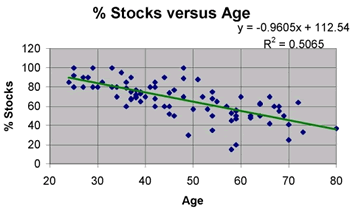
As you can see, there is definitely a lot of scatter in the data. However, if you made a linear fit, it roughly corresponds to a formula of stock percentage = 112.5 – age.
This made me curious – what about all those Target Retirement Funds? Their job is to decide an asset allocation that works for as many people as possible based on their retirement date. If I assume that people retire at 65 years old, here is what the asset allocation versus age looks like for three of the more popular fund families: Vanguard, Fidelity, and T. Rowe Price:
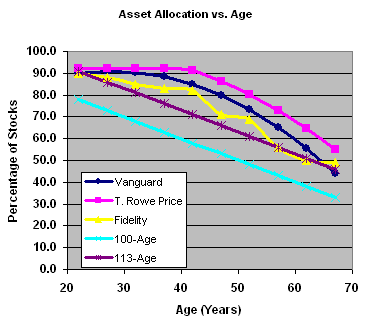
As you can see, the funds are actually pretty aggressive. (I covered previously how T. Rowe Price is more aggressive than Vanguard.) If one did force linear fits for all three fund families, it would correspond roughly to stock percentage of 119 – age. However, they don’t really adjust linearly with time. If I use a 2nd order curve fit instead, I can make a little tool that estimates their stock percentages for any age:
None of this is investment advice, it’s just an observation of what’s out there. Next, I’ll try to find some historical return and standard deviation numbers for another view of how to answer this question. What do you think of all this?
 The Best Credit Card Bonus Offers – March 2024
 Big List of Free Stocks from Brokerage Apps
 Best Interest Rates on Cash - March 2024
 Free Credit Scores x 3 + Free Credit Monitoring
 Best No Fee 0% APR Balance Transfer Offers
 Little-Known Cellular Data Plans That Can Save Big Money
 How To Haggle Your Cable or Direct TV Bill
 Big List of Free Consumer Data Reports (Credit, Rent, Work)
great post, very interesting analysis! The majority of articles I’ve seen recently mention 120-age, so I guess the target retirement funds are closer to that.
Yes, but what should the non-stock part of your asset allocation be? There’s a big difference between 70%stocks-30% cash and 70%stocks-25%bonds-5%cash!
The other point is that this really only applies to your retirement investments – for example, in my case I hope to have more than I need for my retirement, and keep most of my total portfolio aggressively invested during my retirement, so that I can pass on a decent estate to my heirs (whether or not this is a good idea is a totally different questions!). In my case my overall asset allocation would be more aggressive that the above target-date allocations, as only a part of my total portfolio is earmarked for funding my retirement.
Nice job on the analysis and the calculator!
These levels seem pretty aggressive to me. 75-80% stocks at age 50? Better hope the bear market of ’73-’74 doesn’t rear its ugly head… or retirement will be a late 70s sort of thing.
I’m really sorry for the comments being down for much of today. Hopefully I’ve fixed the problem!
There isn’t that much difference between 30% bonds and 30% cash. The historical premium for long-term bonds is at most 1.5% over T-bills. Compare that to the premium of 6.5% or so for stocks.
So 70% stocks/30% long-term bonds is about the same as 77% stock/23% T-bills.
Good post! It would be interesting to compare your “% Stocks vs. Age” chart with the corresponding rate of return each respondent had for that year and then calculate the risk of say a 30/70 split compared to a 40/60 split and if it would really be worth it to have that extra 10% in stocks. Similar to what you did in your “Fidelity MyPlan: Should Good Savers Invest Less Aggressively?“post.
Great analysis!
Interesting post!
I noticed that most of the Diehards seemed pretty heavily invested in Value rather than Growth, and looking at your portfolio, you seem to also emphasize Value. Any reason why this is, other than Value doing well the last few years?
Just leaving a comment to subscribe to future comments.
I think the allocation should be depend on the stock market instead of your age. In an extreme example, if the stock market is as safe as bond, why not always put 100% in the stock market all the time.
I don’t know about the world stock market, but for the US stock market, a cycle usually last 4 years. So I will ask myself this question: What % of my money can be put away at least 4 years without needing it. I am 30 years old and I have no plan of buying a house soon, my answer would be 80%. Then I will put 80% of my money into the stock market.
Hmm… I guess it is related to age because age usually affects the % of money you need within 4 years.
Call me a broken record if you will, because I tack this comment on every conversation about allocation. If you are a careful reader of Bernstein’s “The Intelligent Asset Allocator” you can’t help but miss this profound lesson: the ‘efficient frontier’ is essentially impossible to calculate. Whether you go 85%/15% or 60%/40% is not an easy question to answer, and it probably isn’t too important to worry overly.
They key to benefiting from an asset mix — to boost return and reduce volatility — is to rebalance regularly (i.e. about every 1-3 years). Without rebalancing, the benifits you hope to gain from asset allocation are greatly diminished. Actual allocation is very likely to be less important than rebalancing discipline.
That probably puts the lifecycle funds ahead of most individuals. I wonder how many of us look at the ‘dud’ portion of our portfolio and think, “Oh yeah, I should rebalance and dump more money in there, because that investment sucked for the last 2 years straight.”
I like the lifecycle funds for this, as well as the TIAA-CREF account feature ‘rebalance on my birthday.’
What if you think the 120-age formula is the correct one and now you’re opening up a trust fund for your newborn? Do you borrow money to put into stocks in order to get a negative bonds allocation? 🙂
I have a problem with the lifecycle funds because I’m saving for several different *continginces*.
Here’s the situation: I’m in California where only an idiot would get into real estate for the next few years, but it is likely to become a sensible purchase at some time. If I save more in a 401k at this time I get a tax break and increase the chances of (a) an early retirement, (b) a luxury retirement, or (c) having real estate funds at a later time. [I wouldn’t withdraw from the 401k for housing, rather reduce my contributions.] Plus, I’ve got a pension. So, my 401k is super aggressive.
We’ve got general savings and Roth IRAs set up as income funds, for it’s easier to withdraw the deposits should we move or should the housing market change.
So, the money I won’t need for 25-35 years is pure stocks, but the money we may want access to is mostly cash and bonds. It is impossible to put an exact number on the “retirement” stock/bond split because we’ll change how we use our money as circumstances dictate. For most time periods and locations, where houses begin at less than $500K-$700K, these splits may make sense.
Don’s comments brings two thoughts to mind
a. If you go with the theory that the efficient frontier is hard to predict for the future, and that 85%/15% or 60%/40% makes not too much difference to your long-term ROI, then I’d have though this makes rebalancing LESS important (or at least less frequent). For example, if you start out with 70% stocks, you could easily go more than 1-3 years without your asset mix dropping below 60% stocks or above 85% stocks. BTW, if you’re adding to your investments anyhow (eg. retirement savings) you can just adjust the weighting of your future investments to correct your overall asset mix, rather than actually rebalancing.
b. I wonder if “overbalancing” (is there such a term?) is worth considering as a strategy? ie. when you check your portfolio to rebalance every 1-3 years, instead of bringing the mix back to your target allocation, you actually overweight your asset mix towards the asset class(es) that had underperformed since your last rebalancing eg. if your asset mix started out at 70% stocks, and 2 years later when you want to rebalance it has had a bull run and is now 80% stocks, you rebalance back to, say, 60% or 65% stocks, rather than just bring it back to your target allocation of 70%. I suppose this could be called “chasing loosers” rather than “chasing winners” 😉
When Bernstein pointed out the futility of hitting the efficient frontier exactly, he argued via backtesting. I don’t remember the exact timeframes, but the argument essential boiled down to this: you can find 20 year windows where wildly different allocation strategies were optimal and no one knows the future.
If it were always close, i.e. 80/20 vs 85/15, you could still make a good rule of thumb. But in some periods 20/80 was optimal, etc. I found the comment notable, but what really cemented it home for me was discussing it with a colleague. I teach math at university, and my office neighbor had tried also to calculate the efficient frontier for himself and came to the same conclusion. You just can’t know.
What is true is that all of the (long) periods benefited from rebalancing with lower volatility.
MossySF- actually I had my sons retirement fund invested in a geared share fund from age 2 (he’s now 6), so he was effectively 120% (or more) invested in stocks 😉 I’ve recently chickened out from this position and shifted him into a more balanced asset allocation – after three years of bull market in Australia he’d accumulated about ten years worth of “typical” stockmarket ROI in only three years, so I decided to “lock in” the profits. I’m still a sucker for attempts at marketing timing!
Nice calculators!
My 401K is 100% stocks. I still don’t know enough to say something. but i’ll keep following your posts. you make investment charts and graphs look fun!
Enough Wealth – There is definitely a ton of options within both stocks and bonds.
Al – I agree!
Bill – There is a historical performance premium for Value stocks vs. Growth stocks from as far as 1926-today. If that premium will persist in the future and why it exists at all is a matter of active debate. Many Diehards (but not all) believe it will persist.
MossySF – There are always those leveraged ETFs which try to get you 2x the market return (and loss) 😉
John – I agree, I have separate cash building up for a house, and I do not consider it part of my retirement portfolio. However, I don’t hold any of that money in retirement accounts. Maybe if I had more room.
Don – You are very correct about rebalancing. I am trying to gather some info about it in time for a post when I do my own annual rebalancing 🙂 It seems like people vary from encouraging re-balancing every 6-months to 3 years. That’s a pretty big difference. Also, there is “active” rebalancing when an asset class exceed the target percentage by a certain amount. What to do, what to do…
I think the best guide is your ability to sleep. Sort of a gut reaction. If you can sleep with your stock proportion in your portfoliio, it’s probably the right one for you. I recently managed to puff my portfolio up to slightly over a million. I’m 72 years old and my proportion was about 45% stocks. Suddenly I got real nervous and sold all 13 issues and mutual funds. Then I got very neurotic over not having enough with a chance to grow like stocks can grow. Anyway, a big dip on June 10,2007 allowed me to jump back in after 6 weeks of bad sleeping…strictly in VTI, SPY and UFH exchange traded stocks. Somehow, my new, more conservative approach has improved my sleep quality. Also, I put only 39% in stocks…..just enough of a decrease to give me more serenity. Plus the market turned and I made $9,500 in three days. Nothing like a little profit to help you sleep better.
A response to enough wealth:
I read a lot about rebalancing my porfolio and keeping my asset allocation. I use the 115-age. I am 41, live in expensive southern California, and will have a defined pension, plus 457, brokerage account and savings.
My question is: Is it better to rebalance your porfolio every year or so OR dollar cost average your regular deposits to continually rebalance?
I stumbled on to this looking for a to determine what percentage of a portfolio drives performance over time. The posts that I have been reading are great. I don’t know much, so I am interested in reading more when new post come out.
This is a great blog!
Would you mind publishing the fit behind the calculator?
Thanks!
we are students and we are wondering how you find the percentage of your portfolio in stock market thx.
You must make your own decision….if you think the market is overvalued…HOLD…dont reinvest your divs. If you think the market is undervalued or correctly valued….BUY(if you can). Never sell! Then when you die….your kids can get the step up in basis.
For me…I believe the market(DOW) is right where it should be. If you start at 1920…then 1930…then 1940…etc etc and project the annual growth of the DOW from each starting point to today….you will find that the avg growth is 6-8%.
Don’t chase high divs or buy small companies that are unproven. Instead…
stick to the big stocks that pay the 2-4% dividends. You wont find that at your local bank I guarantee ya! This country is so far in debt if they raise int rates they will bury themselves with more and more debt. True…inflation would cause rates to rise but the whole damn world is so screwed up economically that all currency’s are in trouble. Contrary to all the daily scare tactics…rates are going to remain low for years to come. Watch…see and learn! Dow 20K before dow 10K….mark it!
Just wanted to say that this article brought up something interesting that I hadn’t thought about. Of course the retirement funds would take a more aggressive route than a normal age allocation plan, they are managed by “the best” so they can afford to be more aggressive (sarcasm). Just another reason that more people need to check out their 401k plans and see what their funds are actually doing instead of blindly putting their hard earned money into it. Obviously with employer matched contributions there is no reason not to take advantage of your 401k or 403b, but just know what you’re investing in through them. Nice graphs and I am also a DIY investor if you couldn’t tell haha.