Archive for January, 2012
Monday, January 23rd, 2012
If you have a Hilton HHonors number, a cell phone that accepts text messages, and a Visa card, you can register at visa.com/hiltonhonors to receive promotion text messages and get 1,000 HHonor bonus points. You can earn another 4,000 points if you spend $100 on your linked Visa card at any Hilton-affiliated hotel by June 30, 2012. You can opt out from messages later on with a reply text of “STOP”.
By the way, if you have a smartphone you can also score additional free points from Hilton and other points programs by “checking in” using the Foursquare app (or Facebook, Twitter, and Instagram) when you register with TopGuest. You can get 50 Hilton points every day you check in at a Hilton hotel, for example. You only need to be within 10 miles of the hotel to check in the first time, and in future times I don’t think you need to be nearby at all.
Read the rest of this entry…
Posted in Deals & Offers | 9 Comments »
Friday, January 20th, 2012
Looking back, 2011 was a great year for credit card sign-up incentives. The major issuers rolled out some new cards and features and offered up big bonuses to get you to try them out. By picking up the tastiest offers, you could have reaped thousands of dollars in bonuses even with average incomes and without spending more than normal. If you have good to excellent credit, why not earn some money with it? Here’s what Mrs. MMB and I decided to jump on last year:
Chase Sapphire Preferred: $400 cash or $500 in travel
The Chase Sapphire Preferred(SM) Card gives you 40,000 bonus points after you spend $3,000 in purchases within the first 3 months. With this new card, Chase is basically trying to make a premium card that competes with American Express, with their Ultimate Rewards rivaling Membership Rewards. (It’s metal and heavy, too!) For example, you can now transfer Ultimate Rewards points to Continental/United, Southwest, British Airways, Hyatt, and Marriott. This the same system the Chase Freedom card uses now as well.
But my favorite features are the cash options and the 25% bonus towards travel. 10,000 points = $100 cash = $125 towards travel at no markup (same price as Expedia, Travelocity, etc). You can mix points and cash however you like, which means 40k points = $500 towards any airfare or hotel nights. No annual fee the first year, $95 after that. For more details, please see my Chase Sapphire Preferred review post.
Chase Ink Bold: $500 cash or $625 in travel
The small business version of the Chase Sapphire, this card also offers a huge sign-up bonus. The Chase Ink Bold with Ultimate Rewards gives you up to 50,000 Ultimate Rewards points – 25,000 after your first purchase and 25,000 after spending $5,000 in the first 3 months your account is open. For more details, please see my Chase Ink Bold review post, including details on what constitutes a small business.
Citi ThankYou Premier: $500 in gift card or $665 in airfare
The Citi ThankYou Premier Card is another travel-oriented premium credit card gives you 50,000 ThankYou points after spending $2,500 within 3 months of account opening. The special feature here is that it offers you a 33% premium on when used towards travel. That means those 50,000 ThankYou points can be redeemed for $665 in airfare. They also have their own airfare portal with the same prices as Expedia, and you can also mix and match cash and points if you don’t have enough points to pay for the entire amount. For more details, please see my Citi ThankYou Premier review post. (Now expired)
Delta Airlines – Gold Delta SkyMiles Credit Card: 30,000 miles + $99 Companion voucher
The Gold Delta SkyMiles® Credit Card is not a great deal for everyone, but it works out very well for us. (It’s actually our second card, I had one previously.) My wife and I both fly cross-country together to a city primarily served by Delta at least once a year to visit the parents. The sign-up incentive is pretty good – 30,000 Skymiles after just $500 in purchases within 3 months.
More importantly, the card comes with a buy-one-get-one-for-$99 companion voucher that saved us $250+ this year since it’s usually during a holiday. We’ve used this voucher before, and the prices are comparable to online travel engines, but you do get stuck with the taxes of $50 or so. The annual fee is free the first year, and $95 after that. You also get a free checked bag on every flight for you and up to 8 travel companions (so one card gets us two free bags as a couple, a $25 value per person each roundtrip). The total one-year value of this card is at least $600 if value a mile at a penny.
Grand total: $625 + $625 + $665 + $600 = $2,515
That’s just for four cards from three different issuers, which is far less than the most cards I’ve applied for in a year on my own. This means a couple could make over $5,000, which is 10% of the 2009 US median household income of $50,221 per US Census. As for us, we plan on making good use of this money to cover future airfare and hotel expenses. This total also does not include any earnings from cash-back rewards credit cards.
If we include the Chase Ink Bold, the required spending total was $11,000. Exclude the Ink Bold, and it goes down to $6,000, which if you use time-shifting techniques like pre-paying bills such as insurance/utilities or buying gift cards for groceries/gas, works out to a reasonable $500 per month. That’s well within our normal spending anyway.
Honorable mentions go out to three other cards:
- The Chase British Airways 100,000 miles offer came back in 2011 (now expired), but both my wife and I already jumped on it previously and have already used it for a luxurious business-class trip around Europe.
- The Southwest Airlines card offered up 50,000 points (also expired) which was good for over $800 in Wanna Get Away airfare after just one purchase of any amount. The current offer is 25,000 points for a still-respectable $416 in airfare. We don’t fly Southwest all that often, so we passed on this card this year.
- The Hyatt Card offers two free nights at any Hyatt in the world after any first purchase, which includes some rather swank hotels. There is a $75 annual fee. My sister got this card and we were pretty close to applying, but we wanted to hold off until we had firm travel plans since I believe you have a certain time to redeem.
My psychic powers tell me that some of you are wondering about this
, so here’s the answer: How Opening and Closing Credit Card Accounts Affects Your Credit Score.
Posted in Credit Cards, Deals & Offers | 31 Comments »
Thursday, January 19th, 2012
After my post counting down my years until early retirement earlier this week, I received a very thoughtful e-mail from reader Tim:
I’ve been reading and enjoying your blog for a long time, and think it’s one of the best out there for your mix of personality, short-term and long-term financial tips and advice. But one thing bothers me: the ongoing, almost central theme (obsession?) with early retirement. It seems to be the goal around which everything else in the blog revolves and leads toward.
Why is that? Do you hate your job so much, and can’t even imagine a job you would enjoy enough that you would want to do it whether you were paid or not? It doesn’t strike me that someone as industrious, curious and intellectually active as yourself would really ever retire. I understand there may be other activities you’d like to pursue, but my guess is that most of them would be potentially income-generating. So you’d still have a “job.” And if that’s the case, then why not pursue one or more of those things now, rather than delaying them until “retirement?”
It seems to me that “MyMoneyBlog” is likely one of those things, and I’m very glad you’re doing it. And if one reason is the hope to fully monetize the blog to the point of retirement from your nine-to-five job, then I hope you do that too.
But still, something about that recurrent theme of retiring just leaves me with a hollow, dead feeling in the pit of my stomach, as if we’re all inmates marking time on the wall of a dreary prison cell until our release. Maybe it’s the implied resignation to the assumption that joyless jobs are unavoidable – a bitter fact of life – that I reject. I just don’t like to think that as a society we accept a lifetime of delayed gratification as a given, and don’t rouse ourselves to do anything more about it than make sound financial plans to enjoy ourselves when the pain finally stops.
There are some great questions in there, and really it also showed me that I can improve on explaining my philosophies. I have all these ideas rattling around in my head, and not all of them reach the keyboard. My reply became rather long…
Definition of early retirement. I know that retirement is a very tricky word to use. For too many people, it conjures up images of playing golf and sitting around all day. Financial independence or financial freedom are better terms, and they all mean the same thing to me – I get to do whatever I want. Cook a new dish every day, rebuild a Land Rover Defender or Willys Jeep, volunteer, spend a year abroad, anything. F— You money.
Delayed gratification. Going back to the early retirement curve, a major assumption is that your current expenses are the same as your future expenses. Let’s say your household earns $80k and lives on $40k. Well, that curve assumes you’ll be living on $40k in “retirement” as well. Using a food analogy, getting there is not a crash diet, but requires a permanent change to healthier eating habits. I don’t feel deprived with my current lifestyle as it pertains to spending, otherwise it wouldn’t be sustainable.
A job that I would do forever? I’ve thought about this. Let’s try to design the best job possible. To start, it should satisfy this Career Venn diagram which reminds us to seek the intersection of things that we do well, things that pay well, and things we like to do. In addition, it should provide all the factors that make a job satisfying beyond money: autonomy, complexity, and a connection between effort and reward.
Does my current job cause me pain? Does my wife’s job? Not really, we are white-collar professionals so we have a certain degree of autonomy and challenge to our work. But we also have managers, meetings, clients, and politics.
Is there any such ideal job that exists? Honestly, if it had to pay $50k a year and 40 hours a week, probably not for me. I am the type of person that likes to do something for a while, and then move on to something else. Even self-employment has it’s own set of restrictions. Even though blogging is a sweet gig
, having income that depends on advertising is very volatile.
This is where financial freedom comes in, because it means more flexibility. I have realized over time that I will probably need to do something, and that is a big reason why I am happy with a 4% safe withdrawal rate. All the academic studies that calculate this withdrawal rate stuff assume that a theoretical person blindly takes out 4% inflation-adjusted to the CPI every single year. From reading experiences of real early retirees, they adjust and adapt.
Let’s say we want that 4% withdrawal rate to create $40,000 of income from investments, but it ends up that 3% is a more reasonable number. Now, I need to find a job that pays $10,000 a year. I could do all kinds of things that would be kind of cool for $10,000 a year, and I wouldn’t have to work 40 hours a week either. I could do just about anything – web design, tutor high school or college students, teach English in a foreign country, apprentice with a skilled craftsman, or work as a travel guide.
Indeed, the possibilities are endless. One day, if the stars align, we will have children. At that point, we plan on downshifting to working part-time so that we can both enjoy raising kids without all the financial stress that our parents had. Our portfolio can already create over $15,000 in annual income. Once the kids go to school, there will be more time for work, if needed. In the end, I would say that I am obsessed with freedom and autonomy.
Posted in Frugal Living, Retirement, Simple Living | 34 Comments »
Wednesday, January 18th, 2012
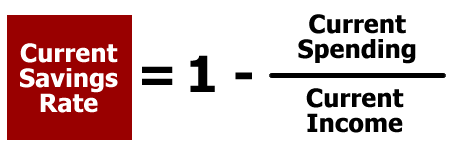
Here’s a chart from a Morninstar article on dividend stock ETFs that caught my eye. It shows the historical relationship between the yield on 10-year US Treasury bonds and the dividend yield on the S&P 500. I am not convinced that this means one should overweight dividend stocks over bonds, but it does provide some historical perspective. The last time the yield differential was around zero was in the 1950s.
Click to enlarge. Source: Morningstar Analysts
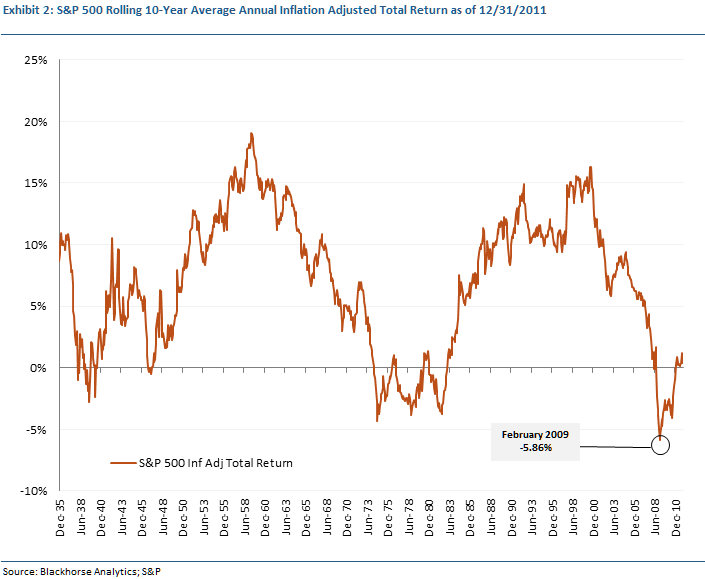
Since we are talking about such long time periods, let me throw in this chart showing (ready for this?) the rolling 10-year average annual inflation adjusted total return for the S&P 500 from 1926 through the end of 2011. Credit to Quant Monitor.
Click to enlarge.
Posted in Investing | 6 Comments »
Wednesday, January 18th, 2012
If you’re the person in your family or circle of friends that always seems to be asked computer questions, or are simply the person asking for help, what you really need is software that allows remote access between computers. That way, you can diagnose and fix problems from across the country without having to leave your desk.
I’ve tried a few different apps, but finally stumbled across an app called TeamViewer. The setup is easy, and works without having to mess with firewalls or router settings. You simply download the application on both computers, and then swap the provided access codes in order to let someone else control your computer. As long as the person you’re helping can download a file off the internet, you’re good to go. Now, I can control the mouse on my parent’s computer and see exactly what they are seeing on their screens. You can also use it to transfer large files directly between computers.
It works for Windows, Mac, Linux, and there are even iPhone and Android apps. It got 5 out of 5 stars from CNET Editors, and 4.5 out of 5 per user reviews. Best of all, it is completely free for non-commercial use. This program has already saved me hours of time, without having to provide a credit card or deal with time limits or 30-day trials. I just wish I found it sooner.
Posted in Frugal Living | 19 Comments »
Tuesday, January 17th, 2012
One of the recurring themes of personal finance is that while the concepts are often simple, execution can be quite difficult. A couple of excellent posts from Mr. Money Mustache and The Military Guide (both also mention the Early Retirement Extreme book) provide another example when answering the question “How many years until I can retire?”
Let me summarize. A simple definition of financial independence is creating enough income from your investments to pay for your expenses. Assuming a “safe” withdrawal rate of 4%, this means your portfolio must be 25 times your expenses. So if you spend $30,000 a year, you’ll need $750,000. (If you want “safer” withdrawal rate of 3%, that increases it 33 times expenses.)
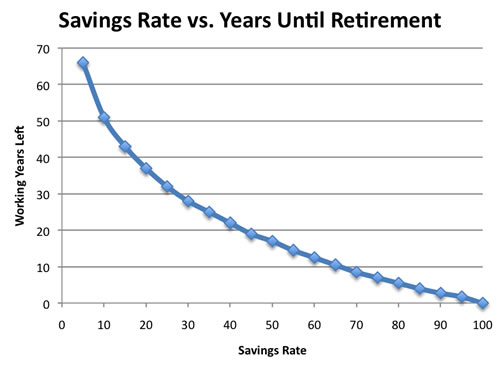
Given the rough assumptions of starting with nothing and earning a 5% inflation-adjusted (real) return on investments every year, you can simplify things even further. (5% real return looks plausible based on the past, but I know it’s harder to see it now.) It works out that the only thing that matters is your personal savings rate:
After-tax numbers work better since expenses are usually after-tax. MMM provides a table, which I in turn converted into a single curve:
Notes:
- The harsh truth is that if you want to retire before Social Security steps in, you’re going to have to save a lot more than 10%.
- The curve is steepest at lower savings rates. That means increasing your savings rate from 10% to 20% shaves off more time working (14 years!!!) than increasing from 20% to 30% (still 8 years!), and so on.
- Retiring in 20 years requires roughly a 40% saving rate. Retiring in 10 years requires a 65% savings rate.
If you’re new to the financial independence community, the idea of saving 40% or more of your income may be incomprehensible. Hopefully you will realize that it is possible, if you wish to pursue it. I have come to the conclusion that some people will happily work for 30 years in exchange for the ability to drive a new BMW every 3 years. Others (gasp!) just like their jobs that much. All that’s fine as long as that’s a conscious decision.
To increase your saving rate, you must either increase income or decrease expenses. While decreasing expenses is actually the more accessible option for most families, it will likely remain unpopular forever. That doesn’t mean you can’t do it, because many people are quietly doing exactly that. Try – you may surprise yourself.
I am also a strong proponent of increasing income. In the end, in our household we did a combination. Both of us earn an solid income after a combination of tuition-based postgraduate education and “DIY education”, but we only live on the lower income. Armed with a 60%+ saving rate, we are on track to achieve financial freedom according to this definition within another 5 years, although we may take a different path by working part-time for a longer period.
I must admit, even though I have known this “truth” for many years, I don’t actively talk about it because we do earn much higher incomes than average. However, that doesn’t change how the numbers work. I applaud all those bloggers and journalists that don’t patronize you and push the idea of higher savings rates, like this article in The Atlantic by Megan McArdle:
If you’re like, well, almost everybody, you’re not saving enough. 15% of each paycheck into the 401(k) is the bare minimum you can get away with, not some aspirational level you can maybe hope to hit someday when you don’t have all these problems.
I mean, obviously if one out of two workers in your household just lost their job, or has been stricken with some horrid cancer requiring all sorts of ancillary expenses, then it’s okay to cut back on the retirement savings for a bit. But let’s be honest: that doesn’t describe most of us in those years when we don’t save enough.
Posted in Frugal Living, Retirement | 13 Comments »
Monday, January 16th, 2012
I’ve read parts of The Big Short by Michael Lewis before, but finally re-read the entire thing over the weekend. If you are unfamiliar with this bestseller, it tells the story of the housing bubble through the viewpoint of investors who saw the crisis coming and bet big money on the collapse of subprime mortgages. Lewis portrays these guys as almost heroes, courageous individuals from smaller hedge funds that went against the commonly-held beliefs of the big firms on Wall Street.
Instead of writing the 8,449th review of this book, my question was – what are these characters betting against now? Now, this doesn’t necessarily mean I think they’ll be right, but I’m still curious.
Michael Burry, Scion Capital
Burry no longer accepts money from outside investors (he doesn’t need to), but still invests at Scion Capital using his own money. He doesn’t write a blog or release his recent letters to shareholders to the public, except for a few old ones. He did make a April 2011 lecture at his alma mater Vanderbilt University entitled Missteps to Mayhem where he sees continued problems with the government printing too much money and not tackling our current fiscal problems.
The government’s borrowing of money for the purpose of injecting cash into society, bailing out banks, brokers, and consumers, is a short-sighted, easy decision for a population that has not yet learned that short-sighted and easy strategies are the route to long-term ruin.
He ends his speech with the ominous advice “All that said, I might suggest opening a retail banking account in Canada.” I’m not even sure that’s possible to do as a U.S. citizen… is it?
From this complete transcript of a September 2010 interview with Bloomberg, he states that he believes that “productive agricultural land with water on site is — will be very valuable in the future”, he is bullish on gold due to currency debasement, but he doesn’t have a good feel for the timing of things as it could take a while to play out.
Steve Eisman, FrontPoint Partners
Eisman left FrontPoint in June 2011 and is reported to start his own hedge fund Emrys Partners in 2012. He has gotten the most publicity in recent years for shorting the stocks of certain for-profit colleges taking advantage of easy credit from government student loans. Basically, people who can’t get into traditional colleges are pitched a great future and convinced to take out large amounts of debt that they can’t pay back, all so these pseudo-accredited colleges can profit. Sound familiar? From a 2010 conference speech:
Until recently, I thought that there would never again be an opportunity to be involved with an industry as socially destructive and morally bankrupt as the subprime mortgage industry. I was wrong. The for-profit education industry has proven equal to the task. [...] This is similar to the subprime mortgage sector in that the subprime originators bore far less risk than the investors in their mortgage paper.
I also looked for information on Charles Ledley and James Mai of Cornwall Capital, but really didn’t come up with much. They have a website, but there is nothing to see for the public.
Posted in Book Reviews, Investing | 4 Comments »
Wednesday, January 11th, 2012
Some of you may be wondering how well your specific portfolio performed last year. Let’s say you started the year with $10,000 and put in another $5,000 throughout the year, and ended up with $16,000. What was your rate of return? Your main goal is simply to separate the effect of new deposits (or withdrawals) and your actual return from investments.
Figuring out your exact personal rate of return requires you to know the exact dates of all your deposits and withdrawals, along with a financial calculator or software program with an IRR function. However, for an simple and quick estimate of your returns, try this calculator instead:
Instructions
- Get your initial balance. This is probably from your brokerage statements. Try January of last year.
- Tally up any deposits or withdrawals. For example, maybe you put $3,000 in your Roth IRA and also put in 5% of your $40,000 salary into a 401(k). That would be $3,000 + $2,000 = $5,000. If you paid a lot in fees or commissions, include those. No need to worry about the dates.
- Get your final balance. Your December statement is probably available already.
- Find the time elapsed (in years) between your initial and final balances.
- Hit Calculate. An estimate of your annualized return is instantly given.
How Good Is This Estimate?
The calculator assumes that the inflows and outflows are spread evenly around the middle of the year. I originally saw this method in The Four Pillars of Investing (review). However, unless the deposits and withdrawals are very large as compared to the initial balance, the estimates are actually pretty good.
For example, let’s say that you start with $100,000 on 1/1/11, and end up with $120,000 on 1/1/11. If you had net deposits of $10,000 during the year, the calculator above would estimate your return at 9.52%. If the $10,000 was actually deposited all at once on one of these specific days, you would get the following exact returns:
| Deposit Date |
Exact Return |
| 1/1/11 (very first day) |
9.1% |
| 6/04/11 (middle of the year) |
9.5% |
| 1/1/12 (very last day) |
10% |
| Estimate |
9.5% |
I Want Exact Numbers Too!
For everything you ever wanted to know about rate of return and then some, see Gummy Stuff. I must warn you that it’s very math intensive. If you just want to know how to figure out the numbers, see his XIRR page. You’ll need the exact dates of all your fees, commissions, deposits, and withdrawals.
Like this tool? Check out the rest of my Tools and Calculators. I hope they are useful.
Updated and revised for 2012.
Posted in Investing, Tools & Calculators | 15 Comments »
Wednesday, January 11th, 2012
Updated with current price quotes for 2012!

Now, I always love every gift card that I get…
but what if you’re trying to simplify your life and wanted to convert your Overpriced.com gift card to good ole’ fungible cash?
Well, the “old-fashioned” way was to sell them on eBay. A couple years ago, I tested out eBay and found estimated eBay cash-out ratios after eBay auction costs and Paypal transaction fees ranged from 81% for Gap gift cards to 90% for Amazon gift certificates. However, the eBay route adds in hassle and potential for fraud. What if some buyer from across the country says your card arrived empty?
A bunch of new websites have popped up that (1) provide upfront quotes for your gift cards, (2) provide a prepaid mailer to send in your cards, and (3) send you a check. The most popular ones appear to be Cardpool, PlasticJungle, GiftCards.com, and GiftCardRescue. Many of these go even further and offer things like online redemption using the codes on the back of the certain cards, and instant payouts via PayPal or via Amazon.com gift certificates.
However, I just wanted to run a simple comparison of what different card-buying websites would offer in straight-up cash for a $100 gift card at various retailers. I’m ignoring any swap-style sites, and also sites like CardWoo that make you mail in the card first without any upfront pricing quotes (why would I do that? sounds like an awful idea). Here are the results, updated for 2012:
Gift Card Website Comparison ($100 Face Value, Updated 2012)
Results
When I first ran this comparison in December 2011, the website that offered the highest prices, on average, was GiftCards.com. However, as of January 2012 the overall winners are Cardpool and PlasticJungle. In either case, none of them had the highest prices across the board so if you can spare the time, trying each of the sites out may earn you a few more bucks. In the end, I would say that these sites do provide a useful service, as the payouts are often even better than what you could net after fees by selling directly on eBay.
The cards to stores that have the broadest appeal like Target and Home Depot have the best cash-out ratios. Something to think about next time you want to buy your buddy a gift card from StuffedMooseHeadsOnly.com.
I found it interesting that none of the sites wanted to buy an Amazon.com gift certificate from me, as they historically have a very high resale value. I’m guessing that Amazon forbids this somehow, or perhaps you can’t check the balance without adding it to a user’s account?
Posted in Frugal Living, Simple Living | 43 Comments »
Tuesday, January 10th, 2012
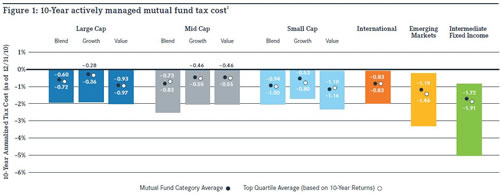
When looking at your investment returns, it’s important to calculate your return after the impact of taxes and expenses (management fees, commissions, bid/ask spreads). That number is what you really end up with, but it’s never shown on any year-end statements. ETF provider iShares put out a Managing Tax Challenges brochure that shows the average annualized tax cost for actively-managed mutual funds over the last 10 years. Via Abnormal Returns and Mebane Faber.
(Click to enlarge)
Many actively managed mutual fund managers have had difficulty delivering benchmark-beating, after-tax returns. Figure 1 shows the 10-year average tax cost for active funds and top quartile active funds. What’s striking is that in every case except for mid cap blend and small cap value, top quartile funds’ tax costs (as indicated with a white dot) were equal to or greater than those of the category average (black dot). Even worse, after taking taxes and fees into consideration, the average active fund underperformed its benchmark.
The takeaway is that expenses and tax-efficiency both matter greatly to the bottom line, and passively-managed ETFs are much more tax-efficient than actively-managed mutual funds, possibly enough to counter the performance benefit of active management. For one, being passively-managed on its own means lower turnover (less buying and selling) and thus less taxable events. Second, the ETF structure itself has inherent advantages over open-ended mutual funds. Neither of these traits are specific to iShares, by the way, although they do have some of the most popular index ETFs out there.
I should note that many Vanguard ETFs are simply different share classes of open-ended mutual funds (Example: VTI and VTSMX). Theoretically, this extends the tax-advantages of ETFs to the mutual fund shareholders, as described in Vanguard’s ETF brochure:
Tax advantage. Like other ETF providers, Vanguard can push low-cost-basis shares out of the portfolio through the in-kind redemption process. Our patented share-class system provides an additional benefit. To meet cash redemption requests from non-ETF shareholders, Vanguard can sell high-cost-basis securities to generate a capital loss. These losses offset any current taxable gains and, if not exhausted, can be carried forward to offset future capital gains—a recycling that is not likely within stand-alone ETFs. Theoretically, cash redemptions could trigger a gain instead of a loss; however, Vanguard’s deep tax-lot structure has allowed us to select high-costbasis shares in both good markets and bad, resulting in a high degree of tax efficiency.
As a result, in many cases if I can own Admiral shares of Vanguard index funds that have the same low expenses as the ETF version, I’d rather just own the mutual fund version for the sake of simplicity. For instance, I like making dollar-based transactions at net-asset value (NAV) instead of having to place a market order (potential loss due to bid/ask spread) and also worrying about NAV discount/premiums. It also keeps me from doing silly things like trying to time the market intraday.
Posted in Investing, Taxes | 9 Comments »
Sunday, January 8th, 2012
Reminder for 2012! The most well known part of the Fair and Accurate Credit Transactions Act (FACT Act) is that you can get a free copy of your credit report from all three major credit bureaus once every 12 months. However, there are also several other consumer databases that you should check as well which are also available absolutely free once every 12 months, and they can also have a significant financial impact. If you got one last year, you can now get another one and reset the 12 month clock.
ChexSystems Banking History
ChexSystems is a consumer information database used by an estimated 80-90% of all banks to help determine the risk of opening new accounts. Think of it as the bank’s version of a credit bureau. If a person commits check fraud or overdraws their account, it will be listed here. In addition, the simple act of opening or closing a bank account may be recorded in their database. Getting a negative ChexSystems record can leave you blacklisted from opening bank accounts at most major banks.
Get your free ChexSystems consumer report here.
Medical History Used For Insurance Underwriting
MIB (previously known as Medical Information Bureau) is run by 470 insurance companies and has a “primary mission of detecting and deterring fraud that may occur in the course of obtaining life, health, disability income, critical illness, and long-term care insurance.” They record information of “underwriting significance” for those who have applied for life and health insurance with MIB member companies. If you have not applied for individually underwritten life, health, or disability income insurance during the preceding seven year period, then you probably don’t have a record.
Get your free MIB consumer file here.
Insurance Claims History
CLUE stands for Comprehensive Loss Underwriting Exchange, and they collect information that is used to calculate your potential risk of loss and thus your insurance premiums. You can also find out about previous claims on the house you are currently renting or recently bought, even if they weren’t made by you.
The C.L.U.E. ®Personal Property report provides a seven year history of losses associated with an individual and his/her personal property. The following data will be identified for each loss: date of loss, loss type, and amount paid along with general information such as policy number, claim number and insurance company name.
The C.L.U.E. ®Auto report provides a seven year history of automobile insurance losses associated with an individual. The following data will be identified for each loss: date of loss, loss type, and amount paid along with general information such as policy number, claim number and insurance company name.
Get your free CLUE Auto and Personal Property Reports here.
In addition, you should also request your free A-PLUS report (Automated Property Loss Underwriting System), which is a smaller database that also contains information about property loss claims.
Employment History
When a potential employer runs a background check through LexisNexis (formerly known as ChoicePoint), this is the information they see. It doesn’t seem to claim be comprehensive, and they may have only limited or even no data about you, but I would still check for potentially negative data.
LexisNexis Screening Solutions Inc. provides Employment History Reports to employers only with a job applicant’s or employee’s consent. Employers utilize a variety of companies to obtain employment history information. Our files would only contain information on you if LexisNexis provided your Employment History Report to an employer.
Get your free LexisNexis employment history report here.
Tenant History
This report can be important if you are a renter and someone runs a background check on you at LexisNexis (ChoicePoint).
LexisNexis Screening Solutions provides Resident History Reports to housing providers that have the subject’s consent. Housing Providers utilize a variety of companies to obtain tenant history information. Our files would only contain information on you if LexisNexis provided your Resident History Report to a housing provider.
Get your free LexisNexis tenant history report here.
Now you know some of what Big Brother does.
Posted in Banking, Insurance, Real Estate | 10 Comments »
Thursday, January 5th, 2012
It’s 2012! Here’s another step to a financial check-up. You probably know about AnnualCreditReport.com for free credit reports. But what about your credit score? If you want some relative comparison of your creditworthiness, here is a compilation of five different ways to grab that credit score for free without the hassle of annoying trial offers. I repeat: No free trial membership required, no credit card number required, nothing to cancel.
Remember, everyone has three credit scores, one from each of the three major credit bureaus: Experian, Equifax, TransUnion.
Credit Sesame
Every month, Credit Sesame can offer you a credit score based on your Experian credit report. They also offer tips to improve your score and qualify for a mortgage. Here’s a screenshot of my current credit score.
CreditKarma
CreditKarma.com is an ad-supported site that offers you the ability to check your credit score daily, called a Transrisk score, based on your TransUnion credit report. The score range is the same as FICO, from 300-850. You don’t get your credit report details, but you do get a few tips on what recent changes to your credit report have impacted your score.
Equifax Credit Score Card
The Equifax Credit Score Card comes directly from Equifax and provides a free credit score range of Low (280-559), Below Average (560-659), Average (660-724), Above Average (725-759), and High (760-850). It’s called the Equifax Risk Score. FICO has a range of 300-850, and this range is 280-850 so you don’t really have to do any scaling. It doesn’t provide any specific data from your Equifax credit report, but it does include a short summary of any negative factors that you may have on your report.
Prosper Person-to-Person Lending
Prosper Lending provides a free credit grade for prospective borrowers, based on your Experian credit data. If you don’t actually finalize the application for the loan, they will not check your credit. They do offer some good rates on personal loans, if you are looking to consolidate credit card debts. Here’s a partial screenshot of my profile:
LendingClub Person-to-Person Lending
Similar to Prosper, if you start an application to become a borrower at LendingClub.com they will check your credit on your behalf to find out what rate they will charge you. Instead of a numerical score, you will get a grade like “A2″ or “B3″. Then you can use the table below to determine your credit score range. For example, A2 would indicate a score range of 747-769. It is also based on your TransUnion credit report.
You will need to provide your personal information and Social Security number to these companies, naturally, so be comfortable with that. None of these methods by themselves will affect your credit score as you are requesting them for yourself.
Posted in Credit Cards, Debt | 73 Comments »