Citi Platinum Select Card: 0% APR Balance Transfers for 21 months
Friday, April 30th, 2010Here’s another indication that the credit crisis is turning around… Check out this new offer from Citibank:
Nice.
Here’s another indication that the credit crisis is turning around… Check out this new offer from Citibank:
Nice.
I’ve been trying to track our expenses better using Mint.com, which means combing through transactions and manually correcting many of the automatic categorizations. I think it’s working, at least in that I hate doing it so much that didn’t make a purchase today so I wouldn’t have to categorize it later.
I found the home page chart greeting me today amusing:
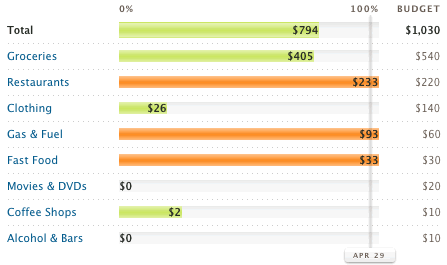
We did pretty good this month, but it would seem like all we do is eat and drive (and in the case of fast food, probably both at the same time). I notice that housing and utilities aren’t included, but I’m not going to tweak the targets until I have a couple months of spending data first.

Until now, I haven’t written much about healthcare reform issues – it’s just feels so daunting and politically-charged. I do support the eventual separation of work and health insurance, as I think that all unemployed, partially-employed, and self-employed individuals should get access to affordable healthcare. As the dust settles a bit, I took a look through the many attempts of media to break down the healthcare reform bill into manageable bites. Here are my notes:
Sources: CS Monitor, Health Reform and Small Business, USA Today, HealthReform.gov
Wow… The last time I wrote about LendingClub was about 6 months ago. Since then, I haven’t really been keeping up with person-to-person lending, which in this case are unsecured credit card-like loans between individuals. Looks like they got a new logo and revamped their website! I kind of miss the old Halloween colors.
Lending Club Portfolio
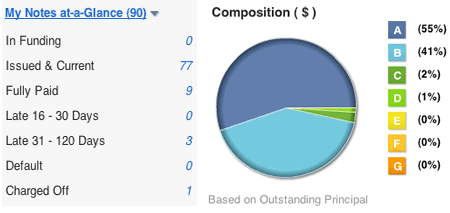
Back then, I had 62 loans outstanding, of which 58 were current, one was 30+ days late, and three were paid off early. Today, my portfolio has 90 loans, of which 77 are current, three are 30+ days late, one was charged off completely, and 9 have already been paid off early. My current invested principal is ~$1,800, and I’ve received over $1,100 in payments already (principal + interest). The new loans must have been acquired close to October, as I don’t even remember the last time I logged into this account. I suppose that’s good in terms of it being a low-maintenance investment.

Performance & Commentary
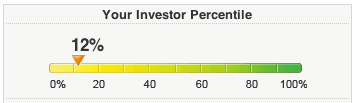
In the last 6 months, my portfolio’s “Net Annualized Return on Investment” based on my interest payments received went from 9.14% to 4.45%. LendingClub puts me in the sad 12th percentile of investors:

What happened? Some bad loan-picking, perhaps some bad luck, but mostly age. The sharp drop itself is due to my recently charged-off loan and how their return calculation takes into account late loans. A “late” loan will affect your calculated return because you’re not receiving those monthly payments. On a $100 loan that might be $3.xx a month. But most late loans eventually turn into defaults. After 120 days late or so, LC will officially recognize the fact that you’ll never see the rest of your $100, and your return will suffer accordingly. Quick example – If you have 50 equal-sized loans, and two go bad immediately, that’s 4% of your principal gone.
As I stated before, if you have loans that are younger than 1-2 years old, do not expect your current return number to be your final return to maturity. One major reason why the advertised average return is so high, is that the average investor has very young loans in their portfolios. My oldest loan was issued back in December 2007. If you just look at the loans that are already 2 years old (full term is 3 years), you’ll see that the average return is only about 4-5%.
This doesn’t mean investors won’t still capture some risk premium for their loans, but I wouldn’t expect 9% returns over 3 years. This is not a low-risk investment, even though I still like the idea of making some fun and helpful loans. With much more data now available, I’ll be looking more into performance trends in a future post.
New Lender Incentives – Free $25 to $250 Bonus
If you are interested trying P2P lending with no risk, you can still use this special $25 lender sign-up link to get a free $25 to try it out with no future obligation. There is no credit check and you don’t even have to deposit anything. After you are approved, the $25 will show up in your account balance, and you can lend it out immediately.
For those that have done their research and are willing to jump in with both feet, those that are willing to invest at least $2,500 at once and link a bank account can get a $250 bonus when you get a referral from an existing member. (Yes, you must actually invest $2,500 in loans.) Send me an e-mail if interested.
If you’re looking to borrow at LendingClub, it’s relatively straightforward. Give some information, and see what interest rate they offer you. Compare it with your credit card, Prosper, or other financing options. If you like it, fill out your application carefully (verify income if possible) and go for it. If you don’t like the rate or the full amount is not funded, you can either accept partial funding or walk away with no obligation.
If you’re like me, your 401k plan comes with a little newsletter each month. A common theme in the world of personal finance advice is to nudge up your savings by one more percentage point a year.
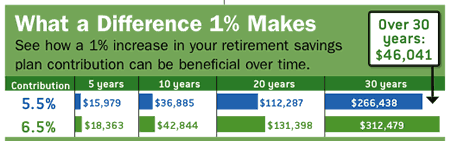
For the “average” person, this is probably not a bad idea. According to the PSCA‘s 52nd Annual Survey of Profit Sharing and 401(k) Plans, the average contribution to a retirement savings plan in 2009 was about $2,114 at a rate of only 5.5% based on a $38,428 annual salary.
Assuming yearly salary raises of 3% and a 6.3% annual rate of return, bumping up that contribution rate by just one percentage point, to 6.5%, could potentially improve savings by close to $6,000 in 10 years and more than $46,000 in 30 years. [source]

But who’s average? The NY Times brings us another pretty interactive calculator where you can input your own numbers and play around. You’ll see what would happen if you increased your savings by one percent, and also what would happen if you increased your savings by 1% every year – up to a max of putting away 16% per year.
I always have to remind myself that $100,000 won’t buy nearly the same amount of stuff in 20 or 30 years. I need to check my math, but you could simply put down how much you expect your raises and investments to outpace inflation, which should provide inflation-adjusted amounts.
The 2011 edition of the Death and Taxes poster is out, which outlines in spectacular detail how the United States federal budget spends its (your?) tax dollars. View the huge image online, or buy it as a 2 ft. x 3 ft poster. If you haven’t seen it before, you really should check it out.
Due to what the creator deems complexity and size constraints, the poster focuses on the $1 Trillion discretionary portion of the budget. Discretionary spending refers to the portion of the budget which goes through the annual Congressional debates every year, and amounts to about 1/3rd of the total budget. Currently, the biggest chunk goes to defense spending. Want to know how much the V-22 Osprey gets? It’s on the poster ($2.2B).
The other 2/3rds of the federal budget is mandatory spending, which includes programs which are funded by eligibility rules or payment rules. An example is welfare. If you’re eligible, you get it. The only way to change how much is spent is by changing the eligibility rules.
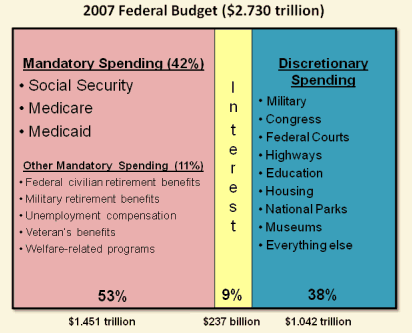
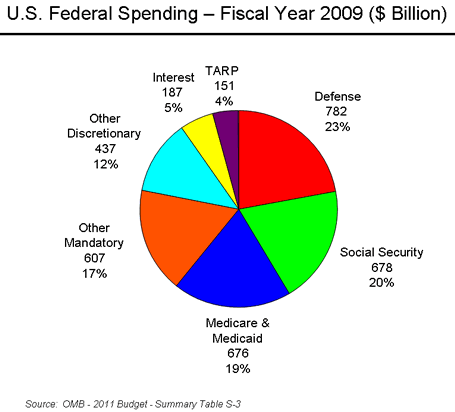
The poster does include a little chart on the bottom right about the total federal budget, but I think it tries to convey too much information in a very small space. Here’s a simpler breakdown from the 2007 budget, courtesy of PerotCharts. As you can see, entitlement programs like Social Security and Medicare are also huge expenses.

And here’s another breakdown of the 2009 total spending via Wikipedia.

As long as take all of this into perspective, this graphic does a great job of making a complex subject accessible. Not sure how long this will last, but right now with code BOGO you can get two posters for $24 + $1.50 shipping.
“You may be eligible to receive rebates from your state or territory for the purchase of new ENERGY STAR qualified appliances. These rebates are being funded with $300 million from the American Recovery and Reinvestment Act of 2009. Under this program, eligible consumers can receive rebates to purchase new energy-efficient appliances when they replace used appliances.”
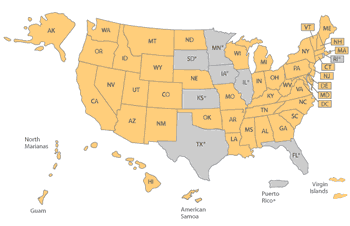
Each state is running their own program. California just started their Cash for Appliances program yesterday, and it’s much better than I thought it was. Some states have already ended their programs (sorry!).
For example, on a $500 front-loading washer that we were looking at, certain CA residents (by zip code) could get $300 back in rebates! That’s $200 from the state of California, $50 from WaterEnergySavings.com (PG&E + local water utility), and another $50 from PG&E. This is on top of the potential water and electricity savings that you’d would get from switching away from an old top-loading washer.
Click on your state on this map for more information. Here are some frequently asked questions.

The car buying strategy that I hear recommended most often is to
Sounds easy, but in practice seems like it might be tedious and time-consuming, not to mention uncomfortable for those that don’t like to haggle. However, I keep hearing mentions of CarBargains, run by a non-profit, will do all the negotiating for you if you pay them $200 ($175 if you are a subscriber to Consumer CHECKBOOK magazine).
Seems like it might just be worth it, but I haven’t heard any in-depth testimonials that aren’t on their site. Their press section includes several positive reviews from such magazines as Money and Kiplinger’s Personal Finance. They also offer a money-back guarantee if you can beat their price “without using their information”, although that would be hard to prove…
Has a reader out there actually used CarBargains recently? If you’d be willing to share your experience in detail, please contact me directly. I’d like to write a post with detailed price quotes and model information. If you participate and agree to having me interview you, I have some ideas for compensation.
A couple of folks asked me for an update about my Ooma VoIP Telephone system, which I bought for $158 to replace my POTS landline in early December and provides me with unlimited free local and long distance “forever”.
Well, it’s been working great for the last 4.5 months. The best compliment I can give about it is that I never think about it, just like with my old landline. I’ve never experienced an outage yet; The dial tone is always there. (I hope I didn’t just jinx myself. You can follow Ooma on Twitter for status updates.)
Caller ID and all that jazz works fine. I can send and receive faxes. I check my voicemail online from work or when traveling. I have read complaints about dealing with Ooma customer service, but I wouldn’t know because I’ve never had any problems. I already shared my number porting experience.
I don’t have the new Ooma Telo nor do I pay for $10/month Ooma Premier service, which offers things like a second line, better PureVoice clarity, enhanced Voicemail, and other stuff I don’t need. I’m happy for the 25% of customers that reportedly do pay for Premier, because it helps ensure that my service stays free.
At $158 spread over the last 4.5 months, I’m now down to $35 a month for Ooma and always dropping. As for current pricing, Amazon has it at $245, back up close to full retail. Right now, Radio Shack has it $180 before a $15 off $125 plus free shipping link and plus another 2.4% back, both available from BigCrumbs, for a total net price of $161.
Update: Sold out at Radio Shack… CompUSA.com has it for $200, and you can get 10% back via Bing Cashback for a net price of $180.
American Express is has a new 25,000 point promotion for their AMEX Gold Card, which is one of their upscale-oriented charge cards where you must pay off the balance each month. Offer only good through 4/26/10.
* Earn 25,000 Membership Rewards bonus points when you spend $1,000 in your first 3 months of Card membership. MR points are very versatile, and can be converted to 25,000 frequent flier miles in a number of programs (or 16 Southwest credits) in various increments, or you can simply get $250 in gift cards at several stores like Home Depot, Crate & Barrel, or Macy’s. (The usual offers are for 10,000 or 15,000 bonus points.)
* Offers 3X points on airfare, 2X points on gas and groceries, and 1X points on everything else. The traditional versions only offer 1 point per $ spent, so these are an extra perk for those that spend a lot on airfare.
* No annual fee for your first year. Another important feature, you can get the sign-up bonus and also try out this card for free for a year. If you keep the card after that, there is a $175 annual fee.
* Earn 15,000 Membership Rewards bonus points when you spend $30,000 per calendar year. This means that if you spend $30,000 in a year ($2,500 per month) that you’ll get at least 25,000 for sign-up + 30,000 on spending + 15,000 bonus = 70,000 points total, plus any extra for gas/groceries/airfare.
For those that charge a lot, that’s enough for 70,000 frequent flier miles (possibly two flights to Hawaii) or $700 in gift cards. If you don’t, there’s still that $250 upfront bonus.
American Express Disclaimer: This content is not provided or commissioned by American Express. Opinions expressed here are author’s alone, not those of American Express, and have not been reviewed, approved or otherwise endorsed by American Express. This site may be compensated through American Express Affiliate Program.
In response to the disruption caused by a certain Icelandic volcano, Lonely Planet has made their iPhone apps for 13 European cities free until April 22nd. These usually cost $15.99 each, and seemed to work fine on my iPod Touch. From their blog:

‘Travellers stuck in unfamiliar places need access to practical information as well as suggestions on what to do whilst stranded’, said Tom Hall, Lonely Planet Travel Editor. ‘That’s why we’re giving away iPhone city guides to major affected destinations.’
I think it’s a nice gesture on their part and also good PR. Heck, I didn’t even know Lonely Planet offered apps until today. Should make for some neat reading. Here are direct iTunes links to the included cities:
I received a thought-provoking comment last week on my Fidelity Portfolio Advisory Service review. Since this post is a couple months old by now, I doubt most readers saw it. After reading it, my first guess was that somehow the visitor was interested about Fidelity PAS and also read up about my own investing activities.
Even thought the comment wasn’t blatantly baised, on a gut instinct, I checked the IP. As I suspected, the visitor came from a Fidelity Investments internet domain. Still, that doesn’t mean the person is necessarily wrong, just most likely works for Fidelity.
Anyhow, the comment from “Ryan”:
I would ask yourself why you were “stuck” in cash and missed the market rally. Was it because you were emotionally involved? Trying to time the market and got in/out at the wrong time? Where you frozen to the point where you didn’t know what to do? Those kind of mistakes can REALLY hurt a portfolio’s return in the long run. I would say if you are ready to commit to a discipled strategy and stick to your asset allocation & rebalancing plan, you are ready to manage the portfolio on your own. You can also think about taking 10% of your portfolio to invest in individual stocks to see if you can get lucky with a few and boost your overall return. But you also have to be prepared to do your homework (jim cramer says an hour a week per stock, so thats 10 hr/week) on those stocks. If you are honest with yourself and don’t think you will have the time, expertise, or interest to keep up with the management of your portfolio, best to have someone do it for you whether it be through actively managed funds or professional management.
I both agree and disagree with parts of this comment.
Yes, I agree that it is one thing to set up and asset allocation and re-balancing plan, and it is another to execute it in times of uncertainty and market turmoil. This is your family’s future. Right now, with the S&P 500 at 1200, it would be good to look back over the last couple of years and see if you kept your stock/bond ratio at your desired targets when the markets were doing much worse. We you unsure? Scared to pull the trigger? Wanted the economy to get “just a bit better” before jumping back in?
However, I don’t agree that if you did have problems, the solution is “actively managed funds or professional management”. Well, not exactly. Why not go back to something simple and low-cost, like the Vanguard Target Retirement Funds? You will receive the power of passive investment into thousands of companies representing every industry around the world. You’ll also be invested in high-quality investment grade bonds from the US government, US agencies, and strong corporations. And you don’t have to worry about rebalancing, because they will do it for you. All at a rock bottom price of about 0.20% of assets annually ($20 a year for every $10,000 invested).
Take VTIVX, the fund for folks retiring around 2045. Want an IRA? Set up automatic investments into VTIVX. Got more to spare from the paycheck? Set up a automatic investment in a taxable account? Got a bonus? Throw it into VTIVX or similar. Scared? Just sit tight, VTIVX will rebalance for you. Don’t sell. Don’t buy anything else. Inaction is actually in this case. No, it won’t be perfect, but it will be a lot better that most of the other options out there. If you had trouble recently, perhaps it’s time to go back to simplicity?
In any case, there is no way I’d pay 1.74% in annual fees to Fidelity to manage my portfolio. Such crazy-high fees can also REALLY hurt a portfolios return, like facing a 50 mph headwind. I’d choose a Vanguard Target Retirement fund of comparable allocation over a 15+ year period vs. any Fidelity PAS portfolio any day of the week and twice on Sunday.