Archive for March, 2009


Save Money On Housing: Live Well In Less Space

Monday, March 30th, 2009
image credit:  governing.typepad.com

Speaking of internal frugality, I’d say one of the most basic ways to save on rent or mortgage payments is to… live in a smaller place. No, wait, really. Let’s think about it.

Even though it’s easy to make fun of 10,000 square feet McMansions, they are only a side effect of an overall trend towards larger houses. According to this 2006 NPR article, the size of new houses has more than doubled since the 1950s. The average new home sold in 2007 was a whopping 2,629 square feet.

altext altext

Maybe as a whole we’re getting fatter and need a bit more space to move around, but not by that much! In fact, the average family size has actually been decreasing over time. Here are some stats I pulled from the U.S. Census:

altext
Source: U.S. Census Bureau

From 1970 to 2004, the average household shrunk by 27%, but the average square footage grew by 66%. Using median numbers gave similar results.

There are several theories as to why this is happening. For starters, we may simply want a higher standard of living. (Sharing bathrooms? That’s for people in 3rd-world countries!) Perhaps it’s from us continually one-upping our neighbors. Maybe builders are pushing bigger homes through marketing. Or it may be a result of the breaking up of the American family, and how we don’t like spending time together anymore.

Most importantly, we don’t need the extra space. If a family of four could live well in 1,500 square feet back in 1950, there is no real reason they can’t do so today. It’s just a choice like any other, and we have to examine whether it is really worth the price.

Finally, it doesn’t stop with the bigger sticker price. There’s the higher property taxes and insurance rates. A bigger home costs more to heat, cool, maintain, and repair. More rooms means more furniture, more wall decorations, more room for clothes, and just more stuff in general. More appliances mean more electricity used. The list goes on and on.

In my opinion, many people don’t even notice that they are stretching to buy homes that just keep getting bigger and bigger. They just follow the crowd. This unconscious choice may partially explain why many of us feel so much more stressed financially than our parents.

Internal vs. External Frugality: Different Ways of Saving

Sunday, March 29th, 2009

So I am trying to kick off one of my planned 2009 projects, which is to methodically go through each major expense area and explore ways to save money there. I started out last week with on housing costs (here and here), and still have a few ideas left. But while brainstorming an outline of future posts, I noticed that there seemed to be a divide in the types of strategies out there.

One set of ideas usually has to do with reducing the amount paid for a specific item or service. I call this external frugality, because you aren’t changing anything about yourself, just the price tag. For example, to save on what you pay for your house, you could look for a buyer’s agent rebate to save something like 1.5% of the purchase price, or carefully shop for mortgages with the lowest combination of closing costs and interest rate.

Another set of ideas usually involves either changing the type, amount, or quality of something. I call this internal frugality, because you are changing your consumption habits. An example of this would be realizing that you don’t necessarily need to same house as everyone else. You could look in more “up-and-coming” neighborhoods, or live in an older house with less square footage.

There are plenty of other examples out there:

External: Calling a cable company and asking for a lower rate.
Internal: You cancel cable completely. You could read more, watch episodes on your computer, or use a low-cost Netflix plan.

External: You find a cheaper long-distance plan, or switch to VoIP.
Internal: You get rid of your landline completely.

External: Learn ways to haggle down the price of a car.
Internal: Don’t own a car. Use public transportation.

I don’t think either or worse, but they are different. In general, it would seem like external frugality is at least initially easier to implement, as you don’t have to actually change your habits. However, I can also imagine that in many situations using internal frugality would lead to both greater absolute savings and also more enduring lifelong savings. But changing habits is really tough.

Next time you think you’re being frugal, examine if you’re doing it externally or internally.

SEC Says Millennium Bank Was Indeed a Ponzi Scheme

Friday, March 27th, 2009

Well, it was about time. The SEC released a press release yesterday stating that they have frozen the assets of the offshore Millennium Bank and its parent, United Trust of Switzerland S.A.

If you don’t recall, Millennium Bank offered certificates of deposit paying insanely high rate north of 8% APY for the last several years. I stopped short of calling it a scam, but pointed out that common sense would state that such increased return could not exist without significant added risk. From the press release:

Washington, D.C., March 26, 2009 — The Securities and Exchange Commission has obtained an emergency court order halting a $68 million Ponzi scheme involving the sale of fictitious high-yield certificates of deposit (CDs) by Caribbean-based Millennium Bank.

The SEC alleges that the scheme targeted U.S. investors and misled them into believing they were putting their money in supposedly safe and secure CDs that purportedly offered returns that were up to 321 percent higher than legitimate bank-issued CDs.

The bank was supposedly based in the Caribbean nation of St. Vincent and the Grenadines (SVG), which had access to high-yielding, safe investments. In reality, the SEC managed to trace the money sent by gullible investors from the offshore back to a US bank account in Napa Valley, CA, where the defendants “misappropriated a vast majority of the investor funds to enrich themselves and pay personal expenses, while making relatively small Ponzi payments to investors.”

According to the SEC’s complaint, the $68 million was raised from more than 375 investors since July 2004. I wonder how much is left. Another case of greed blinding people…

Please don’t confuse this bank with the legitimate and FDIC-insured Millennium Bank of Illinois.

Save Money on Housing: Move To a Lower Cost-of-Living Location… Like Austin, Texas?

Wednesday, March 25th, 2009

As you may know, I own a house in an expensive area of the country. I love my house, and I love where I live, but I also admit that I occasionally daydream about moving somewhere with a lower cost of living.

In my experience, many people don’t like the idea of moving elsewhere because it involves something unknown and unfamiliar. However, if you ask people to think back to the places they have been, they’ll speak fondly of those places. Specifically, I think about moving back to a place that I spent several childhood years in – Austin, Texas.
Now, there are many things to consider before moving besides costs. These may include:

  • Can you find a job there? If so, how will the pay change? Will it offset the change in cost of living?
  • Do you enjoy the local culture? Can you easily participate in your hobbies and interests?
  • Love, family, weather, traffic, nightlife, cultural diversity, etc.

I think a lot of people who haven’t lived in Texas (and most other areas) may have a misconception or stereotype of what it’s like to live there, and that is especially true of Austin. What I like about the area includes the relatively temperature weather, a large university center, a strong tech industry, and of course a low cost of living and tax burden. As for the financial details, I grabbed some graphs from the Austin Chamber of Commerce website, which were based on independent data.

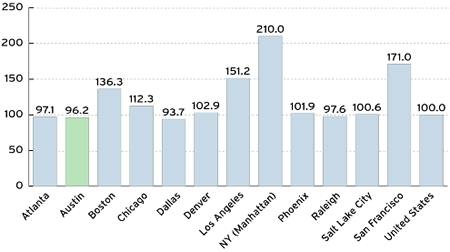
Cost of Living Index, 4 Quarters Ending Q2 2007

The index takes into account the combined costs of housing, utilities, transportation, healthcare, and other factors. According to this CNN calculator based on the same index, if you are earning $100,000.00 after tax in San Jose (CA), the comparable after-tax income in Austin is 61,217.

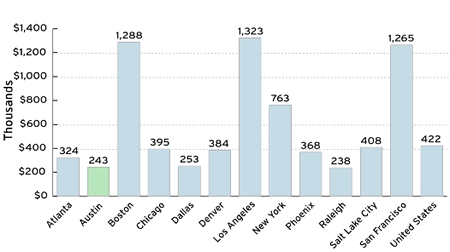
Average Home Price, Middle Management Housing, 2007

(For the chart, a “middle management house” is a single-family dwelling model with approximately 2,200 sq.ft., 4 bedrooms, 2 1/2 baths, family room, and 2-car garage.)

These might have changed a lot since 2007, but the median home price in Austin is still a shade under $200,000. If a house in California costs $600,000 that only costs $200,000 in Austin – how many more years of work would it take to pay for an extra $400,000 plus mortgage interest? Would you move to Texas if it meant you could retire an entire decade earlier? Hmmm…

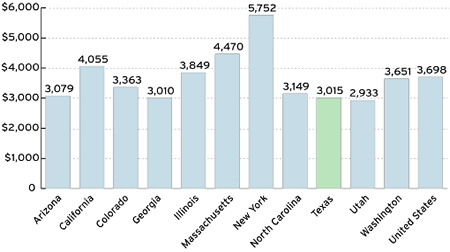
Tax Burden: State & Local Taxes Per Capita, 2005

So not only do things cost less, but I can also earn a lower salary and still get the same after-tax results. In general, Texas ranks 45th out of the 50 states in terms of total taxes per $1,000 of income. With no personal income tax, the primary taxes in Taxes are property and sales tax. In Austin, property taxes are about 2.2% of appraised value per year.

Quick Summary
Going by the numbers, moving somewhere else can certainly seem attractive. For me, not only do things cost less as a whole, but my income would take much less of a tax haircut as well. Now, I don’t think everyone should move, and I have no plans currently to do so myself. But if you are re-examining your financial situation, it can be worthwhile to keep an open mind and consider the possibilities. Everything is a trade-off, and what you gain may be worth more than what you lose.

Save on Housing Costs: Renegotiate Your Rent With Landlord

Monday, March 23rd, 2009
altext

If you are are a renter in this market, you may be able to lower your monthly housing costs with a little research and courage. Mary Pilon of the WSJ Wallet Blog recently showed how she reduced her rent by 11% by writing a convincing letter to her building manager’s office. She even shares a form letter that people can use themselves. I reverse-engineered some of it to see what types of ammunition might be useful when negotiating with your landlord:

Provide local statistics. A quick Google News Search with the keyword of your city and “average rent” or “rental vacancy rate” should bring up some useful stats. For example, according to Forbes, Atlanta is the nations 3rd most empty city, with rental vacancy rate of 16.1%.

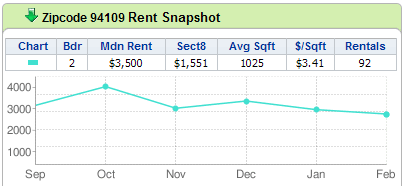
Provide concrete, real examples. Use rent-comparison tools like Rentometer or Zilpy to find out how your rent compares with local properties. (Zilpy also provides rental trends by zip code, as shown below.) Try to find places that are very similar or better than yours, but which are renting for less than you pay now. You could even provide the exact Craigslist page.

Of course, the best comparison is with another person in your complex. Ask what your neighbors what they are paying. That’s how Pilon found out her neighbors were paying $300 a month less than her. If you’re not that close to them, perhaps start up a conversation with “Hey, how’s it going. Isn’t it a bummer that our rents are going up?”. You might get a “Yours too?” or a “Really, mine’s still $XXX…” I don’t see people being overly uptight about sharing rents.

Show why you are attractive renters. Some landlords try to squeeze out every last penny of rent, and deal with the resulting turnover, but 99% of the casual landlords I know would gladly give a discount to low-maintenance tenants. I know some who literally haven’t raise rent in a decade because the renter pays rent like clockwork, takes care of the house, and never bugs them unless it’s really important. You’ll want to show why you should get a discount too.

Remind them that you have a solid rent payment history. Perhaps you have excellent credit scores, or maybe it has greatly improved since you first moved in. Point out any minor repairs or maintenance that you have done on the house, or offer to do some in exchange for a rent reduction. Provide reasons why you want to become a long-term renter, or even agree to extend your lease.

These tactics may not work in all areas of the country, but in lots of places it should at least be worth a shot. The worst thing they can say is no.

INGCompareMe: How Do YOU Compare With Others Financially?

Friday, March 20th, 2009

Here’s another comparison site to waste some Friday afternoon time on – INGCompareMe.com. From their press release – “INGCompareMe makes it possible for anyone to see where they stand in relation to others on a wide range of saving, spending, investing, debt and personal finance matters.”

The comparison database was initially fed by a survey conducted by ING of over 5,000 adults who participated in workplace retirement savings plans. But as more people use the site (like you), their answers are also incorporated into the results.

I’m sure the ultimate goal is to sell you some sort of ING financial advice, but since the tool is anonymous I took it for a whirl. Of course, the question below provides the most insight:

Only 10% of people are below average? I guess I also live in Lake Wobegon. :)

Brightscope: How Does Your Company’s 401k Plan Compare?

Friday, March 20th, 2009

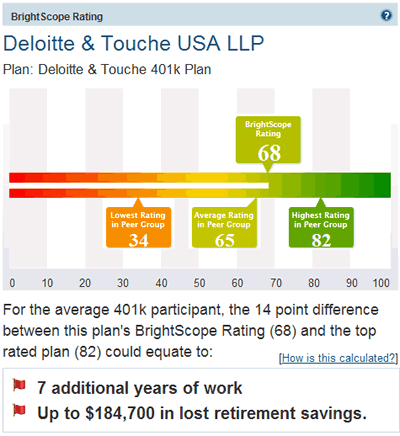
Even though most people I know are too scared to even look at their 401(k) statements right now, have you ever thought about how well your company’s plan stacks up to other similar companies? The problem is that 401(k) plans lack transparency. What if every company had to publish their company match, fees, revenue sharing (*cough* kickbacks), investment choices, and vesting schedules? That would certainly produce competition and peer pressure to make better plans.

This is what the website Brightscope is trying to change. Just type in your company name and see an overall rating based on the components I listed above, also some other interesting details like average account balance. As they point out, a poorly designed plan could be costing you hundreds of thousands of dollars over time – or put another way the equivalent of an extra decade of work!

According to their site, BrightScope is the only 401k analytics firm that is truly independent and does not accept compensation in the form of revenue sharing from mutual fund companies or plan providers. This should make them objective. Found via Capital Ideas.

A related site is 401khelp.com, which covers less companies but does offer more insights and opinions on the plans it does cover. Not sure how often it is updated, though.

$750B From Federal Reserve = Mortgage Rates Dropping To Historic Lows Again?

Thursday, March 19th, 2009

The market news from yesterday was that the Federal Reserve announced that it would buy $300 billion of long-term Treasury bonds, along with an addition $750 billion in mortgage-backed securities. My mortgage broker sent out a corresponding e-mail stating that he expected mortgage rates to drop somewhere around 3/8 to 1/2 points on conforming 30-year fixed mortgages.

The wholesale mortgage rate on a 30-year fixed loan with zero points, a 740+ FICO score and 20% down-payment was about 4.7% recently. The average rate from Bankrate was 5.29%, with an average total of 0.33 points. I don’t recall the exact numbers, but that sounds pretty close to the best rates I saw a few months ago.

If you’re shopping for a mortgage right now, or maybe you have even already locked in your rate, it may be a good idea to see what’s up. I recently shaved off $150 a month off my mortgage payment permanently with a loan modification (not federally subsidized) after researching refinance options. Don’t forget the current $8,000 first-time homebuyer tax credit as well.

For the interested, here is my collection of posts about my home-buying experience.

Is Your State Prepaid Tuition 529 Plan Really Safe?

Wednesday, March 18th, 2009

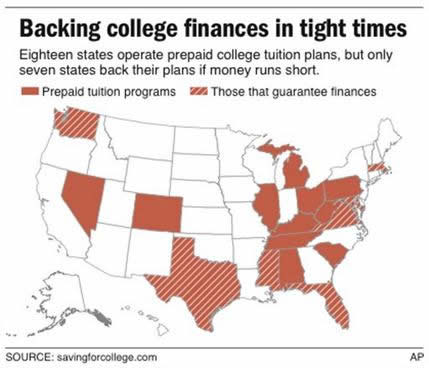
I have thought about signing up for a prepaid tuition plan, as I am leaning towards conservative investments for college savings. Lock-in tuition now, and don’t worry about future hikes. However, it appears that even though 18 states have pre-paid tuition plans, only seven of them actually guarantee them – Florida, Maryland, Massachusetts, Mississippi, Texas, Virginia and Washington. (The image below says six, but the article was corrected later to add Virginia.)

Currently, the plan hurting the most publicly is from Alabama, called the Prepaid Affordable College Tuition Plan (PACT). The plan’s asset value dropped from $899 million in September 2007 to $463 million at the end of January, nearly a 50% drop. Why? Because they invested over 70% of their assets in stocks, and also assumed a consistently high rate of return:

According to an actuarial report on the fund filed by the state in January 2008, the fund’s managers then as­sumed a rate of return of about 8 percent until 2013, and 8.5 percent after that. That report also found that the fund’s liabilities exceeded its assets by about $20 mil­lion.

According to fund docu­ments, 42 percent of its assets, as of March 2008, were invested in large market capi­talization domestic stocks, 9 percent in small market capi­talization domestic stocks, 21 percent in international stocks, 26 percent in domestic fixed-income securities and 2 percent in cash.

48,000 families who were invested in the plan got letters earlier this month that the plan may have trouble meeting its future obligations. To make things worse, their brochures actually once stated that it was guaranteed by the state of Alabama, until later on it was found that wasn’t possible due to state law.

I don’t know about you, but isn’t a guaranteed return the entire point of prepaid tuition plans? I commit money now in order to know that I can afford tuition for my child in the future. I give up the chance for higher returns elsewhere. Otherwise, it’s like heads they win, tails you lose. High returns, they keep the difference. Low returns, they say “oops we got no money”.

Also reported to be in trouble are the programs in Tennessee, South Carolina, West Virginia and Washington. Finally, I also found this article which stated that although guaranteed, the Texas plan had a projected shortfall of $206 million.

The Movement To Bring Back Victory Gardens

Monday, March 16th, 2009

We’re still in the middle of slowly landscaping our yard ourselves, but we decided to go ahead and start a small container garden on the porch. (Okay, dear wife did. Even weeds die when I touch them.) While doing research for this, I stumbled across the concept of “victory gardens” from World War II, where private citizens were asked to grow some of their own food in order to support the war effort.

During World War I and World War II, the United States government asked its citizens to plant gardens in order to support the war effort. Millions of people planted gardens. In 1943, Americans planted over 20 million Victory Gardens, and the harvest accounted for nearly a third of all the vegetables consumed in the country that year. Emphasis was placed on making gardening a family or community effort — not a drudgery, but a pastime, and a national duty.

The above was taken from ReviveVictoryGarden.org, which is one of many organizations which are trying to bring back victory gardens. There are many potential benefits, including:

  • Financial relief from high food prices. (My favorite crops are basil and tomatoes).
  • Healthier eating through less pesticides, chemicals, and preservatives.
  • Environmental benefits from less energy spent on packaging and transportation.
  • Physical benefits from getting more exercise, sunshine, and fresh air.
  • Mental and patriotic benefits from being more self-sufficient.

The city of San Francisco has a Victory Garden 2008+ project with a goal of urban sustainability. There is even a campaign to convince the White House to plant a large Victory Garden on the First Lawn, with the produce going to the White House kitchen and to local food pantries..

Being a visual person, the motivational posters used at the time really caught my eye. I kind of want to make a large print and frame one. Here is one I found from the World War II poster collection at the New Hampshire State Library website:

And here are some more, click to see the full-sized poster:

“This poster was part of the publicity for a brilliantly mounted campaign to encourage the use of homegrown foods. Because commercially canned goods were rationed, the Victory Garden became an indispensable source of food for the home front. The Victory Garden was a household activity during the war and one of the most well received of all home front chores. At its peak, it is estimated that nearly 20,000,000 gardens were grown and about 40 percent of all vegetables produced in the U.S. came from Victory Gardens. By the end of the war the Department of Agriculture estimated total home front production of over one million tons of vegetables valued at 85 million dollars.

The Victory Gardens of WWII remain a vivid memory for many Americans who experienced them. Across the nation, home canning and preserving of farm produce flourished so that more supplies would be made available for our troops. The idea was simple in conception and inexpensive for the individual American at home to carry out. Of all the advertising techniques used to make Americans feel a part of the war effort, this was perhaps the most successful. The Victory Garden fulfilled the requirements of a good advertising campaign: that it attracts a broad and sympathetic audience at a reasonable price.”

Blog Roundup: Murphy’s Law Edition

Monday, March 16th, 2009

The overall theme of this links roundup is dealing with unexpected events and the resulting expenses. If it can go wrong, it probably will, and most likely at an inconvenient time. Here are some fellow bloggers who have also had a not-so-great time recently.

Weekly Bank Interest Rate Update: How Low Can They Go?

Friday, March 13th, 2009

Another sad week for interest rates. I’m almost curious if we are still experiencing deflation. Most taxable money market mutual funds are yielding well below 1% right now. At least I got my $250 bonus from WT Direct as promised this week.

Liquid Savings Accounts

  • The Everbank Yield Pledge Money Market Account is offering a rate of 3.51% for 3 months guaranteed for new accounts, and after that it goes down to the regular rate (currently 2.03% APY). Balances up to $50,000. See my review of the application process here.3.51% APY for 3 months remains better than any other banks’ top 3-month CD rate, while still allowing withdrawals.There is also a FreeNet Checking account you can open up at the same time, which offers a 2.51% rate for the first 3 months on another $50,000 in balances.
  • The quirky Redneck Bank is offering a money market with 3.10% APY on balances up to $35,000. “Where bankin’s funner?” Seriously?
  • DollarSavingsDirect is now down to 2.25% APY. If you are moving money out, remember that you need to maintain a minimum average daily balance of $1,000.00 during the entire month to keep the high rate for that period. For those with lower balances, it may be better to withdraw after you see your last month’s interest credited. See my quickie review here.
  • FNBO Direct is now at 2.15% APY. See my account review here.
  • The “Original” ING Direct is now down to 1.65% APY, but new savers can still get their $25 opening bonus. According to my data, this is the first time ING has ever dropped below 2%.
  • E-Trade Savings (useful if you trade stocks there) is at 1.95% APY.

Rewards Checking Accounts

  • With such low rates, it may be worth reconsidering opening a “rewards” checking account if you haven’t already. There are extra hoops to jump through, and if you get make a mistake you’ll forfeit virtually all your interest for that month. It can be a gamble. But for the very diligent, their rates are still as high as 6.01% on balances up to $25,000. See my review of rewards checking accounts here, and also a list of participating banks by state here.

Certificates of Deposit
It may not be worth locking in these low rates for a long time, but if you have a CD ladder going you might be interested:

  • Pentagon Federal Credit Union has lowered their rates to a 3-year CD at 3.50%, 4-year CD at 3.75%, and 5-year CDs at 4.00% APY. If you aren’t a member and don’t otherwise qualify, you can join the NMFA for a one-time fee of $20.
early retirement status indicator